What It Is
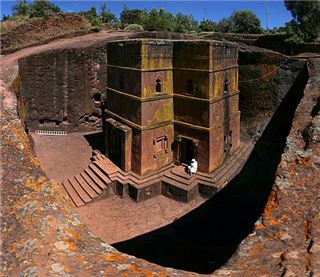
The eleven churches stand at an altitude of around 2,480 metres, five north of the town's river Jordan, five south of it, and one, Biete Giorgis, apart, joined to the others by trenches. The northern churches are Biete Medhane Alem (House of the Saviour of the World), home to the Lalibela Cross; Biete Maryam, possibly the oldest; Biete Golgotha Mikael, known for its arts and said to contain the tomb of King Lalibela; Biete Meskel; and Biete Denagel. The southern, or eastern, group holds Biete Amanuel, possibly the former royal chapel; Biete Qeddus Mercoreus, which may have been a prison; Biete Abba Libanos; Biete Gabriel-Rufael, possibly a former royal palace; and Biete Lehem. The Church of Saint George, Biete Giorgis, is thought to be the most finely executed and best preserved.
Four of the churches are free-standing monoliths and seven share a wall with the mountain from which they were cut. Each is unique: Bet Golgotha has human figures in bas-relief, Bet Mariam colourful paintings of geometric designs and biblical scenes. Mouldings and string courses divide the larger shapes, and the pitched roof and linear mouldings of Biete Maryam suggest Syrian influence. Wells beside many of the churches draw on an artesian system that brings water up to the top of the ridge, and the whole site, linked by tunnels and trenches, forms a place of pilgrimage laid out to represent Jerusalem.