Place · site
Quiriguá
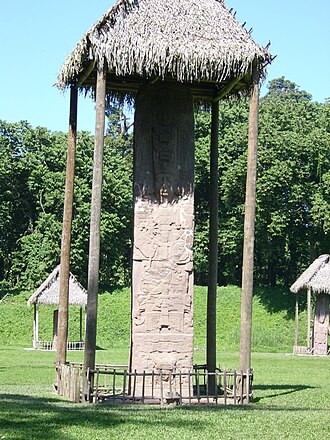
Quiriguá is an ancient Maya archaeological site on the lower Motagua River in the department of Izabal, south-eastern Guatemala, where several Classic period trade routes met. Occupied by 200 CE, it was long a vassal of nearby Copán, with which it shares its architectural and sculptural styles. In 738 its king K'ak' Tiliw Chan Yopaat captured Uaxaclajuun Ub'aah K'awiil of Copán and had him sacrificed, and the city kept its independence and expanded rapidly. Its modest architecture is outweighed by its sculpture in hard red sandstone, including Stela E of 771, the tallest stela of the Maya world. Construction had halted by about 850; the site joined the UNESCO World Heritage List in 1981.
Mentioned in 1 profile
See also



Cite this entry
- APA
- The Epoch Institute. (2026). Quiriguá. In The Epoch Institute Encyclopedia. https://the-epoch-institute.org/encyclopedia/quirigua
- MLA
- “Quiriguá.” The Epoch Institute Encyclopedia, The Epoch Institute, 2026, https://the-epoch-institute.org/encyclopedia/quirigua. Accessed .
- Chicago
- The Epoch Institute. “Quiriguá.” The Epoch Institute Encyclopedia. 2026. https://the-epoch-institute.org/encyclopedia/quirigua.
- Harvard
- The Epoch Institute (2026) ‘Quiriguá’, The Epoch Institute Encyclopedia. Available at: https://the-epoch-institute.org/encyclopedia/quirigua (Accessed: ).
Last reviewed October 2026Random entry ↻