Inventions & Discoveries · Science and discovery
Sundial
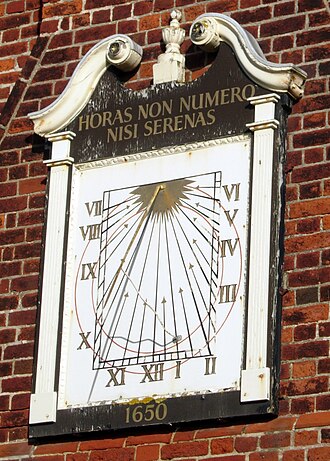
A sundial tells the time of day from the apparent position of the Sun, usually by the shadow that a gnomon casts on a dial marked with hour-lines. The earliest sundials known from the archaeological record are shadow clocks of about 1500 BCE from ancient Egyptian and Babylonian astronomy. By 240 BCE Eratosthenes had used an obelisk and a water well to estimate the circumference of the world, and the Roman writer Vitruvius listed the dials known in his day in De architectura. Canonical sundials marked the liturgical hours of religious orders from the 7th to the 14th centuries, and Giovanni Padovani published a treatise on making sundials in 1570.
On the inventions tree
- First known
- c. 1500 BCE
- Where
- Egypt and Babylonia
Built onBabylonian astronomyc. 1800 BCE
Mentioned in 1 state history
See also







Cite this entry
- APA
- The Epoch Institute. (2026). Sundial. In The Epoch Institute Encyclopedia. https://the-epoch-institute.org/encyclopedia/sundial
- MLA
- “Sundial.” The Epoch Institute Encyclopedia, The Epoch Institute, 2026, https://the-epoch-institute.org/encyclopedia/sundial. Accessed .
- Chicago
- The Epoch Institute. “Sundial.” The Epoch Institute Encyclopedia. 2026. https://the-epoch-institute.org/encyclopedia/sundial.
- Harvard
- The Epoch Institute (2026) ‘Sundial’, The Epoch Institute Encyclopedia. Available at: https://the-epoch-institute.org/encyclopedia/sundial (Accessed: ).
Last reviewed October 2026Random entry ↻