Work / monument · text
The Social Contract
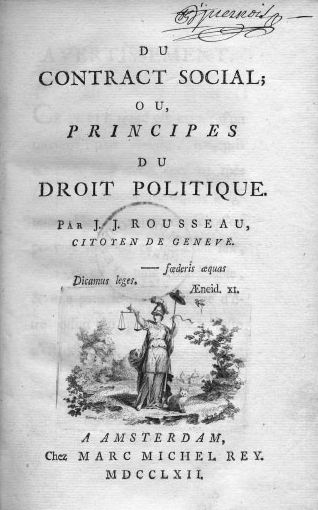
The Social Contract (Du contrat social) is a 1762 book by the Genevan philosopher Jean-Jacques Rousseau on how to establish legitimate authority in a political community, one compatible with individual freedom. It argues against the idea that monarchs were divinely empowered to legislate and holds that only the general will of the people has the right to legislate, for only then do the people obey only themselves and remain free. Rousseau separates the sovereign from the government, the executive power, and argues that equality is essential for the attainment of liberty. The book helped inspire political reforms or revolutions in Europe, especially in France.
Mentioned in 4 profiles
See also








Cite this entry
- APA
- The Epoch Institute. (2026). The Social Contract. In The Epoch Institute Encyclopedia. https://the-epoch-institute.org/encyclopedia/the-social-contract
- MLA
- “The Social Contract.” The Epoch Institute Encyclopedia, The Epoch Institute, 2026, https://the-epoch-institute.org/encyclopedia/the-social-contract. Accessed .
- Chicago
- The Epoch Institute. “The Social Contract.” The Epoch Institute Encyclopedia. 2026. https://the-epoch-institute.org/encyclopedia/the-social-contract.
- Harvard
- The Epoch Institute (2026) ‘The Social Contract’, The Epoch Institute Encyclopedia. Available at: https://the-epoch-institute.org/encyclopedia/the-social-contract (Accessed: ).
Last reviewed October 2026Random entry ↻