
Culture · Americas
Caral–Supe civilisation
At a glance
- Caral–Supe was a cluster of as many as thirty population centres in three small valleys of Peru’s north-central coast, flourishing between about 3000 and 1800 BCE.
- Its people raised great stepped platform mounds and sunken circular plazas, grew cotton and food crops by irrigation and ate fish from the coast, yet made no pottery and almost no art.
- There is no evidence of warfare, and archaeologists still debate how it was governed and whether the sea or farming fed its rise.
Timeline
- c. 3500 BCEHuaricanga, in the Fortaleza valley, becomes the earliest securely dated city of Caral–Supe
- c. 2600 BCECaral in the Supe valley is inhabited and grows into the largest centre of the civilisation
- c. 2250 BCEA gourd from a burial in the Pativilca valley is decorated with the oldest known image of the Andean Staff God
- c. 2200 BCECaral–Supe influence reaches from the Chillón valley to the Santa valley; a long drought begins that later drives people from Caral
- c. 1800 BCEThe civilisation declines as more powerful centres rise along the coast and in the Andes
- 1905Max Uhle notes the site of Caral, though he does not recognise its hills as pyramids
- 2001A paper in Science by Ruth Shady, Jonathan Haas and Winifred Creamer brings Caral to wide attention
- 2009The Sacred City of Caral-Supe is inscribed as a UNESCO World Heritage Site
Origins
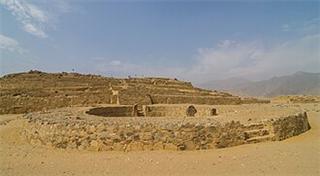
Caral–Supe, also known as Norte Chico, was a complex society of as many as thirty major population centres in the Caral region of Peru’s north-central coast, about 150 to 200 km north of Lima. It flourished along three rivers, the Fortaleza, the Pativilca and the Supe, with further sites on the Huaura. Its name is an archaeologists’ label, taken from the city of Caral in the Supe valley. In archaeological terms it belongs to the preceramic Late Archaic: its people made no pottery. Since the early 21st century it has been recognised as the oldest known civilisation of the Americas and one of the six places where civilisation arose independently.
Its coast is extremely dry, but more than fifty rivers bring Andean snowmelt down to the sea, and the spread of irrigation is seen as decisive in the rise of Caral–Supe: all its monumental buildings lie close to irrigation channels. Radiocarbon work by Jonathan Haas and colleagues suggests that the earliest city, Huaricanga in the Fortaleza valley, dates from about 3500 BCE, and that large-scale settlement and communal building are clear from about 3100–3200 BCE. In 1957 Frédéric Engel called this the Cotton Preceramic Stage, from 3000 to 1800 BCE.
Aspero on the coast was identified as early as 1905, the year Max Uhle also noted Caral without recognising its hills as pyramids. Paul Kosok studied Caral in 1948 and Carlos Williams recorded the Supe valley sites in 1975, but its age was doubted. From 1994 the Peruvian archaeologist Ruth Shady documented the civilisation at Caral; a 2001 paper in Science and a 2004 paper in Nature showed its full extent. These finds pushed the start of complex society in Peru back by more than a thousand years before the Chavín culture of about 900 BCE.
Society

Caral–Supe packed large sites into a small area: the three main valleys cover only 1,800 km², and in the third millennium BCE they may have been among the most densely populated places in the world. Coastal and inland sites seem to have developed together at first, but between 2500 and 2000 BCE, the period of greatest expansion, population and building shifted inland to sites such as Caral. Caral itself housed more than 3,000 people, and the 19 other sites of the Supe valley may have brought the population sharing the same culture there to 20,000.
People ate squash, beans, lúcuma, guava, pacay, sweet potato, avocado and achira, and work by Haas and colleagues in 2013 argues that maize was widely grown and eaten too. Fish reached the inland sites, above all anchovies and sardines. A 2022 study of the bones of 52 people from Aspero and Caral found that plants made up 55–68 per cent of the diet at Aspero and over 70 per cent at Caral. Cotton, the chief product of irrigation, gave cloth and the nets for fishing, binding the farmers of the valleys and the fishers of the coast together.
Society was unequal. Caral was laid out in an Upper Half of six monumental complexes, each with a pyramid, plaza and elite houses where remains of luxury foods such as sea lion have been found, and a Lower Half of smaller, multi-purpose homes where people ate mostly plants and some fish. The two main mounds at Caral were raised in one or two intense phases of work, and large stone warehouses at Upaca suggest leaders who controlled vital goods such as cotton. Jonathan Haas sees power based on economic control and on religion; other archaeologists call his claims for an independent invention of government exaggerated. Workers may have been paid, possibly in dried anchovies, or compelled.
Beliefs & Worldview
Evidence for Caral–Supe religion is limited, and most of what is said about it is inference. Ruth Shady calls Caral “the sacred city” and reports that social, economic and political life focused on its temples, which were remodelled from time to time with major burnt offerings. In a 2005 survey of the research, Mann suggests that building and maintaining the great mounds may itself have been a religious act, a communal ceremony. Many of the settlements share features with the highland Kotosh Religious Tradition: sunken circular courts, stepped pyramids, rooms with benches and hearths fed by underground air ducts, wall niches, beads and flutes.
In 2003 a gourd fragment from a burial in the Pativilca valley, dated to about 2250 BCE, was found with the image of a fanged, hooded figure identified as the Staff God, a major deity of later Andean cultures. Winifred Creamer takes it as a sign of the worship of shared divine symbols; other researchers dispute its meaning. Near Caral, a geoglyph of a human face with long, streaming hair and a gaping mouth was found in 2000, scratched into the desert floor and perhaps linked to the nearby ceremonial site of Chupacigarro; what it represents is unclear.
Some rites involved killing people. At Caral a skeleton from about 3000 BCE, with skull fractures and mutilated fingers, is the earliest known evidence of human sacrifice in the Andes; the person may have been a construction worker or a captive. At Aspero the remains of two children and a newborn are also interpreted as sacrifices. Other burials show care: a baby at Caral was wrapped and buried with a necklace of stone beads, and in 2016 the remains of a woman, presumably one of the local elite around 2500 BCE, were found at Aspero.
Arts & Knowledge

The great achievement of Caral–Supe was its monumental architecture. Sites of 10 to 100 hectares had between one and seven large platform mounds, rectangular terraced pyramids of 3,000 to more than 100,000 m³, and Caral had six platform mounds, many smaller ones and two sunken circular plazas. The builders used quarried stone and river cobbles, carried in bags of shicra grass and packed behind each new retaining wall. The largest mound at Caral, the Pirámide Mayor, measures 160 by 150 m at its base and rises 18 m. At Aspero, Michael Moseley called the mounds “corporate labour platforms”, because they needed an organised workforce.
Beside such buildings, other arts are almost absent. There was no pottery at all, crops were roasted, and the archaeologist Alvaro Ruiz observed that there is almost no sculpture, carving or painting: “What we do see are these huge mounds—and textiles.” Cloth and textile technology mattered greatly, from clothing and bags to fishing nets. A knotted string found at Caral has been called a quipu, the recording device later perfected by the Inca; it has not been formally published and remains undeciphered, but its excavators take it as evidence that record-keeping with knots is older than had been thought.
The people of Caral–Supe made music. A temple at Caral held 32 flutes made of pelican and condor bone, and another find included 37 cornets of deer and llama bone and 33 flutes radiocarbon dated to about 2170 BCE. Later, at the coastal site of Vichama, temple friezes showed starving figures, pregnant women, large fish and a toad struck by lightning, which researchers read as a record of drought and of the hoped-for return of rain.
Contact & Exchange
Exchange between coast and valleys lay at the heart of Caral–Supe. Jonathan Haas sums up the bond: the people of the valleys needed fish for protein, and the fishers needed cotton to make their nets. Which came first is long debated. In 1973 Michael E. Moseley argued that a sea-based economy laid the foundation of Andean civilisation, and that coastal Aspero was the oldest site; Haas and Shady hold that the larger inland centres developed at the same time or led. Scholars now agree that the inland sites held far more people. In 2018 David G. Beresford-Jones and colleagues defended a revised form of Moseley’s idea, in which growing cotton for nets set off the change, while the 2022 bone study found that plants, not fish, fed most people.
Caral–Supe may have stood at the centre of a wider network. Cotton fishing nets and domesticated plants have been found up and down the Peruvian coast, and reports of Shady’s work say that Caral sent its goods and those of Aspero to distant communities for Spondylus shells from Ecuador, dyes from the highlands and snuff from the Amazon, claims that should be treated with caution. Shady suggests a depiction of monkeys may point to contact with the Amazon. By around 2200 BCE its influence reached south to the Chillón valley and the site of El Paraíso and north to the Santa valley.
No sign of warfare of any kind has been found: no fortifications, weapons, burned buildings or mutilated bodies from battle, and settlements were not built for defence. In modern times Caral–Supe has itself caused conflict among archaeologists, as Shady accused Haas and Creamer of taking too much credit for her work; their institutions cleared them of plagiarism, but the Field Museum’s science council rebuked Haas for publicity that gave her too little credit.
Legacy
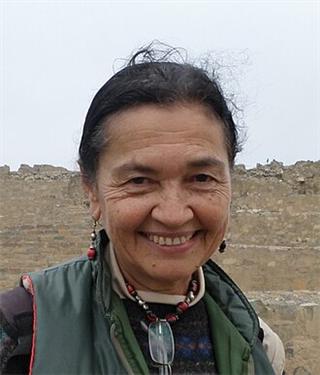
Caral–Supe began to decline about 1800 BCE, as more powerful centres appeared along the coast to the south and north and in the Andes to the east. Its own success may have contributed: Winifred Creamer notes that as it declined, extensive canals appear farther north, as people moved to more fertile land and took their knowledge of irrigation with them. In 2025 new work led by Ruth Shady linked the abandonment of Caral to a long drought around 2200 BCE, part of a global climate event. People of the Supe valley seem to have moved rather than collapsed, rebuilding at sites such as Vichama on the coast and Peñico inland with Caral’s layouts and ceremonial spaces, again without fortifications or weapons.
About a thousand years passed before the next great Peruvian culture, the Chavín, arose. Yet Caral–Supe may have served as a template for later Andean civilisation. The Staff God, the quipu, the wide exchange of goods, communal festive building projects and the high value placed on textiles all recur in later Peruvian cultures, and Caral’s plan appears to have been a model for Andean cities over four millennia. Its discovery also turned research from the highlands, where the Chavín and the Inca had their centres, to the coast.
The Sacred City of Caral-Supe, near the modern town of Caral, 182 km north of Lima, was inscribed as a UNESCO World Heritage Site in 2009. It is still under threat: in 2021 squatters claiming land rights built houses that encroached on the site. Peñico was opened to the public in 2025. Ruth Shady’s research at Caral continues, and the civilisation is still often wrongly left out of general histories that name the Chavín as Peru’s first.
Caral–Supe, or Norte Chico, was a cluster of up to thirty centres in the Supe, Pativilca and Fortaleza valleys of Peru’s north-central coast, flourishing from about 3000 to 1800 BCE. Its people built great platform mounds and sunken plazas, grew cotton and food crops by irrigation and traded with the fishers of the coast, without pottery and without any sign of war. It is the oldest known civilisation of the Americas.
References
- Haas, J. and Creamer, W. (2006) “Crucible of Andean Civilization: The Peruvian Coast from 3000 to 1800 BC”. Current Anthropology 47(5): 745–775.
- Sandweiss, D. H., Shady Solís, R., Moseley, M. E., Keefer, D. K. and Ortloff, C. R. (2009) “Environmental change and economic development in coastal Peru between 5,800 and 3,600 years ago”. Proceedings of the National Academy of Sciences 106(5): 1359–1363.
- Shady Solís, Ruth (2005) Caral Supe, Perú: the Caral–Supe civilization: 5,000 years of cultural identity in Peru. Lima: Instituto Nacional de Cultura.
- Shady, Ruth and Kleihege, Cristopher, eds. (2008) Caral: la primera civilización de América. Lima: Universidad de San Martín de Porres.
- Ortloff, C. R. and Moseley, M. E. (2012) “2600–1800 BCE Caral: Environmental change at a Late Archaic period site in north central coast Perú”. Ñawpa Pacha: Journal of Andean Archaeology 32(2): 189–206.