
Culture · South & Southeast Asia
Indus Valley Civilisation
At a glance
- The most extensive of the first urban civilisations, it covered more ground than Egypt and Mesopotamia together, with over a thousand known sites and great cities such as Harappa and Mohenjo-daro.
- Its builders laid out streets on a grid, used bricks of standard proportions and drained whole neighbourhoods with covered sewers, yet left no palaces, royal tombs or images of war.
- Its short inscriptions remain undeciphered, so its language, rulers and beliefs are known only through archaeology and through Mesopotamian texts that call it Meluhha.
Timeline
- c. 7000 BCEFarmers settle at Mehrgarh in Balochistan, beginning the long prelude to the Indus cities
- c. 3300 BCEThe Early Harappan phase begins, with farming villages and small towns across the Indus plains
- c. 2600 BCEThe mature phase begins: Harappa, Mohenjo-daro and other cities are laid out with grid streets and drains
- c. 2300 BCESargon of Akkad boasts of ships from Meluhha, Magan and Dilmun moored at his capital
- c. 1900 BCEThe cities decline, and seals, script and standard weights fall out of use
- c. 1300 BCEThe last Late Harappan cultures give way to the new village cultures of northern India
- 1921–1922Excavations at Harappa under Daya Ram Sahni and at Mohenjo-daro under R. D. Banerji uncover the same seals
- 1924John Marshall announces the discovery of a forgotten civilisation of the Indus
Origins

The Indus Valley Civilisation, also called the Harappan civilisation after Harappa, the first of its cities to be excavated, was one of the three earliest urban civilisations of the Old World, beside those of Mesopotamia and Egypt, and the largest of them in extent. Its heartland was the alluvial plain of the Indus and its tributaries in present-day Pakistan, together with the basin of the Ghaggar-Hakra, a river now seasonal or dry, which crosses Haryana and Rajasthan in India and continues into the Cholistan desert of Pakistan. Each summer, snowmelt from the mountains and the monsoon rains swelled the rivers, which flooded the plains and left fertile silt behind; when the waters fell, farmers sowed wheat and barley for a spring harvest.
The civilisation’s roots lie in the farming villages of the hills to the west. At Mehrgarh, at the foot of the Bolan Pass in Balochistan, excavated by a French team led by Jean-François Jarrige from 1974, people were growing barley and wheat and herding sheep and goats by about 7000 BCE, and soon kept cattle as well. They lived in houses of mud brick and buried their dead with ornaments of shell and stone. Over the following millennia such communities took up pottery, copper and cotton and spread down into the river plains.
In the Early Harappan phase, from about 3300 BCE, regional traditions named after sites such as Amri in Sindh, Kot Diji and Harappa itself built towns with walls of mud brick and made pottery on the wheel. By the Kot Diji phase, about 2800–2600 BCE, similar styles of pottery and building were shared across much of the plains. Around 2600 BCE, within a few generations, the mature phase emerged. Old towns were rebuilt and new cities founded on fresh plans, and the same script, stamp seals, weights, bricks, pottery and ornaments appeared from the Makran coast near Iran to the Ganges–Yamuna doab. Why the change came so quickly is not known. Scholars point to the growth of crafts and long-distance trade, to the demands of farming on great and unpredictable rivers, and to the rise of elites able to command labour and goods.
Society
More than a thousand settlements of the mature phase have been reported and nearly a hundred excavated. Most were villages, but five were true cities: Mohenjo-daro on the Indus in Sindh, which covered some 250 hectares; Harappa on the Ravi in Punjab; Ganweriwala in the Cholistan desert, still largely unexcavated; Rakhigarhi in Haryana; and Dholavira on an island in the salt flats of the Rann of Kutch in Gujarat. Mohenjo-daro and Harappa may each have housed several tens of thousands of people, though all such figures are estimates. Many cities had a high, walled mound on the west, which archaeologists long called the citadel, and a larger lower town to the east. Main streets ran roughly north to south and east to west, dividing the lower town into blocks crossed by narrow lanes. Houses of baked or mud brick, the bricks made in the proportions 1:2:4, turned blank walls to the main streets and opened inwards onto courtyards. Many had a bathing platform and a latrine whose waste ran into covered brick drains along the streets, and Mohenjo-daro had more than 700 wells.
Farmers grew wheat, barley, peas, lentils and sesame, and in some regions millets and rice; they kept humped zebu cattle, water buffalo, sheep and goats, and fished the rivers. They also grew cotton, and fragments of cotton cloth found at Mohenjo-daro are among the oldest known. Specialist workshops made beads of carnelian and other stones, bangles of conch shell, glazed faience, copper and bronze tools and wheel-made red pottery painted in black. Goods moved on ox-carts, known from clay models, and by boat. A single system of cubical chert weights, in which the smaller weights doubled from one to the next, was used across the whole area.
Who governed these cities is unknown. No palaces, royal tombs or monuments celebrating conquest have been found, weapons are few and there are no images of battle, though cities had walls and gateways, perhaps as much against floods and for the control of trade as for defence. The uniformity of bricks, weights and seals suggests strong shared institutions, but whether power lay with kings, with councils of merchants and landowners or with religious leaders, and whether the cities formed one state or many, is debated. Burials were mostly simple, with pottery and personal ornaments, rather than the rich graves of a ruling family.
Beliefs & Worldview
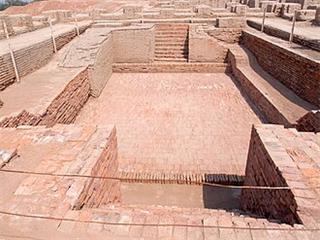
Because the script is unread, Indus religion can be approached only through buildings, images and burials, and every interpretation is uncertain. On the western mound of Mohenjo-daro stands the Great Bath, a sunken pool some 12 metres long, 7 metres wide and 2.4 metres deep, entered by flights of steps at either end, built of closely fitted bricks, sealed with a layer of bitumen and surrounded by a colonnaded courtyard and rooms. Most scholars think it was used for ritual bathing, which suggests that water and purity carried religious meaning, as they do in many later Indian traditions, but no inscription confirms it.
Most seals show a single animal, most often a one-horned bovine that archaeologists call the “unicorn”, standing before an object that may be a ritual stand; others show humped bulls, elephants, tigers, rhinoceroses and water buffalo. A few seem to show religious scenes: a figure in a horned headdress, seated with legs folded and surrounded by animals, which John Marshall in the 1920s called a “proto-Shiva”, an early form of the Hindu god; a horned figure standing within a pipal tree with a kneeling worshipper before it; and composite creatures combining the parts of several animals. Many scholars now doubt that the seated figure can be identified with Shiva, and how far Indus beliefs passed into later Hinduism remains debated.
Terracotta figurines of women, wearing heavy jewellery and fan-shaped headdresses, were found in large numbers in houses. Marshall saw them as images of a mother goddess; others regard them as votive offerings, household images or even toys. At Kalibangan and Lothal, rows of small clay-lined pits containing ash have been interpreted as fire altars. The dead were usually buried lying on their backs, with pots that may have held food and drink, which suggests some belief in a life after death. Motifs such as the pipal leaf recur on pottery and seals and may have had sacred meaning, while the absence of any building that can be identified with certainty as a temple has led some scholars to suggest that worship took place mainly in homes or in the open air.
Arts & Knowledge

The Indus script is known from some 4,000 to 5,000 inscribed objects: seals and their impressions, small tablets of clay, faience and copper, pottery, tools and ornaments. It uses more than 400 distinct signs, too many for an alphabet, and was generally written from right to left, as the crowding of signs at the left end of many lines suggests. The average inscription is only about five signs long. No text has been read: there is no bilingual inscription, the texts are short, and the language they record is unknown. Many decipherments have been proposed and none has won acceptance; in 2004 three scholars, Steve Farmer, Richard Sproat and Michael Witzel, even argued that the signs did not record language at all, a view that has been strongly contested. At Dholavira ten large signs, each about 37 centimetres high and made of pieces of gypsum once set into a wooden board some 3 metres long, were found in a room of the city’s northern gateway, perhaps the remains of a signboard.
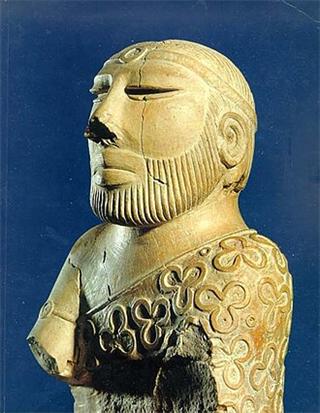
The seals are masterpieces of miniature carving: squares of steatite a few centimetres across, cut in reverse with an animal and a line of signs, then hardened by heating and pressed into clay to seal bundles and containers. Craft workers drilled long beads of carnelian with specially made stone drills, decorated carnelian with white etched designs, glazed faience and fired stoneware bangles at high temperatures. Metalworkers cast copper and bronze, among them the bronze “Dancing Girl” from Mohenjo-daro, a slender figure 10.5 centimetres high whose left arm is covered with bangles. Stone sculpture is rare; the best known is the steatite bust nicknamed the “Priest-King”, 17.5 centimetres high, showing a bearded man in a robe patterned with trefoils. Terracotta carts and animals, some with movable heads, may have been toys.
The builders’ skill shows in the cities themselves: the drains and wells, the brick platforms that raised buildings above floods, and the water works of Dholavira, where in a dry land people built sixteen or more reservoirs, some cut into the living rock. At Lothal in Gujarat a large basin lined with baked brick was interpreted by its excavator, S. R. Rao, as a dockyard for ships, though others think it was a tank for water. Massive buildings at Harappa and Mohenjo-daro, long called granaries, may have been storehouses or halls of uncertain use.
Contact & Exchange

The cities drew on raw materials from far away. Carnelian and agate came from Gujarat, conch shell from the coasts, copper probably from Rajasthan and Balochistan, and lapis lazuli from Badakhshan in north-eastern Afghanistan, where a Harappan settlement at Shortughai, far beyond the Indus plains, seems to have been founded to obtain it. Overland routes reached the towns of the Iranian plateau and the oases of Central Asia.
Indus merchants also travelled by sea. Mesopotamian texts speak of Meluhha, a distant land reached by ship, and most scholars identify it with the Indus civilisation. Sargon of Akkad, founder of the Akkadian Empire, claimed that ships from Meluhha, Magan and Dilmun moored at the quay of his capital, Akkad, and Gudea, ruler of Lagash in the late 3rd millennium BCE, wrote of lapis lazuli and bright carnelian from Meluhha; other texts mention Meluhhan gold dust and fine woods. About twenty Indus seals have been found in Mesopotamia, at Ur, Kish and other cities, together with etched carnelian beads probably made in the Indus region, some of them in the Royal Cemetery of Ur. A cylinder seal of the Akkadian period belonged to Shu-ilishu, “interpreter of the Meluhhan language”, and a text of the time of the Third Dynasty of Ur mentions a “village of Meluhha” in southern Mesopotamia, perhaps a settlement of traders from the Indus or their descendants.
Much of this traffic passed through the Gulf. Indus pottery and other objects have been found in Oman, the land of Magan, and on Bahrain, the centre of Dilmun, whose merchants acted as middlemen and used weights of the Indus standard; a round seal of the Gulf type was found at Lothal. What the Indus cities received in return is less clear, since Mesopotamian goods such as textiles, oils and silver would leave few traces. When the Indus cities declined after about 1900 BCE, the Gulf trade contracted, and by the 7th century BCE Assyrian scribes used the old name Meluhha for Nubia in Africa, the Indus having passed out of Mesopotamian memory.
Legacy
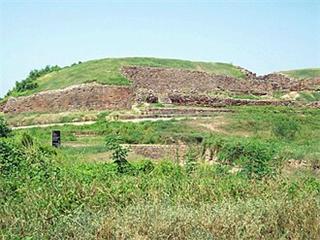
From about 1900 BCE the cities declined. In Mohenjo-daro’s last phases houses were more poorly built and spread into the old streets, and by about 1700 BCE the city was abandoned; across the region writing, seals, standard weights and planned building fell out of use. The people did not disappear. Settlement shifted east towards Haryana and the Ganges–Yamuna doab and south into Gujarat, and Late Harappan cultures, such as the Cemetery H culture of Punjab and Haryana, the Jhukar culture of Sindh and the Rangpur culture of Gujarat, lived on in smaller villages until about 1300 BCE. Most scholars see several causes at work: a weakening of the monsoon, perhaps linked to the widespread drought of about 2200 BCE, shifting rivers and the drying of the Ghaggar-Hakra, and the decline of trade with Mesopotamia.
In the 1940s the British archaeologist Mortimer Wheeler blamed invading Aryans, pointing to skeletons found in the upper levels of Mohenjo-daro, but later study showed that they were not the victims of a single massacre, and the theory of a violent conquest has been abandoned. Most scholars date the Rigveda, the oldest text of the Vedic tradition, to the later 2nd millennium BCE, after the cities had gone, and how far the Harappans’ descendants and traditions shaped later Indian culture is still debated.
The ruins had long been forgotten. Charles Masson, a deserter from the East India Company’s army, described the mounds of Harappa in a narrative of his travels published in 1842; Alexander Cunningham of the Archaeological Survey of India published the first Indus seal in 1875 without recognising its age; and in 1857 builders of the Lahore–Multan railway carried off bricks from Harappa as ballast. Excavations at Harappa under Daya Ram Sahni in 1921 and at Mohenjo-daro under R. D. Banerji in 1922 found the same seals at both, and in 1924 John Marshall, Director General of the Survey, announced a new civilisation. After the partition of India in 1947 Indian archaeologists found and excavated many more sites, among them Lothal, Kalibangan, Dholavira and Rakhigarhi. Mohenjo-daro became a World Heritage Site in 1980 and Dholavira in 2021. Some in India call it the Sindhu–Sarasvati civilisation, identifying the Ghaggar-Hakra with the Sarasvati river of the Rigveda, an identification that remains debated.
The Indus Valley Civilisation, which flourished in present-day Pakistan and north-western India c. 2600–1900 BCE, was the most extensive of the early civilisations: planned cities of brick with drains and wells, standard weights and finely carved seals, linked by trade to Mesopotamia, where it was known as Meluhha. Without palaces or monuments of war, and with its script still unread, it remains one of archaeology’s great puzzles.
References
- Coningham, R. and Young, R. (2015) The Archaeology of South Asia: From the Indus to Asoka, c. 6500 BCE–200 CE. Cambridge: Cambridge University Press.
- Kenoyer, J.M. (1998) Ancient Cities of the Indus Valley Civilization. Karachi: Oxford University Press.
- Parpola, A. (1994) Deciphering the Indus Script. Cambridge: Cambridge University Press.
- Possehl, G.L. (2002) The Indus Civilization: A Contemporary Perspective. Walnut Creek: AltaMira Press.
- Robinson, A. (2015) The Indus: Lost Civilizations. London: Reaktion Books.
- Wright, R.P. (2010) The Ancient Indus: Urbanism, Economy, and Society. Cambridge: Cambridge University Press.