Culture · Europe
Mycenaean civilisation
At a glance
- From about 1600 BCE warrior chiefs on the Greek mainland grew rich, as the gold of the shaft graves at Mycenae shows, and by 1400 BCE kings ruled palace states at Mycenae, Pylos, Thebes and elsewhere.
- Their scribes wrote Linear B, deciphered in 1952 as the earliest known form of Greek, to record land, livestock, workers, weapons and offerings to gods such as Zeus and Poseidon.
- Around 1200 BCE the palaces were destroyed and writing was forgotten; Homer’s epics, composed centuries later, remember Mycenae as Agamemnon’s city, but they are evidence of memory, not of fact.
Timeline
- c. 1600 BCERich burials in the shaft graves of Mycenae mark the rise of a warrior elite
- c. 1450 BCEMycenaean Greeks take over Knossos on Crete, where Linear B comes into use
- c. 1250 BCEThe walls of Mycenae are extended and the Lion Gate is built
- 13th century BCEA Hittite king writes to the king of Ahhiyawa as his “brother” in the Tawagalawa letter
- c. 1200 BCEA wave of destruction ends the palaces; Pylos burns around 1180 BCE
- c. 1100 BCEThe last Mycenaean communities fade as Greece enters the Early Iron Age
- 1876Heinrich Schliemann excavates the shaft graves of Grave Circle A at Mycenae
- 1952Michael Ventris deciphers Linear B, showing that it records Greek
Origins

The Mycenaean civilisation takes its modern name from Mycenae, the citadel in the north-eastern Peloponnese that Greek legend made the seat of King Agamemnon. Its people spoke Greek, as their writing shows, but what they called themselves is uncertain. Homer calls the Greeks who fought at Troy Achaeans, Danaans and Argives, and Hittite texts speak of a land called Ahhiyawa, a name most scholars connect with the Achaeans.
In the Early Helladic period of the 3rd millennium BCE mainland Greece had prosperous settlements, some with large buildings such as the House of the Tiles at Lerna, but many were destroyed or abandoned towards its end. The Middle Helladic period that followed, from about 2000 BCE, was poorer: small villages, simple graves and a grey wheel-made pottery called Minyan ware. When speakers of Greek, or of the language from which it grew, arrived in Greece is debated; many scholars place it around the start of this period, others earlier or later. A study of ancient DNA published in 2017 found the Mycenaeans genetically close to the Minoans of Crete, but with a share of ancestry related to peoples of the Eurasian steppe or Armenia that the Minoans lacked, which fits, though it does not prove, an arrival of Indo-European speakers from the north or east.
Change came fast in the 17th and 16th centuries BCE. At Mycenae two circles of deep shaft graves, Grave Circle B, begun before 1600 BCE, and Grave Circle A, of about 1600–1500 BCE, held men, women and children buried with gold masks, diadems and cups, bronze swords, daggers inlaid with hunting scenes in gold and silver, Baltic amber and objects in Cretan style. Heinrich Schliemann found Grave Circle A in 1876; Ioannis Papadimitriou and George Mylonas excavated Grave Circle B from 1952. These burials reveal a warrior elite enriched by war, raiding and trade. In Messenia, in the south-west, families of the same rank built the earliest tholos tombs, stone chambers roofed with a beehive-shaped dome.
By the 15th century BCE mainland rulers were adopting Cretan art, crafts and methods of administration. Around 1450 BCE Mycenaean Greeks took control of Knossos on Crete, where Linear B, adapted from the Minoan Linear A to write Greek, appears in quantity for the first time.
Society

By the 14th and 13th centuries BCE Greece was divided among palace states centred on Mycenae, Tiryns, Midea, Pylos, Thebes, Orchomenos and Athens, among others, and on Knossos in Crete. Each seems to have been ruled by a king, the wanax, who headed the administration and had a part in religion. Next to him the tablets name the lawagetas, “leader of the people”, perhaps a commander, and below them landholders, officials and district governors. The qa-si-re-u, the word that became the later Greek basileus, “king”, was then a lesser local figure, in one case the head of a group of bronze-smiths.
The best-documented kingdom is Pylos in Messenia, whose palace, found by Carl Blegen in 1939, is called the Palace of Nestor after the old king of the Iliad. Its tablets describe a state divided into two provinces of nine and seven districts and record land holdings, flocks, levies in kind, bronze issued to smiths, and rations of grain and figs for dependent workers. Among these were women textile workers and their children, some identified by the names of places on the Anatolian coast such as Miletus and Knidos, perhaps captives or bought slaves. The palaces ran specialised industries, above all textiles, perfumed olive oil and bronze working, but most farming and much exchange lay outside their records, and ordinary villagers appear in them only as names, numbers and obligations.
Society was organised for war. The tablets from Knossos list chariots, wheels and armour, and tombs and settlements have yielded long bronze swords, spearheads, helmets covered with plates of boar’s tusk such as Homer later described, and a full suit of bronze armour from a tomb at Dendra in the Argolid, of about 1400 BCE. Rulers fortified their citadels with walls of huge, roughly fitted blocks, called Cyclopean because later Greeks believed that only the giant Cyclopes could have moved them. Mycenae, Tiryns, the Acropolis of Athens and the vast fortress of Gla in Boeotia were walled in this way, and in the 13th century BCE Mycenae, Tiryns and Athens built protected passages down to water sources, as if expecting sieges.
Most people lived in villages, growing wheat, barley, olives and vines and keeping sheep and goats; the tablets of Knossos alone record tens of thousands of sheep, raised above all for wool.
Beliefs & Worldview
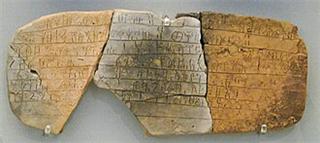
The Linear B tablets are the oldest written evidence for Greek religion. They name many gods who were still worshipped a thousand years later: Zeus and Hera; Poseidon, especially honoured at Pylos; Hermes, Dionysus and Artemis; Enyalios, a war god whose name later became a title of Ares; Paiawon, later a title of Apollo; and Eleuthia, goddess of childbirth. The most frequent title is Potnia, “Lady” or “Mistress”, given to one or more goddesses, as in the “Potnia of the labyrinth” at Knossos and the “Potnia of the horses” at Pylos, and a “Potnia of Atana” at Knossos may be an early form of Athena. Other deities of the tablets, such as a “Divine Mother” and Drimios, son of Zeus, later disappeared.
The tablets record offerings of olive oil, honey, wine, grain, livestock and perfumes, and goods delivered to shrines and to priests, priestesses and “slaves of the god”. One tablet from Pylos, Tn 316, lists gold vessels and men and women sent to several deities; whether the people were meant for sacrifice, as some scholars have argued, or for service in the shrines is disputed.
Archaeology shows the places of cult. Within the citadel of Mycenae a group of shrines, the Cult Centre, contained clay figures of deities or worshippers, altars and wall paintings, and a shrine at Phylakopi on Melos held similar figures. Small clay figurines shaped like the Greek letters phi and psi, perhaps protective images, are found in great numbers in houses, tombs and shrines.
The dead were usually buried, not cremated: families in chamber tombs cut into hillsides, rulers in tholos tombs, great stone domes covered with earth. Bodies were laid out with jewellery, weapons, vessels and food, and earlier burials were often pushed aside to make room for new ones. Centuries later, in the 8th century BCE, Greeks left offerings in some Mycenaean tombs, honouring the unknown dead as heroes of a legendary past. Much of this religion passed into Ancient Greek religion, although its palace rituals ended with the palaces.
Arts & Knowledge
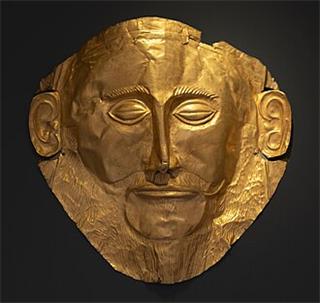
Mycenaean builders and artists borrowed much from Crete and made it their own. The heart of each palace was the megaron, a large hall entered through a porch and vestibule, with a round hearth between four columns. At Pylos the throne stood against one wall, flanked by painted lions and griffins, and another painting showed a lyre player. Wall paintings of processions of women, hunts and battles, in a style learned from Minoan artists, decorated the palaces of Tiryns, Pylos, Thebes and Mycenae.
The greatest monuments are at Mycenae. Around 1250 BCE its walls were extended and the Lion Gate built, with a relief of two lions facing a column above the lintel. The Treasury of Atreus, a tholos tomb of about the same date, has a corbelled stone dome about 13 metres high, the largest in the world for more than a thousand years. Engineers drained much of Lake Copais in Boeotia with dikes and canals to create farmland, and built roads with bridges of Cyclopean masonry, such as the bridge at Arkadiko on the road between Tiryns and Epidaurus, which still stands.
Craftsmen excelled in small works: the gold cups from Vapheio of about 1500 BCE, with scenes of bulls being caught; bronze daggers inlaid with gold and silver; carved ivory, such as a group of two women and a child from Mycenae; and engraved sealstones, among them a tiny agate found in 2015 in the grave of the “Griffin Warrior” near the Palace of Nestor, which shows a combat in astonishing detail. Potters made fine painted wares in great quantity, including stirrup jars for oil and wine. The Warrior Vase from Mycenae, of the 12th century BCE, shows soldiers marching out while a woman raises her arm, perhaps in farewell.
Linear B was a syllabary of about ninety signs, used with further signs for commodities and a decimal system of numbers. Scribes wrote on clay tablets probably kept only for the current year; they survive because the fires that destroyed the palaces baked them hard. Tablets come from Knossos, Chania, Pylos, Mycenae, Tiryns, Thebes and other sites, and painted inscriptions appear on storage jars. They record administration only: no laws, letters or literature survive. Alice Kober showed in the 1940s that the language was inflected; Michael Ventris, an architect, announced in 1952 that it was an early form of Greek, and a tablet from Pylos with pictures of tripods and vessels, read in 1953, confirmed it. With John Chadwick he published Documents in Mycenaean Greek in 1956.
Contact & Exchange
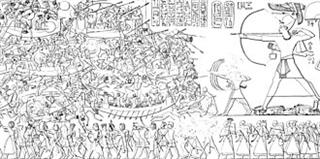
The Mycenaeans traded across the Mediterranean. Their painted pottery, much of it containers for wine and perfumed oil, is found from Sardinia, Sicily and southern Italy to Cyprus, the Levant and Egypt, where it reached Akhenaten’s city at Amarna. In return came copper from Cyprus, tin, gold, ivory, glass and Baltic amber, and a hoard of Near Eastern cylinder seals of lapis lazuli was found in the palace of Thebes. The Uluburun shipwreck, which sank off south-western Turkey in the late 14th century BCE and was excavated between 1984 and 1994, shows the scale of this trade: it carried about ten tonnes of copper and one of tin, with glass ingots, ebony, ivory, Canaanite jars and Mycenaean pottery.
The great powers knew of them. A list of foreign places on a statue base from the mortuary temple of Amenhotep III at Thebes in Egypt, of the early 14th century BCE, names places in Crete and probably Mycenae on the mainland. More than twenty Hittite texts of about 1400–1200 BCE mention Ahhiyawa, which Emil Forrer identified with the Achaeans in 1924; most scholars now accept that it was a Mycenaean kingdom, though whether its king ruled from Mycenae, Thebes or elsewhere is debated. In the Tawagalawa letter, probably written by Hattusili III, the Hittite king addresses the king of Ahhiyawa as his “brother”, complains of the raider Piyamaradu, who operated from Millawanda (Miletus), and recalls an earlier quarrel over Wilusa, usually identified with Troy. In a treaty of Tudhaliya IV the king of Ahhiyawa was written among the great kings of the age and then struck out. Relations with the Hittite Empire swung between diplomacy and conflict on the Anatolian coast, where Mycenaeans lived at Miletus from about 1450 BCE and their pottery reached Troy.
Within the Aegean, Mycenaean culture took the place of Minoan influence after 1450 BCE, spreading across Crete, the Cyclades and the Dodecanese, especially Rhodes. At the end of the period, Egyptian inscriptions of Merneptah and Ramesses III list among the Sea Peoples groups such as the Ekwesh and the Denyen, whom some scholars connect with the Achaeans and the Danaans. The Philistines, who settled in the southern Levant in the 12th century BCE, at first made pottery derived from late Mycenaean styles, which suggests that some of them came from the Aegean world.
Legacy

From about 1250 BCE the palace world showed signs of strain, and Mycenae suffered a first destruction. Around 1200 BCE a wave of destruction struck the palaces. Mycenae was damaged again around 1190 BCE, Tiryns and Thebes were destroyed, Gla was abandoned and the palace of Pylos burned around 1180 BCE. Tablets from its last months record “watchers guarding the coast” and the calling up of rowers, perhaps preparations against an attack by sea. Whether earthquakes, drought and famine, revolt, raiders such as the Sea Peoples or the breakdown of the trade on which the palaces depended were to blame is debated; many scholars think several combined. The old theory of a “Dorian invasion” from the north, based on Greek legends of the return of Heracles’ descendants, has little archaeological support. The collapse was part of the wider Late Bronze Age collapse that also brought down the Hittite Empire.
Life went on without the palaces. In the 12th century BCE the lower town of Tiryns grew, Mycenae survived on a smaller scale, and people moved to Achaea, the islands and Cyprus, where Greek speakers settled; the Cypriot dialect, like the Arcadian, preserves features close to the language of the tablets. Writing was forgotten, and by about 1100 BCE Greece had entered the Early Iron Age. The Greek language, the names of the gods and many place names survived, but in Greece and the Aegean writing returned only in the 8th century BCE, with an alphabet adapted from the Phoenicians.
The Mycenaeans lived on in memory. Homer’s Iliad and Odyssey, composed probably in the 8th or 7th century BCE from a long oral tradition, remember Mycenae “rich in gold”, Agamemnon and Nestor of Pylos, and preserve old details such as the boar’s-tusk helmet. But the poems also reflect the world of their own time, and no Linear B tablet names Agamemnon or a war against Troy: they are evidence of memory, not of fact. Thucydides observed in the 5th century BCE that Mycenae had become a small place, and Pausanias, in the 2nd century CE, saw the Lion Gate and graves said to be those of Atreus and Agamemnon.
Schliemann, guided by Pausanias, dug inside the walls of Mycenae in 1876, and Christos Tsountas, Alan Wace and Carl Blegen made the study systematic. The decipherment of Linear B settled a long dispute between Evans, who saw the mainland as a dependency of Crete, and Wace and Blegen, who argued for an independent mainland culture: Greek-speaking Mycenaeans had ruled Knossos itself.
The Mycenaean civilisation of Late Bronze Age Greece, from about 1600 to 1100 BCE, created the earliest known Greek-speaking states, ruled from palaces such as Mycenae and Pylos and recorded in Linear B. Its citadels, tombs and trade reached across the eastern Mediterranean, and after its collapse around 1200 BCE its memory, reshaped by centuries of storytelling, became the heroic age of Homer’s epics.
References
- Beckman, G., Bryce, T. and Cline, E.H. (2011) The Ahhiyawa Texts. Atlanta: Society of Biblical Literature.
- Chadwick, J. (1976) The Mycenaean World. Cambridge: Cambridge University Press.
- Cline, E.H. (2014) 1177 B.C.: The Year Civilization Collapsed. Princeton: Princeton University Press.
- Dickinson, O. (1994) The Aegean Bronze Age. Cambridge: Cambridge University Press.
- Mylonas, G.E. (1966) Mycenae and the Mycenaean Age. Princeton: Princeton University Press.
- Ventris, M. and Chadwick, J. (1956) Documents in Mycenaean Greek. Cambridge: Cambridge University Press.