
Culture · Oceania
Lapita culture
At a glance
- The Lapita culture, named after a site in New Caledonia and known by its finely stamped pottery, appeared in the Bismarck Archipelago north-east of New Guinea between about 1500 and 1300 BCE.
- Within a few centuries its seafarers crossed hundreds of kilometres of open ocean to become the first people of Vanuatu, New Caledonia, Fiji, Tonga and Samoa.
- Descended largely from Austronesian voyagers of Island Southeast Asia, they probably spoke the ancestor of the Oceanic languages, and their descendants in Tonga and Samoa became the Polynesians.
Timeline
- c. 1500–1300 BCELapita pottery and settlements appear in the Bismarck Archipelago, north-east of New Guinea
- c. 1000 BCELapita voyagers become the first settlers of Vanuatu, New Caledonia and Fiji
- c. 880 BCENukuleka on Tongatapu is founded, the oldest dated settlement in Polynesia
- c. 800 BCESettlers reach Samoa, leaving decorated pottery at Mulifanua on Upolu
- c. 500 BCEDentate-stamped decoration has died out; plain pottery continues in Tonga and Samoa
- 1909Father Otto Meyer finds the first recorded Lapita sherds on Watom Island, off New Britain
- 1952Edward Gifford and Richard Shutler excavate the site of Lapita in New Caledonia
- 2003The Lapita cemetery at Teouma on Efate, Vanuatu, is discovered
Origins

Lapita is the name archaeologists give to a culture recognised above all by its pottery, decorated with fine patterns stamped into the clay with toothed tools. The name comes from a site on the Foué peninsula on the west coast of Grande Terre in New Caledonia, where Edward W. Gifford and Richard Shutler Jr excavated in 1952; they took it from a misheard local word, xapeta’a, which in the Haveke language means “to dig a hole” or “the place where one digs”. Pieces of the same pottery had been found long before, by Father Otto Meyer, a Catholic missionary, on Watom Island off New Britain in 1909, and by William C. McKern on Tongatapu in Tonga in 1920. Over the following decades archaeologists came to see that these finds, thousands of kilometres apart, belonged to one tradition.
Lapita pottery appears in the Bismarck Archipelago, north-east of New Guinea, between about 1500 and 1300 BCE; the exact date is still debated, and several recent studies favour the later end of that range. These islands had been inhabited for some 40,000 years by peoples of Papuan ancestry, and Lapita appeared among them quite suddenly, with new kinds of pottery and of settlement. Most archaeologists connect it with the expansion of Austronesian-speaking farmers and seafarers, whose ancestors had spread from Taiwan through the Philippines and eastern Indonesia in the preceding centuries. Red-slipped pottery with stamped designs filled with lime, made somewhat earlier in the northern Philippines and the Mariana Islands, is often compared with Lapita and may be its forerunner. From the Bismarcks, Lapita voyagers passed by the main Solomon Islands, long inhabited, where few Lapita sites are known, and became the first people of the Reef and Santa Cruz Islands, Vanuatu, New Caledonia, Fiji, Tonga and Samoa.
How the culture took shape is debated. Jared Diamond popularised the image of an “express train to Polynesia”, a rapid migration from Taiwan with little mixing on the way, while other scholars stressed long development within Melanesia. Roger Green’s widely used “triple-I” model combines the two: the intrusion of Austronesian newcomers, innovation in the Bismarcks, and integration with the people already there. Ancient DNA has since shown that four early individuals buried in Vanuatu and Tonga were of almost entirely East Asian ancestry, related to that of Taiwan and the northern Philippines, with little or no Papuan admixture. That points to a substantial migration, even if the culture the migrants carried had taken its shape in the Bismarcks.
Society
Lapita communities lived by the sea. Their settlements stood on beaches and sand spits, often on small islands just offshore from larger ones, from which people could reach both the reefs and land for gardens. At Talepakemalai in the Mussau Islands, one of the oldest Lapita sites, excavated by Patrick Kirch in the 1980s, waterlogged layers preserved the wooden posts of houses built on stilts over a shallow lagoon, together with the seeds and nutshells of plants that people ate. Most settlements seem to have been hamlets or small villages.
They lived by fishing, gathering shellfish and farming. Their rubbish heaps hold the bones of reef fish and the shells of molluscs, and on islands that no one had reached before they also hunted turtles, seabirds and other animals that had never met humans. Many of these species soon declined or vanished. At Teouma on Efate in Vanuatu, cut limb bones of a large horned land turtle, Meiolania damelipi, lie in the layers left by the first settlers, and the species disappeared from the island about three hundred years after people arrived. The Lapita people brought pigs, dogs and chickens, and the Pacific rat travelled with them. They grew taro, yams, bananas and breadfruit and planted or tended coconut, Canarium almond and other useful trees: crops known from plant remains at some sites and from the words for them that linguists reconstruct in the ancestral Oceanic language.
Little is known directly of how Lapita communities were governed. Patrick Kirch has argued, from comparison with later Oceanic societies and from the reconstructed vocabulary of Proto-Oceanic, that they were organised in “house societies”, groups of kin attached to a founding house and its ancestors, and that the inherited rank so marked among later Polynesians had early roots. Strontium isotopes in the teeth of people buried at Teouma show that some of them had grown up elsewhere, a sign that people moved between communities, whether as settlers or through marriage.
Beliefs & Worldview
Lapita beliefs must be inferred from burials, from the designs on the pottery and from comparison with later Oceanic societies. The richest evidence comes from Teouma, on the south coast of Efate in Vanuatu, found in late 2003 and excavated by Stuart Bedford, Matthew Spriggs and their colleagues from the Australian National University and the Vanuatu Cultural Centre. It is the oldest cemetery yet known in the Pacific islands, in use around 3,000 years ago. There the dead were buried and later, once the flesh had decayed, their skulls were removed. Some skulls were evidently kept or reburied elsewhere: in one grave three skulls had been placed on the chest of another burial, and in at least one a ring of cone shell lay where the head had been. Decorated pots were associated with some of the burials.
This careful handling of skulls points to a cult of ancestors in which the dead remained part of the community, as they did among many later Oceanic peoples, who kept, displayed or reburied the skulls of important forebears. Many scholars also read the stylised human faces on the finest pots as images of ancestors. Such vessels seem not to have been ordinary cooking pots, and they probably served in feasts, exchanges and rites rather than daily meals. Some designs have been compared with later Oceanic tattoo and bark-cloth patterns, and wear on obsidian flakes from a Lapita site in the south-eastern Solomon Islands has been interpreted by some researchers as evidence of tattooing about 3,000 years ago.
No temples or shrines of the Lapita period are known, and the open-air hamlets have yielded few objects that can be called religious beyond the pots and the graves. Comparison with the many religions of later Oceania, which shared beliefs in ancestral spirits, in sacred power and in the setting apart of sacred people, places and things, suggests the kind of world the Lapita people may have lived in, but the evidence of the pots and the graves is all that comes directly from them.
Arts & Knowledge
Lapita pottery was made by hand, without a wheel, from clays tempered with sand or crushed shell, and fired at low temperature. Its decoration is its signature. Before firing, potters pressed toothed tools, like small combs, into the damp surface to make lines of tiny dots, a technique called dentate stamping, and built them into bands of geometric motifs, together with incised lines, small circles and other stamped shapes; white lime was often rubbed into the impressions so that the patterns stood out against a red-slipped surface. The motifs were laid out in zones and repeated with striking consistency from the Bismarcks to Samoa. Among them are stylised human faces, with eyes, nose and sometimes a headdress or ear ornaments, which on later pots dissolved into abstract patterns. The forms include flat-bottomed dishes, jars with sharply angled shoulders, bowls and tall stands, but most Lapita pottery was plain.
The Lapita people also made adzes and chisels of stone and of the thick shell of the giant clam, fishhooks of shell, and ornaments: rings, armbands, beads and discs, many of them cut from cone shells. Obsidian, chert and other fine-grained stones gave sharp flakes for cutting. They left no writing.
Their greatest achievement was the sailing canoe. No Lapita canoe survives, but the speed and reach of their voyages, the Proto-Oceanic words that linguists reconstruct for outriggers, sails and paddles, and the later canoes of Oceania show that they built outrigger canoes, and perhaps double-hulled ones, able to cross hundreds of kilometres of open sea. The crossing from Vanuatu to Fiji, some 850 kilometres, was one of the longest of their voyages. They probably navigated, as later Pacific islanders did, by the stars, the swells, the winds and the flight of birds. The archaeologist Geoffrey Irwin has argued that they explored by sailing against the prevailing south-east trade winds, so that if they found no land they could return quickly with the wind behind them.
Contact & Exchange
Lapita communities kept in touch over great distances. Obsidian, a volcanic glass prized for its sharp edges, can be traced by its chemistry to its source, and obsidian from Talasea on New Britain and from Lou Island in the Admiralty Islands has been found far from home. Talasea obsidian reached Vanuatu, New Caledonia and Fiji, thousands of kilometres to the south-east, and also travelled west: pieces have been identified at Bukit Tengkorak in Sabah, on the island of Borneo. The Talasea sources were nothing new: their obsidian had been carried across the sea to New Ireland some 20,000 years earlier, so the Lapita people were drawing on sources long known to the older inhabitants of the Bismarcks. Some pottery, too, was carried between islands, as studies of the sand and minerals in its clay show, and so were stone adzes and shell valuables. The cone-shell rings found at many sites may have circulated as gifts between exchange partners, as shell valuables did in later Melanesian systems such as the kula of the Massim islands off eastern New Guinea.
The exchange network probably did more than move goods. It linked communities scattered over thousands of kilometres that shared the same designs and the same ways of making pots, and it may have served, as some archaeologists have suggested, as a lifeline for new settlements on empty islands in their first, precarious generations. Over time the network contracted. Regional styles of pottery diverged, obsidian from the Bismarcks became rare in the south and east, and the island groups of Fiji, Tonga and Samoa, the furthest from the homeland, developed their own traditions.
The Lapita settlers also lived alongside the older population of the Bismarck Archipelago and the main Solomon Islands, peoples of Papuan ancestry with whom their descendants mixed over time. In the following centuries further movements from the Bismarcks carried Papuan-related ancestry into Vanuatu and beyond. Ancient DNA shows that this ancestry came to predominate among the people of Vanuatu, while the Austronesian languages brought by the first settlers remained, a striking case of a population changing while its languages continued.
Legacy
Lapita did not end so much as turn into its successors. Through the first millennium BCE the dentate-stamped decoration grew simpler and then disappeared, and each region developed pottery of its own. In Fiji, Tonga and Samoa plain wares followed; by about 500 BCE classic Lapita decoration was no longer made anywhere, and in Tonga and Samoa potting itself was eventually given up. The islands of East Polynesia, settled much later, never made pottery at all.
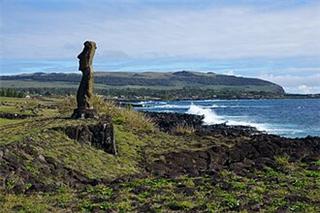
In Tonga and Samoa the descendants of the Lapita settlers developed, over many centuries, the language and culture that scholars call Ancestral Polynesian. From these islands, after a long interval, voyagers set out to settle East Polynesia from about the 11th century CE, reaching the Society Islands, the Marquesas, Hawaii, Rapa Nui and New Zealand. Tonga later became the seat of the Tuʻi Tonga Empire. Further west, in Fiji, Vanuatu, New Caledonia and the Bismarcks, the descendants of Lapita developed distinct societies of their own, and today some 450 Oceanic languages, from the Admiralty Islands to Hawaii and New Zealand, descend from the language that most scholars believe the Lapita people spoke.
The culture was rediscovered piece by piece: Meyer’s finds on Watom in 1909, McKern’s in Tonga in 1920 and Gifford and Shutler’s in New Caledonia in 1952. From the 1960s archaeologists such as Roger Green defined a single Lapita cultural complex and tied it to the origins of the Polynesians. The Lapita Homeland Project in the Bismarck Archipelago in the 1980s, Kirch’s excavations on Mussau, the discovery of Teouma and, since 2016, the study of ancient DNA have confirmed that the ancestors of the Polynesians came from Island Southeast Asia by way of the Bismarcks, and not from the Americas, as Thor Heyerdahl had argued. The debate now turns on how quickly they moved, how much they mixed with the peoples they met, and how a culture of potters became a world of navigators who no longer needed pots.
The Lapita culture, known by its finely stamped pottery, appeared in the Bismarck Archipelago between about 1500 and 1300 BCE and within a few centuries carried the first settlers to Vanuatu, New Caledonia, Fiji, Tonga and Samoa. Its seafarers, largely of Austronesian ancestry, kept exchange networks alive across the ocean, and their descendants became the Polynesians and many other peoples of Oceania.
References
- Bellwood, P. (2017) First Islanders: Prehistory and Human Migration in Island Southeast Asia. Hoboken: Wiley Blackwell.
- Irwin, G. (1992) The Prehistoric Exploration and Colonisation of the Pacific. Cambridge: Cambridge University Press.
- Kirch, P.V. (1997) The Lapita Peoples: Ancestors of the Oceanic World. Oxford: Blackwell.
- Kirch, P.V. (2017) On the Road of the Winds: An Archaeological History of the Pacific Islands before European Contact. Revised and expanded edn. Oakland: University of California Press.
- Skoglund, P. et al. (2016) "Genomic insights into the peopling of the Southwest Pacific". Nature 538.
- Spriggs, M. (1997) The Island Melanesians. Oxford: Blackwell.