Work / monument · artifact
Gundestrup cauldron
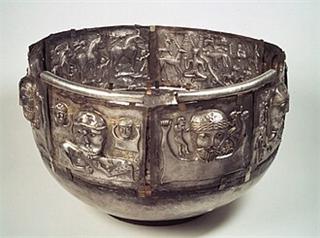
The Gundestrup cauldron is a richly decorated silver vessel thought to date from between 200 BCE and 300 CE, or more narrowly 150–1 BCE, found dismantled in a peat bog near Gundestrup in Himmerland, Denmark, in 1891. The largest known piece of European Iron Age silver work, 69 cm across, it is kept in the National Museum of Denmark in Copenhagen. Its gilded repoussé plates combine Thracian silverworking with Celtic figures, such as carnyx players and an antlered figure commonly identified as Cernunnos, and motifs from the Near East.
Mentioned in 1 profile
See also






Cite this entry
- APA
- The Epoch Institute. (2026). Gundestrup cauldron. In The Epoch Institute Encyclopedia. https://the-epoch-institute.org/encyclopedia/gundestrup-cauldron
- MLA
- “Gundestrup cauldron.” The Epoch Institute Encyclopedia, The Epoch Institute, 2026, https://the-epoch-institute.org/encyclopedia/gundestrup-cauldron. Accessed .
- Chicago
- The Epoch Institute. “Gundestrup cauldron.” The Epoch Institute Encyclopedia. 2026. https://the-epoch-institute.org/encyclopedia/gundestrup-cauldron.
- Harvard
- The Epoch Institute (2026) ‘Gundestrup cauldron’, The Epoch Institute Encyclopedia. Available at: https://the-epoch-institute.org/encyclopedia/gundestrup-cauldron (Accessed: ).
Last reviewed October 2026Random entry ↻