Glossary · Term · language
Imperial Aramaic
Imperial Aramaic is a term coined by modern scholars for a historical variety of Aramaic, also called Egyptian Aramaic because most surviving examples were found in Egypt. In its wider sense it names the phase from the middle of the 8th century BCE to the end of the 4th century BCE, when Aramaic served as a language of public life and administration in the late Neo-Assyrian Empire, the Neo-Babylonian Empire and the Achaemenid Empire; others restrict it to the Achaemenid period. The Elephantine papyri and ostraca are its largest group of records. Its script gave rise to the Aramaic-derived alphabets of the East, among them Syriac, Palmyrene and Mandaic.
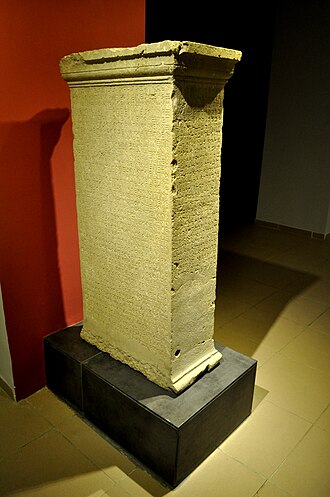
Mentioned in 3 profiles
See also





Cite this entry
- APA
- The Epoch Institute. (2026). Imperial Aramaic. In The Epoch Institute Encyclopedia. https://the-epoch-institute.org/encyclopedia/imperial-aramaic
- MLA
- “Imperial Aramaic.” The Epoch Institute Encyclopedia, The Epoch Institute, 2026, https://the-epoch-institute.org/encyclopedia/imperial-aramaic. Accessed .
- Chicago
- The Epoch Institute. “Imperial Aramaic.” The Epoch Institute Encyclopedia. 2026. https://the-epoch-institute.org/encyclopedia/imperial-aramaic.
- Harvard
- The Epoch Institute (2026) ‘Imperial Aramaic’, The Epoch Institute Encyclopedia. Available at: https://the-epoch-institute.org/encyclopedia/imperial-aramaic (Accessed: ).
Last reviewed October 2026Random entry ↻