
Language · Islamic Caliphates & Middle East
Middle Persian
At a glance
- Middle Persian, the language of Persia proper, became the prestige and literary language of the Sasanian Empire, used even by non-Persian Iranians, and stayed a prestige language for some time after the empire fell.
- It had shed most of Old Persian’s case endings, using prepositions and compound tenses instead, and in its past tenses it treated the doer of an action like a by-phrase, an ergative pattern that New Persian gave up.
- Almost all its literature is Zoroastrian, written mostly in the 9th to 11th centuries in Book Pahlavi, when the language had long ceased to be spoken; so the script’s name, Pahlavi, came to mean the language itself.
Timeline
- 4th century BCEThe fall of the Achaemenid Empire opens the Middle period of the Iranian languages
- 2nd century BCECoins issued in the province of Pars carry legends in early Pahlavi
- 224The Sasanians, native speakers of Middle Persian, take power from the Parthian Arsacids, and Middle Persian becomes the prestige language of the state
- 3rd centuryThe prophet Mani writes the Šābuhragān in Middle Persian in a script of his own making
- 6th–7th centuriesThe earliest Zoroastrian texts in Middle Persian are probably written down, codifying an older oral tradition
- 7th centuryThe Arabs overthrow the Sasanians, and Middle Persian begins to evolve rapidly into New Persian
- 9th–11th centuriesMost surviving Zoroastrian Middle Persian texts are written, long after the language has ceased to be spoken
- 14th centuryCopyists make most of the manuscripts through which Middle Persian texts survive
Origins
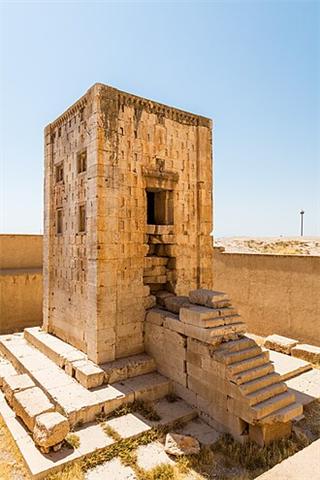
Middle Persian was the middle stage of the language of the Persians, an Iranian people of Persia proper, in the highlands of south-western Iran on the border with Babylonia. The Persians called it Parsig, “Persian”; under the Sasanians it was also called Ērānīg, “belonging to Iran”, and the high priest Kartir’s inscription on the Ka'ba-ye Zartosht speaks of “ērānīg ud anērānīg”, the language of the Iranians and the non-Iranians. It descended from Old Persian, the language of the Achaemenid Empire, and belongs to the Western Middle Iranian languages. The Middle period of the Iranian languages runs from the fall of the Achaemenid Empire in the 4th century BCE to the fall of the Sasanian Empire in the 7th century CE.
The Achaemenids had written their government business in Aramaic, and their scribes carried the practice across the empire. Written Middle Iranian grew out of it very slowly: more and more Iranian words entered the Aramaic, until Aramaic with Iranian elements became Iranian with Aramaic elements. Under the Parthian Arsacids this Aramaic-derived writing came to be linked with the Parthians and was called pahlavi, “Parthian”. The first Middle Persian records are early Pahlavi legends on coins of the province of Pars from the 2nd century BCE. When the Sasanians, natives of the south-west, overthrew the Arsacids in the 3rd century CE, their own language became the prestige language of the state.
Sounds, Script & Grammar
Middle Persian was written in abjads, scripts that write mainly the consonants, derived from the Imperial Aramaic alphabet. The Pahlavi scripts were full of Aramaeograms, words written in Aramaic but read in Persian: LY, Aramaic “to me”, stood for man, “me”, and Book Pahlavi had about a thousand of them. Pahlavi spelling was also very conservative, keeping the pronunciation of the Arsacid period, and Book Pahlavi, a cursive script with many joined letters, had merged the old letters into just 14 distinct signs. The Manichaean script, which the prophet Mani (216–274) made from his native Aramaic script, was regular and unambiguous, and it shows clearly how the language sounded in the 3rd century.
Between the Arsacid and Sasanian periods consonants softened after vowels: Arsacid šap, “night”, and pit, “father”, became šab and pid. Stress fell on the last syllable, because the syllables after the old stress had been lost: Old Persian martiya-, “man”, became mard.
The loss of final syllables swept away many grammatical endings, so Middle Persian is an analytic language that uses prepositions and compound verb forms instead. The early inscriptions keep only a direct and an oblique case, and later texts only singular and plural. In the past tenses the alignment is ergative: tō mardān dīd hēnd, “you saw the men”, is literally “by you the men were seen”. The usual word order is subject, object, verb.
Speakers & Spread
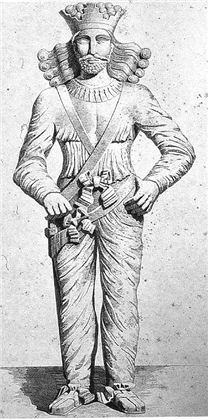
Middle Persian was first the speech of the Persians of the south-west. Under Sasanian rule (224–651) it became a prestige dialect, used also by non-Persian Iranians, and the multilingual inscription of Shapur I shows it as the main state language of the empire; together with the idea of Ērānšahr, “the land of Iran”, it shaped a political identity. Sasanian kings and officials carved their inscriptions in it in the 3rd and 4th centuries, and it appears on coins, seals and Egyptian papyri.
It also travelled with religion. Zoroastrianism, the state religion of Sasanian Iran, gave it its largest body of writing; Manichaeans used it for their scriptures from the 3rd to the 9th century, possibly the 13th; and the Church of the East used it for the Pahlavi Psalter. These varieties were used until the beginning of the second millennium in many places in Central Asia, including Turpan, and even in parts of South India.
After the Arabs overthrew the Sasanians in the 7th century, Middle Persian remained a prestige language for a time, but it began to evolve rapidly into New Persian, now written in Arabic script, and its name parsik became the Arabicised farsi. The literate elite, chiefly Zoroastrian priests, rejected these changes as un-Iranian and went on writing the old language in the old script. By the 9th to 11th centuries Middle Persian had long ceased to be spoken.
Literature & Learning
Middle Persian survives in Sasanian inscriptions, Egyptian papyri, coins and seals, fragments of Manichaean writings and, above all, Zoroastrian literature. The royal inscriptions include the multilingual inscription of Shapur I and the inscription of the high priest Kartir on the Ka'ba-ye Zartosht. Mani wrote his book the Šābuhragān in Middle Persian, and Manichaean Middle Persian has a sizable body of theological texts, homilies and hymns. The Middle Persian of the Church of the East survives in the Pahlavi Psalter, a fairly literal translation of the Syriac Peshitta, rich in Syriac religious words such as purkānā, “redemption”.
Pahlavi literature sets out the traditions and rules of Zoroastrianism. Its earliest texts were probably written down in late Sasanian times, in the 6th and 7th centuries, codifying older oral tradition; to these belong the translations of the Avesta and perhaps some teaching and entertainment literature. Most texts, chiefly the doctrinal and legal works that form most of the corpus, date from the 9th to the 11th century. Its works include the Denkard and the Shkand-gumãnig Vizār, and narratives such as The Book of Ardā Wirāz and the Lesser Bundahišn. The surviving manuscripts are usually 14th-century copies.
As knowledge of Pahlavi declined after the Muslim conquest, Zoroastrians sometimes copied their texts into clearer scripts: the Avestan alphabet, a practice called Pazand, or the Perso-Arabic script, called Pārsī.
Change & Descendants
The great change from Old to Middle Persian was from a synthetic language, which marks grammar with endings, to an analytic one. Nouns, pronouns and adjectives lost almost all their case endings, prepositions took over their roles, many tenses came to be formed with helping verbs, and a split ergative pattern developed. Sounds changed too: the diphthongs ay and aw became ē and ō, θ became s at the start of a word and h elsewhere, and final vowels were lost.
Scholars order the written forms by age. Inscriptional Pahlavi has the most archaic features; the Manichaean texts and the Psalter show slightly later stages; the Pahlavi translations of the Avesta keep some old features; and most Zoroastrian Book Pahlavi texts are the most innovative. The Zoroastrian, Manichaean and Christian varieties differ only minimally from one another.
The change from late Middle to Early New Persian was gradual, and in the 10th and 11th centuries Middle Persian texts were still intelligible to speakers of Early New Persian. By the 10th century, though, unstressed initial vowels had dropped, final -g was lost, the subjunctive and optative moods had gone, the ergative pattern had given way again to a consistent nominative and accusative one, Arabic loanwords had replaced many Aramaic and native words, and the Arabic script had taken the place of Pahlavi. The modern descendants of Middle Persian are New Persian, Achomi and Luri.
Legacy
Middle Persian is the linguistic ancestor of New Persian, the official language of Iran, of Afghanistan as Dari and of Tajikistan as Tajik. New Persian does not allow the clusters of consonants with which many Middle Persian words began, such as spās, “thanks”. Some Middle Persian vowels did not survive, so words once distinct now sound alike: šir, “milk”, and šer, “lion”, are both pronounced šir, though Dari and Tajik keep the older difference.
Its words travelled far. Many Persian loanwords in English go back to Middle Persian, and Classical Arabic borrowed many words from it, replacing sounds foreign to Arabic, g, č, p and ž, with others; the Arabic forms of the endings -ik/-ig and -ak/-ag help to date when a word was borrowed. The script’s name, Pahlavi, from Parthawig, “Parthian”, came after the Sasanian period to mean the late, written Zoroastrian form of the language, and so Middle Persian itself; its ISO 639 code, pal, reflects that use.
Modern study has had to work around the ambiguities of Pahlavi, and the clearer Manichaean and Psalter scripts have helped to recover Sasanian pronunciation. There are two traditions of transcription: one closer to the spelling and the Arsacid sounds, used by Ch. Bartholomae and H. S. Nyberg, and a now more popular one reflecting Sasanian pronunciation, used by C. Saleman, W. B. Henning and D. N. MacKenzie, whose Concise Pahlavi Dictionary appeared in 1986.
In the Research Series
Middle Persian, the language of the Persians between Old and New Persian, became the prestige and literary language of the Sasanian Empire (224–651). Written in Aramaic-derived Pahlavi scripts full of Aramaic word-signs and in Mani’s clearer script, it survives mainly in Zoroastrian books written down after it had ceased to be spoken, and after the Arab conquest it evolved into New Persian.
References
- MacKenzie, D. N. 1986. A concise Pahlavi dictionary. London: OUP
- Nyberg, H. S. (1964): A Manual of Pahlavi I – Texts, Alphabets, Index, Paradigms, Notes and an Introduction, Wiesbaden: Harrassowitz.
- Skjærvø, Prods Oktor. 2009. Middle West Iranian. In Gernot Windfuhr (ed.), The Iranian Languages, 196–278. London & New York: Routledge.
- Sundermann, Werner. 1989. Mittelpersisch. In: Compendium Linguarum Iranicarum. Herausgegeben von Rudiger Schmidt. Wiesbaden: Dr. Ludwig Reichert Verlag. pp. 138–165.
- Maggi, Mauro and Paola Orsatti. 2018. From Old to New Persian. In: The Oxford Handbook of Persian Linguistics. pp. 7–52
- Skjærvø, Prods Oktor. 2007. Introduction to Pahlavi. Cambridge, Mass.