
Language · South & Southeast Asia
Pali
At a glance
- Pali is a Middle Indo-Aryan language that scholars see as a blend of several Prakrit dialects of around the 3rd century BCE, partly Sanskritised; Buddhist tradition long called it Magadhi, the Buddha’s own speech.
- Its great work is the Tipiṭaka, the canon of Theravada Buddhism, written down in Sri Lanka in the 1st century BCE and carried, with its commentaries, to Burma, Thailand, Laos and Cambodia.
- Pali has no script of its own and lived on as a language of study, chant and royal letters; it has lent words to Burmese (thousands of them), Khmer, Lao, Sinhala and Thai.
Timeline
- c. 3rd century BCEAround the time of Ashoka, a language close to the Pali of the canon may take shape as a compromise among the dialects in which the earliest Buddhist teachings were kept
- 1st century BCEMonks in Sri Lanka write down the Tipiṭaka, until then handed down by mouth, in the time of King Vattagamini
- 4th–5th centuryBuddhaghosa compiles the commentaries, among them the Visuddhimagga, and revives Pali as a language of Buddhist scholarship
- 9th centuryThe oldest surviving Pali manuscript, four palm-leaf folios of the Cullavagga later found in Nepal, is written
- 11th centuryA “Pali renaissance” begins around the Pagan Kingdom and spreads across mainland Southeast Asia
- 14th centuryPali dies out as a literary language in mainland India, while the Subodhālaṅkāra brings Sanskrit poetics into Pali
- 1881The Pali Text Society is founded to publish romanised Pali texts and English translations
- 2024The Government of India designates Pali a classical language of India
Origins
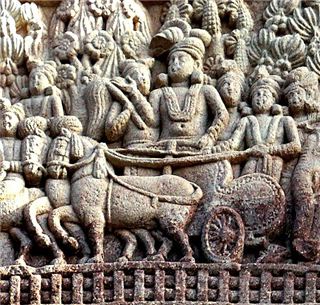
Pali is a Middle Indo-Aryan language, and nearly every word in it has cognates in the other Middle Indo-Aryan languages, the Prakrits. It is not a direct continuation of Ṛgvedic Sanskrit: it descends from one or more dialects that were, despite many similarities, different from Ṛgvedic Sanskrit. Beginning with the Theravada commentaries, Buddhists identified Pali with Magadhi, the language of the kingdom of Magadha in what is now Bihar, and took it to be the language the Buddha himself used; the identification may have been an attempt to tie the community more closely to the Maurya Empire.
Modern scholarship sees it differently. Pali is regarded as a mix of several Prakrits from around the 3rd century BCE, combined and partly Sanskritised, and no attested dialect of Middle Indo-Aryan has all its features. Most scholars place its origin in a western dialect rather than an eastern one: it shares features with the Junagadh rock inscription of Rudradaman in Kathiawar, and A. K. Warder links it with Avanti, where the Sthavira Nikāya was centred, though it keeps some eastern traits called Māgadhisms.
The Buddha probably taught in several closely related dialects that were largely understood by one another’s speakers. K. R. Norman suggests that around the time of Ashoka an attempt was made to gather all the teachings, and that a language close to the Pali of the canon may have emerged then as a compromise among those dialects.
Sounds, Script & Grammar

Pali has no script of its own. Its written tradition kept one system of letter values but expressed it in many scripts: Sinhala in Sri Lanka, Mon-Burmese in Myanmar, Khmer in Cambodia, Thai since 1893, Lao since 1930, Devanāgarī in India, Bengali and Chakma in Bangladesh. In the 1840s King Mongkut of Thailand invented the Ariyaka script as a universal medium for Pali, but it never came into popular use. Since the 19th century Pali has also been written in the Roman script, with marks for its long vowels and retroflex sounds, as in Pāḷi.
Its sounds are simpler than those of Sanskrit. Clusters of consonants were assimilated into double consonants, so that Sanskrit karma became kamma, mārga became magga, bhikṣu became bhikkhu and nirvāṇa became nibbāna. The three Sanskrit sibilants merged into one s, the diphthongs ai and au became e and o, as when maitrī, “friendliness”, became mettā, and final consonants were dropped, so that every word ends in a vowel or a nasal vowel.
Pali is highly inflected: almost every word carries suffixes on its root. Nouns have three genders, two numbers and in principle eight cases, the forms a noun takes for its role in a sentence, though several often coincide. Verbs mark person, number, tense, voice and mood, and the verb usually comes at the end of the clause. Unlike Sanskrit, Pali seldom applies sandhi, the merging of sounds where two words meet.
Speakers & Spread

Pali spread with the Theravada tradition. Scholars think that after Ashoka’s time it served as a lingua franca among Buddhists, and almost all the Pali texts known today are believed to derive from the Anuradhapura Maha Viharaya in Sri Lanka; literary evidence shows Theravadins in mainland India until the 13th century, but no Pali texts of theirs have been recovered. In Sri Lanka Pali declined until around the 4th or 5th century, as Sanskrit rose and Buddhists became fewer on the subcontinent, before the work of Buddhaghosa revived it.
In mainland Southeast Asia the earliest Pali inscriptions date from the first millennium CE, some perhaps from the 4th century, in what are now Burma, Laos, Thailand and Cambodia, and may have come from southern India rather than Sri Lanka. From the 11th century a “Pali renaissance” spread out from around the Pagan Kingdom as royal dynasties sponsored monastic lineages from the Mahavihara. Royal courts in Sri Lanka and mainland Southeast Asia wrote to each other in Pali, grammars were made for speakers of Sinhala, Burmese and other languages, and in Cambodia Pali replaced Sanskrit as the prestige language in the 13th century.
Pali died out as a literary language in mainland India in the 14th century but survived elsewhere until the 18th. Its great centres of learning remain Sri Lanka, Myanmar, Thailand, Laos and Cambodia.
Literature & Learning
Pali literature is divided into the canon and the texts outside it. The canon is the Tipiṭaka: the Vinaya Piṭaka, the five nikāyas of the Sutta Piṭaka and the books of the Abhidhamma Piṭaka, which the Theravada tradition holds to contain the words of the Buddha and his immediate disciples. The Sri Lankan chronicle Mahāvaṃsa records that it was first written down in the 1st century BCE, ending a tradition of oral preservation, because famine, war and the rival Abhayagiri Vihāra threatened the Sangha. The Dhammapada opens with the verse that mental states have mind as their leader and chief, and that suffering follows one who speaks or acts with a corrupted mind as the wheel follows the foot of the draught animal.
Around the canon grew commentaries (Atthakatha), sub-commentaries (ṭīkā), Abhidhamma manuals and treatises such as Buddhaghosa’s Visuddhimagga, which codified the Sinhala commentarial tradition kept since the 3rd century BCE. Chronicles (Vaṃsa) such as the Dipavamsa and the Mahavamsa, both in Pali verse, tell the history of Buddhism in Sri Lanka and the deeds of kings. There are also works on grammar and poetics, medicine, astrology, divination and cosmology, and the Milindapañha may have been composed in northern India before it reached Sri Lanka.
From the 5th century, and more in the second millennium, Pali writers took up Sanskrit poetic forms such as kavya: the 14th-century Subodhālaṅkāra, attributed to Sangharakkhita Mahāsāmi, was modelled on Daṇḍin’s Kavyadarsha.
Change & Descendants
Pali was never fixed once and for all. Differences between texts of the canon suggest material from more than one dialect, and after its first compromise form the language underwent a small degree of Sanskritisation, as when Middle Indic bamhana gave way to brāhmana. Later Pali took much of its technical vocabulary from Sanskrit, directly or with sound changes, while post-canonical texts added words from local languages, as when Sri Lankan writers took Sinhala words; dating texts by such loanwords is now a specialised field.
The name itself came late. It does not appear in the canon; it seems to come from the commentaries, where pāli meant the line of original text quoted, as against the commentary that followed, and it became the language’s name in Sri Lanka early in the second millennium CE. R. C. Childers took pāḷi to mean “line, row, series”, and the name is still spelt in four ways.
In mainland Southeast Asia Peter Masefield has studied Indochinese or “Kham” Pali, long thought a degraded form but perhaps a consistent dialect, its changes caused by letter combinations hard to write in local scripts. He argues that after monastic ordination died out in Sri Lanka and many texts were lost, the Sri Lankan canon was translated into Indochinese Pali and then back into Pali. The 13th-century Tibetan historian Buton Rinchen Drub wrote that the Sthaviravādins used Paiśācī, a largely unattested literary language, which has led some scholars to link it with Pali.
Legacy
Pali has shaped the languages of the Theravada lands. Burmese has adopted thousands of Pali loanwords since its earliest stage as Old Burmese, above all in religion, government, the arts and science, including its ordinal numbers from first to tenth; by the 13th century the Pali pronoun so had become the Burmese particle so, still used to modify nouns. In Cambodia Chuon Nath used Pali roots in the 1900s to coin Khmer words for modern things such as the train, and in Thailand and Laos scholars including Jit Bhumisak and King Vajiravudh coined words for foreign ideas and inventions from Pali roots. Pali also enriched Sinhala from the Anuradhapura period.
Pali was first mentioned in Western writing in Simon de la Loubère’s account of his travels in Siam. Benjamin Clough published an early grammar and dictionary in 1824, Eugène Burnouf and Christian Lassen their Essai sur le Pali in 1826, and Robert Childers the first modern Pali-English dictionary in 1872 and 1875. The Pali Text Society, founded in 1881, has published romanised editions and English translations ever since; in India Dharmananda Kosambi and the Maha Bodhi Society worked to revive Pali studies.
Today Pali is studied mainly for the Buddhist scriptures and is often chanted in ritual. Pali recitations were long thought to hold power: early texts already use Pali charms against snakebite, and many in Theravada cultures still believe that a vow taken in Pali has a special significance.
In the Research Series
Pali is a Middle Indo-Aryan language, a blend of Prakrit dialects of around the 3rd century BCE, in which the canon of Theravada Buddhism was preserved. Written down in Sri Lanka in the 1st century BCE and copied in the script of each land, it spread with Theravada Buddhism to Burma, Thailand, Laos and Cambodia, where it is still studied and chanted, and it has lent many words to their languages.
References
- Steven Collins, A Pali Grammar for Students (Silkworm Press, 2006)
- Thomas Oberlies, Pāli: A Grammar of the Language of the Theravāda Tipiṭaka (Walter de Gruyter, 2001)
- Vito Perniola, A Grammar of the Pali Language (Pali Text Society, 1997)
- Edward Müller, Simplified Grammar of the Pali Language (Asian Educational Services, 1995; first published 1884)
- K. L. Hazra, Pāli Language and Literature: A Systematic Survey and Historical Study (D.K. Printworld, 1994)