Language · South & Southeast Asia
Tamil
At a glance
- Tamil is a Dravidian language attested since about 300 BCE in Tamil-Brahmi inscriptions, and one of the longest-surviving classical languages in the world.
- Its early literature includes the Tolkāppiyam, the oldest Tamil grammar, and the 2,381 Sangam poems, dated between the 1st century BCE and the 5th century CE; Tamil inscriptions have been found as far away as Sri Lanka, Thailand and Egypt.
- Old Tamil became Middle Tamil by the 8th century and Modern Tamil from 1600; today Tamil is official in Tamil Nadu, Puducherry, Sri Lanka and Singapore, and in 2004 it became the first recognised classical language of India.
Timeline
- c. 300 BCEOld Tamil appears in short inscriptions in Tamil-Brahmi, a variant of the Brahmi script
- c. 150 BCEThe Hathigumpha inscription of Kharavela, king of Kalinga, names a Tamira Samghatta, a Tamil confederacy
- 1st century BCEEgyptian pottery of this date found at Quseir al-Qadim, likely the port of Myos Hormos, bears Tamil-Brahmi inscriptions
- 8th centuryOld Tamil has become Middle Tamil, which has gained a present tense and all but lost the old āytam sound
- 13th centuryThe Naṉṉūl restates the rules of the Tolkāppiyam and becomes the standard grammar of literary Tamil
- 1578Portuguese missionaries print the prayer book Thambiran Vanakkam, making Tamil the first Indian language to be printed and published
- 20th centuryThe Pure Tamil Movement campaigns to remove Sanskrit elements from Tamil
- 2004Tamil becomes the first legally recognised classical language of India
Origins

Tamil belongs to the southern branch of the Dravidian languages, a family of around 26 languages native to the Indian subcontinent. Like the others it descends from Proto-Dravidian, which was most likely spoken around the third millennium BCE, possibly around the lower Godavari river basin, by people of the Neolithic cultures of South India. Its closest major relative is Malayalam, and Kannada too is relatively close. Hindu legend tells that Tamil, as Tamil Thāi, “Mother Tamil”, was created by Shiva and brought to the people by Murugan and the sage Agastya.
The language is attested since about 300 BCE. Its earliest records are short inscriptions in Tamil-Brahmi, a variant of the Brahmi script, and earlier dates have been claimed: burial urns found at Adichanallur in 2004, dating from at least 696 BCE, carry writing in Tamil-Brahmi, and a sample from Keezhadi has been claimed to date to around 580 BCE. Apparent Tamil loanwords in Biblical Hebrew from before 500 BCE are the oldest attestation of all.
The origin of the name is unclear. The Tolkāppiyam is the earliest text to use it, and around 150 BCE the Hathigumpha inscription of Kharavela, the Jain king of Kalinga, names a Tamira Samghatta, a Tamil confederacy. Scholars have read tamiḻ as “our own speech” or “self-speak”, and the Tamil Lexicon of the University of Madras defines it as “sweetness”.
Sounds, Script & Grammar
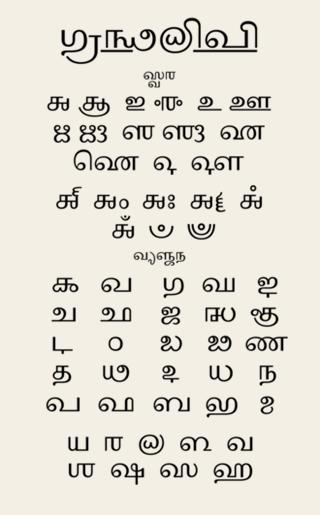
The Tamil script descends from Tamil-Brahmi, by way of a script called vaṭṭeḻuttu used alongside Grantha and Pallava. It has 12 vowels, 18 consonants and one special character, the āytam, which combine into 247 characters. As in other Indic scripts, every consonant carries a built-in vowel a: a dot called the puḷḷi removes it, so that ன is ṉa and ன் is ṉ. The script does not tell voiced from unvoiced stops, which are voiced by their place in the word, and six letters from the Grantha script are sometimes used for sounds borrowed from Sanskrit and other languages.
Tamil grammar is agglutinative: suffixes are added to a root, one after another, to mark class, number, case, tense and other categories, with no fixed limit. The single word pōkamuṭiyātavarkaḷukkāka means “for the sake of those who cannot go”. Nouns fall into two great classes, the “rational”, humans and gods, and the “irrational”, everything else, with five classes in all. Traditional grammarians counted eight cases on the Sanskrit model; modern grammarians treat each suffix as a case of its own.
The verb comes at the end of the clause, in the order subject–object–verb, and Tamil uses postpositions rather than prepositions. It has no articles and no linking verb “is”, so atu eṉ vīṭu means “that [is] my house”, and it tells an inclusive “we”, nām, from an exclusive one, nāṅkaḷ. Even its terms for grammar are Tamil rather than Sanskrit.
Speakers & Spread

Tamil is the main language of most people in Tamil Nadu and Puducherry in India and in the Northern and Eastern Provinces of Sri Lanka, and small minorities speak it in other Indian states and in Colombo and the Sri Lankan hill country. It once reached further: Tamil or its dialects were the major language of administration, literature and daily life in Kerala until the 12th century CE, and Tamil inscriptions were made in southern Andhra Pradesh until then and in southern Karnataka from the 10th to the 14th centuries.
Tamil also travelled by sea. It was the lingua franca of early maritime traders from India, and Tamil inscriptions in Brahmi have been found in Sri Lanka and on trade goods in Thailand and Egypt. Migrants of the colonial era took it to Malaysia, Singapore, Mauritius, South Africa, Burma and other lands; in Réunion, Guyana, Fiji and Trinidad many have Tamil origins but few speak it, and in Réunion, where France forbade it in public, it is now being learnt again. Malaysia has 543 government primary schools that teach in Tamil.
Today Tamil is official in Tamil Nadu, Puducherry and the Andaman and Nicobar Islands and is one of the 22 languages of the eighth schedule of India’s constitution. It is an official and national language of Sri Lanka, with Sinhala, and an official language of Singapore, and migrants from Sri Lanka and India speak it in Canada, the United States, the United Kingdom and Australia.
Literature & Learning
The earliest Tamil literary works and their commentaries praise the Pandiyan kings for organising the Tamil Sangams, long-lasting academies that worked on the language. The oldest surviving text is the Tolkāppiyam, a work on Tamil grammar and poetics whose oldest layers could be as old as the late 2nd century BCE. It describes much of Tamil grammar in five parts, eḻuttu, col, poruḷ, yāppu and aṇi, the last two mostly for poetry.
Beside it stands Sangam literature, a corpus of 2,381 poems usually dated between the 1st century BCE and the 5th century CE. In the Tevaram of Cuntaramurti the poet asks Shiva, “Do you know proper Tamil?”; the scholar David Shulman reads the question as one about knowing how to love, and notes that to “know Tamil” could also mean to be a civilised being. In the 9th and 10th centuries a special form of Tamil, the Vaishnava paribasai, grew up to express Vaishnavite religious values. In the 13th century the Naṉṉūl restated and clarified the rules of the Tolkāppiyam, and it remains the standard grammar of literary Tamil.
Tamil was early in print. In 1578 Portuguese Christian missionaries published a prayer book in the old Tamil script, Thambiran Vanakkam, making Tamil the first Indian language to be printed and published, and the Tamil Lexicon of the University of Madras was one of the earliest dictionaries of an Indian language. A 2001 survey counted 1,863 Tamil newspapers, 353 of them dailies.
Change & Descendants
Scholars divide the history of Tamil into Old Tamil (300 BCE–700 CE), Middle Tamil (700–1600) and Modern Tamil (from 1600). The change from Old to Middle Tamil, complete by the 8th century, brought the near disappearance of the old sound written with the āytam (ஃ), the merging of two n sounds and the turning of a stop into an r-like sound. Above all, a present tense appeared, grown from the verb kil, “to be possible”, which in Old Tamil had marked short-lived actions and became the present marker kiṉṟa.
Written Tamil still follows the Middle Tamil of the 13th-century Naṉṉūl, and it is conservative enough to read eighth-century inscriptions with, while the spoken language has moved on, losing the negative conjugation of verbs and some vowels between consonants. Tamil lives in diglossia, with high and low registers: classical caṅkattamiḻ, the formal centamiḻ of textbooks and public speaking, and the colloquial koṭuntamiḻ of cinema, television and many politicians, often mixed with English in cities as Tanglish.
Dialects grew from different sound changes: the classical iṅku, “here”, is iṅkū in the Kongu dialect of Coimbatore, inga in Thanjavur and iṅkai in parts of Sri Lanka. Sri Lankan Tamil keeps words no longer used in India and has borrowed from Portuguese, Dutch and English, and castes have sociolects of their own, among them Brahmin Tamil. Malayalam, which began to diverge in the 9th century, had become a separate language by the 13th or 14th.
Legacy
Tamil has lent words far beyond India. Besides rice, English has cheroot from curuṭṭu, “rolled up”, mango from māṅgāy, mulligatawny from miḷaku taṇṇīr, “pepper water”, curry from kaṟi, catamaran from kaṭṭu maram, “bundled logs”, and congee from kañji, and anaconda may come from anaikkonda, “having killed an elephant”. Tamil in turn took words from its trading partners, such as cavvarici, “sago”, from Malay and campān, “skiff”, from Chinese, and later from Urdu, Portuguese, French and English.
Its vocabulary is mainly Dravidian, and it was never as heavily Sanskritised as the other Dravidian languages: complex ideas in science, art, religion and law could always be expressed without Sanskrit loans. Some late medieval authors resisted Sanskritisation, and in the 20th century the Pure Tamil Movement, taṉit tamiḻ iyakkam, led by Parithimaar Kalaignar and Maraimalai Adigal and supported by Dravidian parties, replaced many Sanskrit words; by some estimates their share in formal Tamil fell from 40–50% to about 20%. Learned bodies have coined technical terms from Tamil roots, and by 2019 the listed vocabulary held over 470,000 words.
In 2004, after a campaign by Tamil associations, Tamil became the first legally recognised classical language of India, announced by President Abdul Kalam, himself a Tamil. Canada keeps January as Tamil Heritage Month, and South Africa’s constitution protects the language.
In the Research Series
Tamil is a Dravidian language attested since about 300 BCE, spoken by the Tamil people of southern India and Sri Lanka and by communities across the world. The Tolkāppiyam and the Sangam poems stand at the start of its well-documented literary history, and words such as curry, mango and catamaran passed from it into English. In 2004 it became the first recognised classical language of India.