Research Series · Essay 12 · · 19 min read
The Written Word
How Thirty-Two Languages Were Written, Carried, Outlived Their States and Came Back
The First Marks
The oldest writing in the Institute's language profiles is bookkeeping. In the late 4th millennium BCE the temples and administrators of Uruk, the largest city of its time, needed to record goods, rations, animals and labour. Clay tokens and numerical tablets were followed, around 3200 BCE, by the first tablets combining numbers with signs for things and people. Most of these texts are accounts; the rest are lists of words used to train scribes. At first the signs stood for things, not sounds, and it is hard to tell what language they record. The rebus settled it: the sign for “arrow”, ti in Sumerian, was used to write the Sumerian word ti, “life”. Over the following centuries the system was extended to names, to grammar and at last to any sentence, and by about 2600 BCE it carried the first literary texts.
Writing appeared in Egypt at about the same time, apparently independently. Small bone and ivory labels from a royal tomb at Abydos, of about 3250 BCE, seem to record place names or quantities of goods; a seal of King Peribsen, around 2700 BCE, holds the earliest known complete sentence in Egyptian. Hieroglyphs worked in three ways at once: about two dozen signs each stood for a single consonant, others for whole words, and silent determinatives at the end of a word showed its kind of meaning. The vowels were never written, so Egyptologists still pronounce nfr, “good”, by convention as nefer.
China's earliest writing served divination. From about 1250 BCE diviners of the Shang kings near present-day Anyang asked the ancestors and gods about harvests, weather, war, hunting and childbirth, heated cattle shoulder blades and turtle shells, read the cracks and carved the questions on the bones. The script is already a mature system, which suggests that writing had developed earlier, though no earlier stage has been firmly identified.
In the Aegean the first Greek was the writing of palaces. The Linear B tablets of Knossos, from around 1400 BCE, and of Pylos and Mycenae are inventories of land, livestock, textiles, weapons and offerings, kept on unbaked clay meant to be reused; they survive because the fires that destroyed the palaces baked them hard. When the palaces fell, around 1200 BCE, writing disappeared from Greece for some four centuries, except on Cyprus. A script made for an administration could end with it.
Many languages were carried long before they were written. The 1,028 hymns of the Rigveda, composed around 1500 to 1200 BCE, were learned by heart by priests who recited them in several orders of words to keep the text exact, and Sanskrit inscriptions appear only from about the 1st century BCE. The Pali canon of Theravada Buddhism was handed down by mouth until monks in Sri Lanka wrote it down in the 1st century BCE, because famine, war and a rival monastery threatened the Sangha, its community of monks. The Inca kept their records on khipus, knotted cords; the Nahuas painted codices whose glyphs could be read as sounds; the Hawaiians had no writing apart from petroglyphs, and kept their history in stories and in hula. For several of these languages the first written record was made by outsiders: Hawaiian words noted by James Cook's crew in 1778, a Quechua grammar printed by a Dominican friar in 1560, a Guarani grammar completed by a Jesuit in 1629.
Scripts That Travelled
The alphabet began as a borrowing from Egypt. Early in the 2nd millennium BCE speakers of a Semitic language working in Egypt and Sinai took hieroglyphic signs to write the consonants of their own language, using the picture of an ox's head for the sound at the start of their word for ox. This Proto-Sinaitic script is the ancestor of the Phoenician alphabet, first attested in the mid-11th century BCE on inscribed bronze arrowheads, and through it of the Greek, Latin, Hebrew and Arabic alphabets: the letter A descends from a hieroglyph. Phoenician wrote twenty-two consonants and left even its long vowels unwritten.
In the 8th century BCE the Greeks used Phoenician letters for consonants that Greek lacked to write vowels instead, so that aleph became alpha and yod became iota, and made the first full alphabet. Through the Etruscans it became the Latin alphabet, now the most widely used writing system in the world; around 900 the Cyrillic alphabet was made for the Slavs largely from Greek letters; and Greek inspired the Coptic, Gothic and Armenian scripts. When Egyptian Christians wrote their language in Greek letters from the 3rd century, adding signs taken from demotic for sounds Greek lacked, the vowels of Egyptian were written for the first time.
The Aramaic alphabet travelled furthest. Written quickly with ink on leather and papyrus, its twenty-two letters proved easier to use than cuneiform, and as Aramaic spread its local forms became scripts of their own. The Jews adopted its “square script” after the Babylonian exile, and it is the Hebrew alphabet still used; the Nabataeans of Petra developed a form that became the Arabic script; the Christians of Edessa developed Syriac; in the east it gave rise to the scripts of Middle Persian, Parthian and Sogdian, and through Sogdian to the Old Uyghur, Mongolian and Manchu scripts; in north-western India it was the source of Kharosthi. Many scholars believe that even the Old Turkic runes were developed from the Sogdian alphabet.
India's scripts came from Brahmi, known from the edicts of Ashoka in the 3rd century BCE; the Institute's keyboard for it notes that nearly every script of South and Southeast Asia comes from it. Sanskrit has no script of its own. It was written in many scripts derived from Brahmi, among them Siddham, which carried Buddhist mantras to China and Japan, and since the 19th century chiefly in Devanagari. Tamil was written from about 300 BCE in Tamil-Brahmi; the oldest Malay, the Kedukan Bukit inscription of 683 near Palembang, in a Pallava script; and Pali, which also has no script of its own, in the script of each Theravada land, Sinhala, Mon-Burmese, Khmer, Thai since 1893 and Lao since 1930.
The Arabic alphabet of twenty-eight letters grew from the Nabataean script, its earliest dated inscriptions falling in the century before Islam. It was adapted to write Persian, with four letters added for p, ch, zh and g, and Urdu, Pashto, Kurdish, Uyghur, Ottoman Turkish, Malay, as Jawi, whose oldest evidence is the Terengganu Inscription Stone of about 1303, Swahili and Hausa. In the Horn of Africa Ge'ez was carved from the 4th century in a script made for it, an abugida whose signs join a consonant to a vowel; that script outlived the spoken language and now writes Amharic, Tigrinya and most other languages of Ethiopia.
Some scripts have a maker's name. Old Persian cuneiform, some three dozen signs, was probably created at the order of Darius I for his royal inscriptions. Ulfilas most likely invented the Gothic alphabet for his Bible; Cyril and Methodius devised Glagolitic for their mission to Moravia in 862 or 863; Mesrop Mashtots created the Armenian alphabet of thirty-six letters in 405; King Sejong of Korea promulgated Hangul in 1446. The first thing the New England missionaries printed in Hawaiʻi, in 1822, was the alphabet itself.
Script and language parted easily. Akkadian scribes wrote the Sumerian sign LUGAL, “king”, and read it as šarrum, and cuneiform was used for more than a dozen languages. Middle Persian scribes wrote about a thousand Aramaic words and read them as Persian: LY, Aramaic for “to me”, was read man, “me”. Classical Chinese was read in Korea, Japan and Vietnam in each country's own pronunciation, and scholars who shared no spoken language could converse by writing it, a practice called “brush talk”. Mongolian has been written in more scripts than almost any other language, from the Uyghur script that Genghis Khan adopted in 1204 to Cyrillic, mandatory in Mongolia from 1941. A language did not own its script, and a script could serve any language that took it.
Carried by Empires, Faiths and Trade
Empires carried writing furthest, though rarely in their own tongue alone. Sargon of Akkad made Akkadian a language of empire around 2300 BCE, and in the second half of the 2nd millennium BCE it became the international language of the Near East. The Amarna letters, found in Egypt in 1887, show the pharaohs corresponding almost entirely in Akkadian with the kings of Babylon, Assyria, Mitanni and the Hittites: rulers who spoke Egyptian, Hittite, Hurrian or Canaanite languages wrote to one another in it.
Aramaic, in its profile's words, conquered the conquerors. The Assyrian Empire deported hundreds of thousands of people, many of them Aramaic speakers, and by the 8th century BCE its officials used Aramaic beside Akkadian; palace reliefs show pairs of scribes, one writing cuneiform on clay, the other Aramaic on a scroll. The Achaemenid Empire then made Imperial Aramaic its main language of administration from Egypt to Bactria, as the papyri of the Jewish garrison at Elephantine show, while Old Persian was used almost only for royal monuments such as Darius's trilingual inscription at Behistun. In the 3rd century BCE Ashoka addressed his north-western frontier at Kandahar in Greek and Aramaic.
Alexander's conquests made Greek the language of government, trade and culture from Egypt to Afghanistan, and the common Koine replaced the old dialects. Latin spread with Rome's colonies, roads and armies and replaced Oscan, Umbrian and Etruscan, but in the east Greek remained the common language and Roman officials there often used Greek themselves. Persian, reborn in Arabic letters, became from the 11th century the language of government of dynasties that were mostly Turkic and Mongol, Ghaznavids, Seljuks, Ilkhanids and Timurids; Akbar made it the language of all Mughal government records in 1582, and it stayed the official language of the courts of British India until 1837. Classical Chinese held its empire together in writing: the civil service examinations, held from 605 until 1905, tested the classics, and Korea, Japan and Vietnam used the same written language for government for more than a thousand years.
In the Americas two empires spread their languages, and the conquest that ended them spread those languages further. The Triple Alliance of 1428 made Nahuatl the language of its government, tribute and trade, and the Inca Empire spread Quechua by resettling whole communities and teaching it to the sons of conquered rulers in Cusco. Philip II made Nahuatl the general language for instructing the Indigenous peoples of New Spain in 1570; the Third Council of Lima adopted a standard Quechua for the catechism, and the catechism printed in Lima in 1584, in Spanish, Quechua and Aymara, was the first book printed in South America. Later colonial powers did the same in Africa and Asia: German, British and Belgian administrations used Swahili, and the Dutch and British both used Malay as a tool of centralisation.
Faiths carried languages across borders that no empire held. The Qur'an made Arabic the language of a new religion, and around 700 the Umayyad caliph Abd al-Malik made it the language of government in place of Greek and Persian. Pali spread with Theravada Buddhism: royal courts in Sri Lanka and mainland Southeast Asia wrote to one another in it, and in Cambodia it replaced Sanskrit as the prestige language in the 13th century. Before that, Sanskrit had been the language of royal inscriptions from Afghanistan to Java, Cambodia and Vietnam, a world historians have called a “Sanskrit cosmopolis”. Christianity gave a written literature to language after language: Syriac, carried by missionaries to China, where a stone set up at Xi'an in 781 records the arrival of the faith in Chinese and Syriac; Gothic, Coptic and Armenian, whose oldest surviving text is a 5th-century Bible; Georgian, written after the Christianisation of Iberia in the mid-4th century; Ge'ez, whose Bible of 81 books, translated mostly from Greek, keeps the only complete text of the Book of Enoch; and, much later, Hawaiian and Guarani.
Trade carried the rest. Phoenician became a lingua franca of the Iron Age Mediterranean through the trade and colonies of Tyre and Sidon, and its western form, Punic, the language of Carthage. Tamil was the lingua franca of early maritime traders from India, and Tamil-Brahmi inscriptions appear on trade goods in Thailand and Egypt. The traders of Srivijaya spread Old Malay through the ports of the archipelago; Sultan Abu Hayat of Ternate wrote to the king of Portugal in Malay around 1521–1522, though his people spoke an unrelated language. Swahili took shape from the 8th century in the merchant towns of the East African coast and 19th-century caravans from Zanzibar carried it to the Great Lakes and the Congo. The words followed the cargo: rice from Tamil arici through Hebrew and Greek, chocolate and tomato from Nahuatl, sugar and coffee from Arabic, llama and quinoa from Quechua.
Outliving the State
A written language could outlive everyone who spoke it. Sumerian gave way to Akkadian as a spoken language, probably between about 2100 and 1800 BCE, but Akkadian-speaking pupils in the Old Babylonian “tablet houses” learned it as a classical language, and for the next two thousand years it remained the language of ritual, incantation and learning; in the 7th century BCE Ashurbanipal boasted that he could read the difficult texts of Sumer. Akkadian in turn survived the empires that had spoken it: after Alexander it lived only among the temple scholars of Babylonia, who used it for astronomy, ritual and divination until the 1st century CE. Middle Egyptian remained the classical language of religious and monumental inscriptions until the end of antiquity.
Latin outlived Rome by more than a thousand years. The Germanic kingdoms that replaced the Western Empire went on governing in it; in the Middle Ages it was no one's mother tongue, yet it was the language of the Church, the universities, law and much government, Magna Carta among its documents. It remained the language of government in the Kingdom of Hungary until 1844; until 2012 the formal description of a new plant had to be written in it; and it is still the official language of the Holy See.
The holy languages lived longest without speakers. By the 3rd and 4th centuries CE Hebrew had ceased to be anyone's mother tongue, yet for the next sixteen centuries it was leshon ha-kodesh, “the holy tongue”, in which Jews prayed, studied, wrote law, philosophy and poetry and corresponded across the diaspora. Sanskrit was the language of priests, scholars and courts rather than of daily life: in Sanskrit drama kings and Brahmins speak it while women and most other characters speak Prakrits, and Hindu rituals are still performed in it. Coptic has no native speakers but is the liturgical language of the Coptic churches. Ge'ez was no longer a living language by the 14th century but remained Ethiopia's official written language until the 19th, kept by the priests and monks who ran traditional education; in Richard Pankhurst's words, “the Church thus constituted the custodian of the nation's culture”.
The same pattern runs through the other churches and faiths. Church Slavonic held among the eastern Slavs a place like that of Latin in the west, closer to everyday speech, and Orthodox Slavs lived with one Slavic language for worship and another for daily life. Classical Armenian, Grabar, remained the literary standard from the 5th century to the 19th. Middle Persian is the extreme case: after the Arab conquest the Zoroastrian priests rejected the changes that were making it New Persian as un-Iranian and went on writing the old language in the old script, so that most of its surviving literature was written in the 9th to 11th centuries, long after anyone spoke it, and the script's name, Pahlavi, came to mean the language itself.
A learned language often lasted because it did not change while speech did. Panini's grammar of some four thousand rules fixed Classical Sanskrit in a form that changed little thereafter; Classical Arabic, codified on the model of the Qur'an and the old poetry, changed little in its written form over thirteen centuries; Classical Chinese, read aloud, could not be understood by a listener who had not studied it. The result was diglossia, a high written language beside a low spoken one, as Modern Standard Arabic stands beside the regional varieties and as Katharevousa stood beside Demotic in Greece until 1976. In Ottoman Turkish, Arabic and Persian words made up as much as 88% of the vocabulary, and the court register was largely unintelligible to rural Turks; a scribe wrote the Arabic word asel for honey in a document and asked for bal, the Turkish word, in the market.
How Languages End and Were Read Again
Languages in the profiles more often lost their speakers to a neighbour than to a ban. Akkadian was displaced in speech by Aramaic, which the Assyrian and Babylonian empires' own deportations had spread, and by the time of Alexander it was probably spoken by few if any people. Aramaic in its turn gave way to Arabic after the 7th-century conquests and survived in mountain villages of northern Iraq, south-eastern Turkey and north-western Iran and in a few villages of Syria. Phoenician seems to have died out in the east by the 1st century BCE, while Punic lasted in North Africa until the 6th century CE, perhaps even the 9th, its kinship with Arabic probably easing its speakers' Arabisation. Gothic declined after the Goths' defeat by the Franks and their elimination in Italy, lost its last role as a church language in Spain in 589, and is last heard of in the liturgy reported around Tomis in 840–842 and in graffiti of the mid-9th century at Mangup in Crimea.
The end of Egyptian was slow and, at one point, violent. Arabic replaced Greek as the language of administration at the turn of the 8th century; Coptic remained the speech of the native population outside the capital until the 10th, and declined massively under the Fatimid caliph al-Hakim, who, the Coptologist Emile Maher Ishaq writes, forbade it everywhere on pain of having the tongue removed. It was the majority language of Egypt until some time between the 10th and 12th centuries, its last known literary work dates to the late 14th, and passive speakers over 50 were still recorded at Zainiya, north of Luxor, in the 1930s.
Other languages ended by becoming something else. Spoken Latin changed region by region into the Romance languages, now the first languages of nearly 900 million people. Old English, its endings worn away in the mixed population of the Danelaw, became Middle English; Old Norse became Icelandic, Faroese, Norwegian, Danish and Swedish; Middle Persian became New Persian; Old Church Slavonic grew by the mid-11th century into the regional recensions of Church Slavonic. These are endings of a stage, not of a line.
Scripts died more completely than languages. The last known hieroglyphic inscription was carved at Philae in 394 and the last demotic one in 452, and late writers such as Horapollo read the signs as symbols of hidden wisdom, an error that misled scholars for more than a thousand years. The last datable cuneiform tablet, an astronomical almanac from Uruk, was written for the year 79 to 80 CE, and knowledge of Akkadian was then lost for some seventeen hundred years.
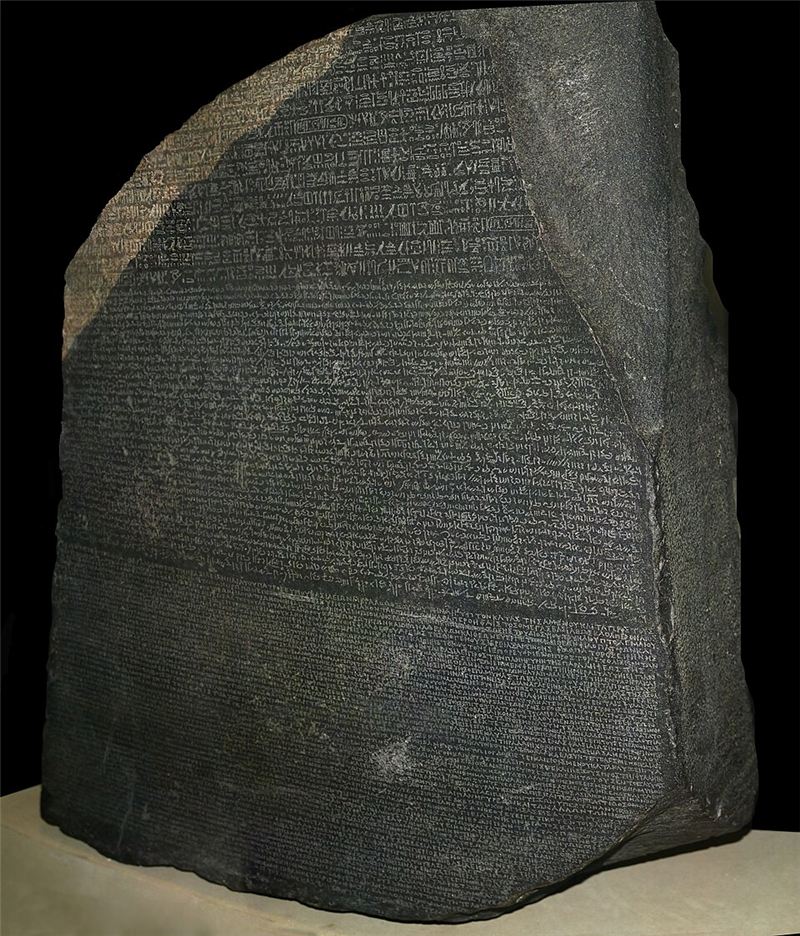
Recovery usually began from two texts side by side or from a language still known. Jean-Jacques Barthélemy deciphered Phoenician in 1758 from a Greek and Punic bilingual found in Malta. French soldiers found the Rosetta Stone, with its decree in hieroglyphs, demotic and Greek, in 1799, and in 1822 Champollion, who knew Coptic well, showed that hieroglyphs combined signs for sounds and for meanings: Egyptian's last stage, kept alive in the liturgy, helped to read its oldest script. Scholars unlocked Akkadian from the Babylonian version of the trilingual inscription of Behistun, copied by Henry Rawlinson on a cliff face in western Iran; in 1857 four of them translated a newly found inscription independently, and their versions agreed so closely that the decipherment was accepted as proved. In 1869 Jules Oppert named the older language beneath it Sumerian. Vilhelm Thomsen read the Old Turkic runes in 1893, beginning with the words for “heaven” and “Turk”, and in 1952 Michael Ventris showed that Linear B was Greek.
Silenced and Revived
Some languages in the profiles were pushed out of schools and public life. After the overthrow of the Hawaiian monarchy, Act 57 of 1896 made English “the medium and basis of instruction in all public and private schools” in the Republic of Hawaiʻi. The law did not ban Hawaiian, but children who spoke it, even on the playground, were disciplined, and in 1937 Winona Beamer was expelled from the Kamehameha Schools for chanting in it. Guarani was prohibited in Paraguay's state schools for over a hundred years even while populists used pride in it to stir national feeling. France forbade Tamil in public in Réunion. In Inner Mongolia Mandarin became the only language of instruction for all subjects from September 2023, after protests against the first step in 2020 were quickly suppressed.
Against these stands the one revival the Hebrew profile calls unique: no other language that had ceased to be anyone's mother tongue has become the everyday language of a nation. Eliezer Ben-Yehuda settled in Jerusalem in 1881, insisted on speaking only Hebrew at home and compiled a great dictionary; his son Ben-Zion, born in 1882, is often called the first native speaker of modern times. The revival needed thousands of new words, coined from ancient roots, milon, “dictionary”, from mila, “word”, and later maḥshev, “computer”, from the root of thinking and calculating, by the Hebrew Language Committee of 1890 and the Academy of 1953. It spread with the schools of the new settlements; a dispute over the language of the Technion in Haifa ended in victory for Hebrew in 1913; the British Mandate recognised it in 1922; and today it is spoken by some 9 million people.
The other revivals in the collection are smaller and less certain. In 1984 the ʻAha Pūnana Leo, the “language nest”, opened its first preschool, where elders spoke Hawaiian to children every day, and in 1987, after 91 years, Hawaiian was again a medium of instruction in public schools; the 2011 census counted 2,000 native speakers among 24,000 fluent ones, and UNESCO still classes it as critically endangered. Paraguay's democratic constitution of 1992 made Guarani equal to Spanish; between 2002 and 2022 the share of Paraguayans speaking only Guarani fell from 28% to 12%, yet Spanish monolingualism did not rise. In the second half of the 20th century Pope Cyril VI of Alexandria started a Church-sponsored movement to revive Coptic. Elsewhere recognition came by law: Swahili became the language of Tanzania's government and primary schools in 1967, Quechua an official language of Peru in 1975 and Nahuatl a national language of Mexico in 2003. Scripts were reformed too. Turkey replaced the Perso-Arabic script with the Latin alphabet in 1928; in Mongolia, Cyrillic, closer to speech than the traditional script, helped raise literacy from 17.3% to 73.5% between 1941 and 1950.
What kept a written language alive, across these thirty-two histories, was seldom the state that first wrote it. The palaces that kept Linear B took their script with them when they fell. What lasted were the institutions that taught reading to people who did not speak the language at home: the tablet houses of Babylonia, the monasteries and universities of Latin Europe, the synagogue and its schools, the Ethiopian Church, the Chinese examinations, the Theravada monasteries. Revival has needed the same things, schools, dictionaries and academies to coin words. A state can decree a language into its schools or out of them, as the Republic of Hawaiʻi did in 1896 and Tanzania in 1967; whether it lives depends on whether children learn it and adults go on reading it.
What the Data Shows
When this essay was written, in November 2026, the Institute profiled thirty-two languages: six of the Ancient Near East, six of Europe, five of the Islamic Caliphates and Middle East, four of South and Southeast Asia, three of Central and East Asia, three of the Americas, two of Egypt and North Africa, two of Sub-Saharan Africa and one of Oceania. Eighteen are counted as still spoken, their spans running to the present, and fourteen as no longer spoken. The eighteen include Latin, Ge'ez, Pali and Sanskrit, which the profiles describe as living chiefly in worship and learning, so “still spoken” here means still in use rather than a mother tongue. Twelve of the thirty-two have a keyboard in the Institute's Write in Ancient Scripts: Akkadian, Ancient Egyptian, Ancient Greek, Arabic, Aramaic, Classical Chinese, Hebrew, Old Norse, Old Turkic, Persian, Sanskrit and Sumerian.
The spans are conventions and measure different things. The six oldest are Ancient Egyptian, 3250 BCE–1700 CE; Sumerian, 3200 BCE–80 CE; Akkadian, 2500 BCE–80 CE; Sanskrit, from 1500 BCE; Ancient Greek, 1400 BCE–600 CE; and Classical Chinese, 1250 BCE–1920 CE. Sanskrit's date is that of hymns composed and kept by memory, not of writing, and Sumerian's and Akkadian's ends are those of the last cuneiform tablets, not of speech. The longest recorded spans are Ancient Egyptian's 4,950 years, Sanskrit's 3,525, Sumerian's 3,280, Classical Chinese's 3,170, Hebrew's 3,025 and Aramaic's 2,925. The shortest are Old Turkic's 580 years, Gothic's 550, Guarani's 396 and Old Church Slavonic's 237; but Guarani's span is short because its written record begins with the Jesuit grammar of 1629, not because it ended, and Old Church Slavonic's because the profile closes it when it grew into Church Slavonic, which is still sung.
The fourteen ends are Akkadian and Sumerian in 80 CE; Ancient Greek and Phoenician in 600; Gothic in 850; Middle Persian in 1000; Old Church Slavonic in 1100; Old English in 1150; Old Turkic in 1300; Old Norse in 1350; Ancient Egyptian and Coptic in 1700, together, since Coptic is Egyptian's last stage; Classical Chinese in 1920; and Ottoman Turkish in 1928. Read against the profiles, they divide into two kinds. Sumerian, Akkadian, Phoenician, Gothic and Egyptian with Coptic left no daughter language; Greek, Middle Persian, Old Church Slavonic, Old English, Old Norse, Ottoman Turkish and Classical Chinese end where a later stage of the same line takes over, and Old Turkic was close to the common ancestor of the Turkic languages spoken today. Many of the “no longer spoken” are ancestors rather than dead ends. The figures show that the line between a living and a dead language, in the written record, is rarely a single date.
Further Reading
- Chadwick, J. The Decipherment of Linear B. Cambridge: Cambridge University Press, 1958.
- Daniels, P. T., and W. Bright, eds. The World's Writing Systems. New York: Oxford University Press, 1996.
- Fellman, J. The Revival of a Classical Tongue: Eliezer Ben Yehuda and the Modern Hebrew Language. The Hague: Mouton, 1973.
- Fournet, Jean-Luc. The Rise of Coptic: Egyptian versus Greek in Late Antiquity. Princeton University Press, 2020.
- Green, N., ed. The Persianate World: The Frontiers of a Eurasian Lingua Franca. Oakland: University of California Press, 2019.
- Gzella, H. A Cultural History of Aramaic: From the Beginnings to the Advent of Islam. Leiden: Brill, 2015.
- Leonhardt, J. Latin: Story of a World Language. Translated by K. Kronenberg. Cambridge, MA: Belknap Press of Harvard University Press, 2013.
- Mannheim, B. The Language of the Inka since the European Invasion. Austin: University of Texas Press, 1991.
- Parkinson, R. B. Cracking Codes: The Rosetta Stone and Decipherment. London: British Museum Press, 1999.
- Pollock, S. The Language of the Gods in the World of Men: Sanskrit, Culture, and Power in Premodern India. Berkeley: University of California Press, 2006.
- Schütz, Albert J. The Voices of Eden: A History of Hawaiian Language Studies. University of Hawaiʻi Press, 1994.
- Whiteley, W. Swahili: The Rise of a National Language. London: Methuen, 1969.
- Woods, C., ed. Visible Language: Inventions of Writing in the Ancient Middle East and Beyond. Chicago: Oriental Institute, 2010.
- Zuckermann, G. Revivalistics: From the Genesis of Israeli to Language Reclamation in Australia and Beyond. New York: Oxford University Press, 2020.
Profiles in this essay
 Aramaic900 BCE – present
 Sumerian3200 BCE – 80 CE
 Ancient Egyptian3250 BCE – 1700 CE
 Latin600 BCE – present
 Hebrew1000 BCE – present
 Sanskrit1500 BCE – present
 Classical Chinese1250 BCE – 1920 CE
 Arabic100 BCE – present
 Phoenician1050 BCE – 600 CE
 Coptic200 CE – 1700 CE
 Middle Persian300 BCE – 1000 CE
 Ge'ez300 CE – present
 Old Church Slavonic863 CE – 1100 CE
 Hawaiian300 CE – present
 Guarani1629 CE – present
 Persian520 BCE – present
Cite this essay
- APA
- The Epoch Institute. (2026). The Written Word. In Research Series. https://the-epoch-institute.org/essays/the-written-word
- MLA
- “The Written Word.” Research Series, The Epoch Institute, 2026, https://the-epoch-institute.org/essays/the-written-word. Accessed .
- Chicago
- The Epoch Institute. “The Written Word.” Research Series. 2026. https://the-epoch-institute.org/essays/the-written-word.
- Harvard
- The Epoch Institute (2026) ‘The Written Word’, Research Series. Available at: https://the-epoch-institute.org/essays/the-written-word (Accessed: ).