South & Southeast Asia
Srivijaya Empire
At a glance
- Based at Palembang in Sumatra, Srivijaya was a sea power that ruled the Strait of Malacca from the 7th to the 13th century.
- It grew rich by taxing China-India shipping and became a renowned centre of Buddhist learning, spreading Old Malay across the region.
- Chola raids, Javanese rivals, direct Chinese shipping and the spread of Islam wore it down until Temasek and Malacca took its role.
Rise & Fall
- 671The Chinese pilgrim Yijing visits Srivijaya on his way to India
- 682The Kedukan Bukit inscription records Sri Jayanasa's military expedition
- c. 990Srivijaya withstands an attack on Sumatra by Dharmawangsa of Medang
- 1016The Medang court in Java is destroyed by the rebellion of the ruler of Wurawari
- 1025Rajendra Chola I sacks Srivijaya and its ports and captures its ruler
- c. 1068A further Chola naval expedition under Virarajendra strikes the region
- 1275Kertanagara of Singhasari launches the Pamalayu expedition against Malayu
Foundation
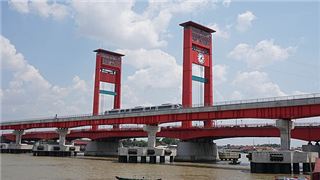
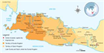
The Srivijaya Empire was the dominant maritime power of Southeast Asia from the seventh to the thirteenth centuries, a thalassocracy built not on territorial conquest and agricultural surplus but on control of the sea lanes and the extraction of revenue from the traffic passing through the Strait of Malacca and the waters around Sumatra and the Malay Peninsula. Its origins are obscure. The first clear description comes from the Chinese Buddhist pilgrim Yijing (I-Tsing), who stopped there in 671 CE on his way to study in India and described a thriving centre of Buddhist learning with more than a thousand monks, comparable to the great monasteries of India; Chinese sources record the polity as Shilifoshi. The Kedukan Bukit inscription of 682 CE, found near modern Palembang and written in Old Malay, among the earliest surviving examples of that language, records the ruler Dapunta Hyang Sri Jayanasa leading a military expedition and establishing his authority over the surrounding region. Palembang on the Musi River in southern Sumatra was the empire's core capital, strategically placed to control shipping moving between the Indian Ocean and the South China Sea through the Malacca and Sunda straits. The empire did not emerge from a single act of conquest but coalesced gradually from a network of Malay chieftaincies that the rulers of Palembang brought under tributary suzerainty through military pressure, commercial incentive and the deliberate use of Buddhist religious legitimacy. The Sailendra dynasty, which appears to have been closely connected to Srivijaya from the eighth century, built the great Buddhist monument of Borobudur in central Java, suggesting that Srivijayan cultural and political influence reached across the Java Sea at the empire's height.
Socioeconomy
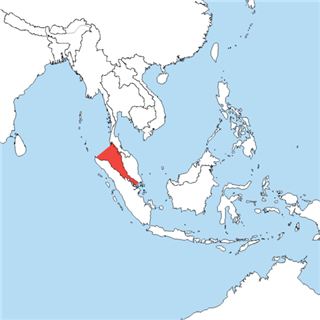
The Srivijayan economy was fundamentally a transit economy: the empire prospered not by producing goods but by taxing their movement through the maritime corridors it controlled. The Strait of Malacca was the principal bottleneck for seaborne trade between China and the Indian subcontinent, and Srivijaya's control of the ports and anchorages on both sides of it allowed the empire to levy harbour fees, customs duties and protection payments on merchants of every nationality. Chinese ceramics and silk, Indian textiles and spices, and luxury goods from the Persian Gulf and Arabia all moved through Srivijayan waters, generating revenues sufficient to support a substantial fleet, a Buddhist monastic establishment of international repute, and a court that exchanged regular embassies with Tang and later Song China. The polity itself produced relatively little for export: Sumatra's interior yielded forest products, including camphor, benzoin resin and aromatic woods, as well as alluvial gold, which supplemented commercial revenues. The empire enforced its commercial dominance through naval force and through oaths of loyalty (sumpah), preserved in inscriptions such as those of Kota Kapur and Telaga Batu, whose elaborate curse formulae bound subordinate port polities and officials to Palembang. Merchant communities from China, India, Arabia and the wider Malay world maintained permanent quarters in the major ports, creating cosmopolitan commercial centres of remarkable diversity. The empire's prosperity was therefore directly tied to the volume of trade passing through the region, a dependency that left it vulnerable to shifting trade routes, the rise of competing ports and the emergence of naval powers able to challenge its supremacy at sea.
Military

The Srivijayan military was primarily a naval force, organised around the war fleets whose control of the Malacca Strait underpinned the empire's entire economic and political system. Much of its strength came from the orang laut, the 'sea people', maritime communities who had lived on their boats among the islands of Sumatra and the Malay Peninsula for generations and whose seamanship, local knowledge and capacity for rapid mobilisation made them the most effective maritime force in the region. The orang laut were not soldiers in the conventional sense but a client population whose loyalty Srivijaya secured through patronage and whose naval service formed the empire's main coercive capability. Srivijaya could also project power over considerable distances. When the Javanese kingdom of Medang under Dharmawangsa attacked Sumatra around 990 CE, Srivijaya withstood the assault, and in 1016 the Medang court was destroyed by a rebellion of the vassal ruler of Wurawari, an event many historians attribute to Srivijayan backing or regard as a Srivijayan invasion of Medang. The most serious challenge came from South India. In 1025 the Chola king Rajendra Chola I launched a great naval raid that sacked Srivijaya and a string of its ports, including Kadaram (Kedah) and Malaiyur, and captured its ruler Sangrama Vijayatunggavarman; a further Chola expedition followed around 1068 under Virarajendra. These raids exposed a structural weakness: faced with a power willing to send a concentrated fleet from outside the region, Srivijaya's dispersed network of orang laut auxiliaries could not mount a sustained defence. They did not destroy its commercial position outright, but they revealed the limits of its military capacity and opened the way for rival ports to assert greater independence.
Governance & Law
Srivijaya's government has been described by scholars as a 'galactic polity' or mandala: a centre-periphery arrangement in which the paramount ruler at Palembang exercised suzerainty over subordinate port lords who kept substantial autonomy within a framework of ritual submission, commercial obligation and periodic tribute. The empire's authority rested more on commercial incentives and religious prestige than on the direct administration and territorial garrisons characteristic of continental Asian empires. Subordinate rulers were bound to the paramount through oath-taking ceremonies backed by Buddhist ritual and the threat of supernatural punishment, and the prospect of commercial exclusion, denial of access to Srivijayan-controlled trade networks, was for most of them a more effective sanction than military force. The ruler's legitimacy was framed within Mahayana and later Vajrayana Buddhism, and he was probably presented as a figure of great spiritual merit, possibly a bodhisattva, whose authority derived from accumulated virtue. The promotion of Srivijaya as a major centre of Buddhist learning, which Yijing recommended to Chinese monks as a place to study before travelling on to India, served several purposes at once: it attracted pilgrims and their patronage, reinforced the ruler's religious standing, and created a network of monastic foundations that carried Srivijayan influence beyond the reach of its fleets. Srivijayan rulers also endowed Buddhist foundations abroad, including a monastery at Nalanda in Bihar and the Chudamani Vihara at Nagapattinam on the Chola coast. Administrative records are sparse, reflecting the modest bureaucratic complexity of a commercial thalassocracy compared with a territorial agrarian empire.
Global & Regional Impact
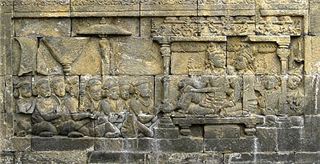
Srivijaya's historical significance lies in its role as the foundational commercial and cultural intermediary of maritime Southeast Asia, establishing the trade networks, commercial practices and religious culture that shaped the subsequent development of the whole region. For some six centuries it served as the principal node linking the commercial systems of China, India, the Islamic world and the islands of Southeast Asia, making the Strait of Malacca one of the most commercially vital maritime passages in Asia. Its patronage of Mahayana Buddhism fostered an enduring synthesis of Indian and local traditions that shaped the art, architecture and religious practice of the region; the temple complexes of Muaro Jambi and Muara Takus in Sumatra, and the Sailendra monuments of central Java, rank among the finest achievements of Asian religious art. Old Malay, used in Srivijaya's inscriptions and spread as a language of commerce across its network, was an ancestor of the Malay language that later became one of the most widely spoken languages of Southeast Asia. The commercial infrastructure Srivijaya developed, with dependable harbour facilities, predictable customs procedures and the protection of merchant shipping, set the pattern for the entrepôt system later followed by Malacca, Johor, Penang and ultimately Singapore. The maritime routes of the so-called Silk Road, which grew in importance as overland routes through Central Asia became less secure in the late first millennium, ran through the Srivijayan network, making the empire an indispensable link in the long-distance commerce of the medieval Old World.
Decline & Fall

Srivijaya's decline was gradual and had many causes: external military pressure, the growth of competing commercial centres and a long-term shift of regional power from maritime Sumatra to agrarian Java. The Chola raids of 1025 and around 1068, while not destroying Srivijaya's commercial position, weakened its naval supremacy and encouraged subordinate ports to assert their independence from Palembang; by the late eleventh century the centre of gravity appears to have shifted to Jambi, the old Malayu. The rise of the Javanese kingdoms of Kediri, then Singhasari and Majapahit, created a powerful rival centre that contested Srivijayan cultural and commercial influence. Chinese merchants of the Song period increasingly sailed directly to the ports of South and Southeast Asia in their own ships, reducing their dependence on Srivijayan intermediaries. The spread of Islam through the Indian Ocean trading world brought Muslim merchants into growing prominence, and the gradual conversion of port communities in northern Sumatra and the Malay Peninsula from the late thirteenth century onwards eroded the Buddhist framework on which Srivijayan legitimacy rested. Former dependencies broke away, and in 1275 Kertanagara of Singhasari launched the Pamalayu expedition against Malayu, further weakening the Sumatran centre. By the time Kublai Khan's envoys were seeking tribute in the region in the late thirteenth century, Srivijaya was a shadow of its former power, and by the fourteenth century it had effectively dissolved into the regional system from which it had emerged, with Temasek (Singapore) and later Malacca inheriting its commercial role.
Srivijaya's supreme historical legacy is the maritime commercial system and Malay cultural framework that made the Strait of Malacca one of the world's most commercially vital waterways, a strategic significance that endures to the present day.
Test yourself
5 questions on this page, from its key events and facts.
The questions open here once the page has loaded.
References
- Christie, J.W. (1995) 'State Formation in Early Maritime Southeast Asia', Bijdragen tot de Taal-, Land- en Volkenkunde, 151(2), pp. 235–288.
- Coedès, G. (1968) The Indianized States of Southeast Asia. Translated by S.B. Cowing. Honolulu: East-West Center Press.
- Hall, D.G.E. (1981) A History of South-East Asia. 4th edn. London: Macmillan.
- Kulke, H. (1993) 'Śrīvijaya Revisited: Reflections on State Formation of a Southeast Asian Thalassocracy', Bulletin de l'Ecole française d'Extrême-Orient, 80(1), pp. 159–183.
- Miksic, J.N. and Goh, G.Y. (2017) Ancient Southeast Asia. London: Routledge.
- Wolters, O.W. (1967) Early Indonesian Commerce: A Study of the Origins of Srivijaya. Ithaca: Cornell University Press.
Connections
Open the full connections map →