Europe
Kingdom of Northumbria
At a glance
- A union of the Anglian kingdoms of Bernicia and Deira that stretched from the Humber to the Firth of Forth.
- Its monasteries produced Bede, Alcuin, the Lindisfarne Gospels and the Codex Amiatinus, the Northumbrian Renaissance.
- Defeat at Nechtansmere in 685 ended its expansion; the Vikings took York in 867 and England absorbed it in 954.
Rise & Fall
- 655Oswiu defeats and kills Penda of Mercia at the Battle of the Winwaed
- 664The Synod of Whitby adopts Roman practice for dating Easter
- 685The Picts defeat and kill Ecgfrith at the Battle of Nechtansmere
- 731Bede completes the Ecclesiastical History of the English People
- 793Vikings sack the monastery of Lindisfarne
- 867The Great Heathen Army holds York; kings Osberht and Ælla are killed
- 954Eric Bloodaxe is expelled and Northumbria passes to the English crown
Foundation
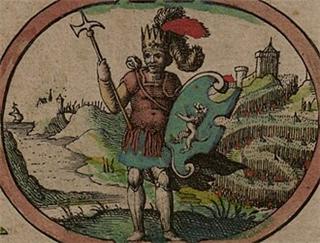
Northumbria, the land of the people north of the Humber, was formed from two Anglian kingdoms: Bernicia, centred on the coastal fortress of Bamburgh, whose dynasty traced its descent from Ida in the mid 6th century, and Deira, centred on the Yorkshire Wolds and York. They were first joined around 604 by Æthelfrith of Bernicia, who defeated Áedán mac Gabráin of Dál Riata at the Battle of Degsastan in 603 and the Britons near Chester about 615. After Æthelfrith's death at the River Idle in 616, the Deiran Edwin ruled both kingdoms and was baptised at York by Paulinus in 627, but his death at the Battle of Hatfield Chase in 633 split them again. Oswald reunited them after his victory at Heavenfield in 634. His brother Oswiu, king of Bernicia from 642, struggled with Deiran rivals, had King Oswine killed in 651 and finally made the union lasting after he defeated and killed Penda of Mercia at the Battle of the Winwaed in 655; the kingdom is dated here from that mid-650s reunion. From then Northumbria stretched from the Humber to the Firth of Forth, absorbing the British kingdoms of Elmet, Rheged and Gododdin and reaching west to the Irish Sea.
Socioeconomy
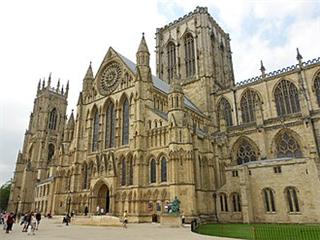
Northumbria was a land of upland pasture and lowland farming, organised in large estates, or shires, that supplied food renders to the king and his nobles. Royal centres such as Bamburgh, Yeavering, where excavations revealed a great timber hall and assembly structure, and later York formed the hubs of power. York, the old Roman city of Eboracum, became the seat of a bishop in 627 and of an archbishop from 735, and its trading quarter developed into a port with links to Frisia and the Rhineland. Christianity came from two directions: Roman missionaries under Paulinus converted Edwin's court, while Oswald brought monks from Iona under Aidan, who founded Lindisfarne in 635. Monasteries became the richest institutions of the kingdom. Benedict Biscop founded Wearmouth in 674 and Jarrow in the early 680s, with books, glaziers and masons brought from Gaul and Rome, and Abbess Hild ruled the double monastery at Whitby. These houses held large endowments of land and produced manuscripts on an extraordinary scale; the Codex Amiatinus alone required the skins of hundreds of calves. Kings issued silver coins from around 700, and in the 9th century small base-metal coins known as stycas circulated in large numbers.
Military
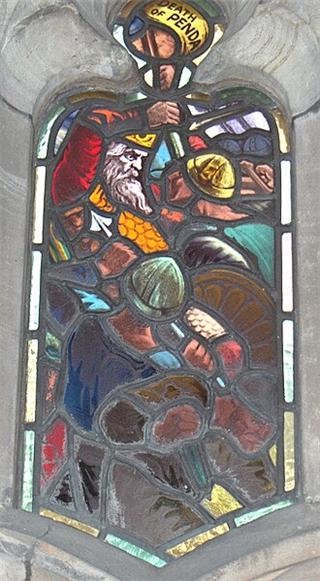
Northumbrian power was won by war. Æthelfrith, Edwin, Oswald and Oswiu each held a wide overlordship backed by royal war bands, and Bede counts Edwin, Oswald and Oswiu among the kings who held imperium over the southern English. Oswiu's victory at the Winwaed in 655 gave him control of Mercia for three years and made him the strongest king in Britain. His son Ecgfrith extended rule over the Picts and established a bishopric at Abercorn on the Forth, but lost Lindsey after defeat by Æthelred of Mercia at the Battle of the Trent in 679. In 684 his army raided Brega in Ireland, and in 685 he led an invasion of Pictland that ended in disaster at the Battle of Nechtansmere, where the Pictish king Bridei son of Beli killed him and destroyed his army. Northumbrian expansion northwards ended, and the Picts, Scots and some Britons regained their independence. Eadberht (737–758) took Kyle in Ayrshire and in 756, with the Pictish king Óengus, forced the Britons of Dumbarton to submit, but lost most of his army shortly afterwards. In the 9th century Northumbria faced the Vikings, and in 867 its rival kings Osberht and Ælla were killed trying to retake York from the Great Heathen Army.
Governance & Law
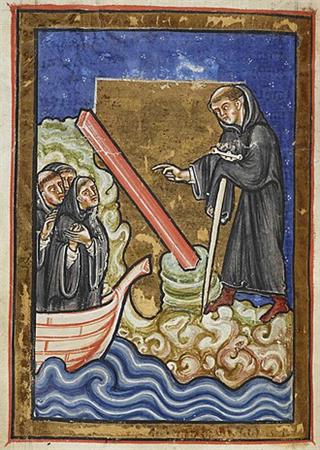
The king ruled with a council of nobles and churchmen, travelling between royal estates and relying on reeves to collect renders and enforce justice. Royal power depended heavily on the church: kings founded and endowed monasteries, and bishops such as Wilfrid of York, Cuthbert of Lindisfarne and Ecgberht of York were political figures in their own right. Ecgberht, brother of King Eadberht, secured the archiepiscopal pallium in 735, and for two decades the brothers ruled kingdom and church together. In 664 Oswiu presided over the Synod of Whitby, which decided that the Northumbrian church would follow Roman rather than Irish practice in calculating Easter, a choice with lasting consequences for the English church. Royal succession was open to several branches of the Bernician dynasty and to rival families, and after the death of Aldfrith in 704 or 705 it became extremely unstable. In the 8th century most kings were deposed, exiled or murdered, and several entered monasteries. This instability weakened the kingdom just as other powers grew. From the late 9th century the old kingdom was divided: Viking kings ruled York and the south, while English high-reeves or earls based at Bamburgh governed the north between the Tees and the Tweed.
Global & Regional Impact

Northumbria's lasting importance lies in its culture. The monasteries of Lindisfarne, Wearmouth-Jarrow, Whitby, Hexham and Ripon created the so-called Northumbrian Renaissance, which blended Irish, Anglo-Saxon and Mediterranean traditions. The Lindisfarne Gospels, made around 700, and the Codex Amiatinus, the oldest surviving complete Latin Bible, taken towards Rome by Abbot Ceolfrith in 716, are among the finest books of the early Middle Ages. The stone crosses of Ruthwell and Bewcastle carry some of the most ambitious sculpture of the period, and the Ruthwell Cross bears runic verses related to the poem The Dream of the Rood. Bede of Jarrow (c. 673–735) wrote the Ecclesiastical History of the English People, completed in 731, the foundation of English historical writing, and his works on time-reckoning helped spread the practice of dating events from the birth of Christ. Cædmon's hymn, composed at Whitby, is among the earliest recorded poems in English. Alcuin, educated at the cathedral school of York, became the leading scholar at Charlemagne's court and shaped the Carolingian revival of learning. Through these men and books Northumbria influenced the intellectual life of Britain, Ireland and the Frankish kingdoms.
Decline & Fall

Political weakness followed the defeat at Nechtansmere in 685 and grew through the 8th century, as rival families fought over the throne. The Viking raid on Lindisfarne in June 793, which Alcuin lamented in letters from Francia, opened a new era of attacks. In 829 the Northumbrians submitted to Ecgberht of Wessex at Dore, though only briefly. The decisive blow came in 866–867, when the Great Heathen Army seized York; the kings Osberht and Ælla, who had ended their own quarrel to fight together, were killed attacking the city in March 867. The Vikings set up dependent English kings north of the Tyne, and in 876 their leader Halfdan shared out the lands of southern Northumbria among his followers, founding the Viking Kingdom of York. English rulers held out at Bamburgh as high-reeves or earls. In 927 Æthelstan took York and received the submission of the northern rulers, but Norse and Hiberno-Norse kings repeatedly regained the city in the following decades. The last of them, Eric Bloodaxe, was expelled in 954, traditionally dying at Stainmore, and York and the rest of Northumbria were absorbed into the Kingdom of England, with the north governed by earls of the house of Bamburgh.
Northumbria was the largest Anglo-Saxon kingdom of the 7th century and the home of the Northumbrian Renaissance, whose monasteries produced Bede, Alcuin, the Lindisfarne Gospels and the Codex Amiatinus, shaping learning across Britain and Francia before Viking conquest divided it and it passed to the English crown in 954.
References
- Rollason, D. (2003) Northumbria, 500–1100: Creation and Destruction of a Kingdom. Cambridge: Cambridge University Press.
- Higham, N.J. (1993) The Kingdom of Northumbria AD 350–1100. Stroud: Alan Sutton.
- Kirby, D.P. (1991) The Earliest English Kings. London: Unwin Hyman.
- Yorke, B. (1990) Kings and Kingdoms of Early Anglo-Saxon England. London: Seaby.
- Bede, Ecclesiastical History of the English People, trans. L. Sherley-Price, rev. R.E. Latham (1990). London: Penguin.
Connections
Open the full connections map →