South & Southeast Asia
Khmer Empire
At a glance
- A Cambodian empire founded in 802, whose god-kings ruled much of mainland Southeast Asia from Angkor.
- Vast reservoirs and canals fed a huge population and paid for Angkor Wat and Angkor Thom, among the world's great monuments.
- Strained waterworks, drought, Thai invasions and shifting trade led the court to abandon Angkor for the Phnom Penh region.
Rise & Fall
- 802Jayavarman II is consecrated universal monarch on Phnom Kulen, founding the empire
- late 800sYasovarman I settles the capital at Angkor
- 1177Cham forces sack Angkor
- 1203Jayavarman VII, having expelled the Cham, subjugates Champa itself
- 1296Chinese envoy Zhou Daguan arrives and later writes a vivid account of Angkor
- 1431The Thai kingdom of Ayutthaya captures Angkor, by traditional dating
Foundation

The Khmer Empire emerged in the early ninth century in mainland Southeast Asia, consolidating earlier polities of the Mekong basin into a centralised state centred in present-day Cambodia. Its foundation is traditionally dated to 802 CE, when Jayavarman II underwent a consecration ritual on Mount Mahendraparvata, the Phnom Kulen plateau, proclaiming himself a universal monarch (chakravartin), inaugurating the cult of the devaraja and symbolically freeing the land from the overlordship of “Java”. This event marked the ideological birth of the empire, establishing a model of sacred kingship that fused political authority with religious legitimacy. The empire's rise was enabled by the fertile floodplains of the Tonle Sap and Mekong systems, which supported intensive wet-rice agriculture, and by its position within regional trade networks linking India and China. Early consolidation involved the integration of competing chiefdoms through both military force and ritual authority, and the capital settled at Angkor under Yasovarman I in the late ninth century, laying the foundation for one of the most enduring and architecturally significant civilisations in Southeast Asian history.
Socioeconomy
The Khmer economy was fundamentally agrarian, sustained by one of the most sophisticated hydraulic infrastructures of the pre-modern world. Networks of vast reservoirs (barays), canals and embankments, among them the West Baray, some eight kilometres long, regulated water flow, helping to secure harvests and support a large population concentrated around Angkor. Society was hierarchically organised, with the king and priestly elites at the apex, followed by officials, artisans, farmers and labourers, many of whom were bound to state or temple service. Land was often attached to religious foundations, first Hindu and later Buddhist, which functioned as economic as well as spiritual centres; an inscription of the temple of Ta Prohm records thousands of villages and attendants assigned to its upkeep. Trade complemented agriculture, with the empire exchanging rice, fish, forest products and luxury goods within regional networks. Taxes were collected largely in kind and through labour obligations, giving the state the capacity to mobilise resources for construction and the upkeep of infrastructure. This system created both economic resilience and structural dependence on environmental stability.
Military
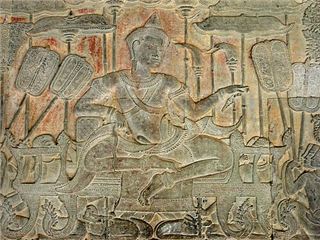
The Khmer army combined infantry, war elephants and naval forces adapted to the region's riverine and wetland environment. Troops were raised through provincial levies and labour obligations, with commanders drawn from the aristocracy. War elephants served as instruments of battlefield dominance, providing both physical and psychological impact, while infantry fought with spears, swords and shields, as the reliefs of Angkor Wat and the Bayon vividly depict. Naval forces controlled river routes and carried war to neighbouring polities. Expansion reached its height under rulers such as Suryavarman II, who campaigned against Dai Viet and Champa, and Jayavarman VII. The sack of Angkor by Cham forces in 1177 exposed the empire's vulnerability, but Jayavarman VII drove out the invaders, defeating them in a celebrated naval battle on the Tonle Sap, enclosed his new capital of Angkor Thom within massive walls and moat, and subjugated Champa itself in 1203. Military power enabled territorial expansion and protection, but it was closely tied to the state's economic capacity, making prolonged campaigns and infrastructure maintenance interdependent.
Governance & Law
Governance in the Khmer Empire was centred on the devaraja ideology, which positioned the king as both political leader and sacred intermediary with the gods. Administrative structures were hierarchical, with provincial officials overseeing local administration, taxation and labour mobilisation. Inscriptions in Sanskrit and Old Khmer reveal a complex bureaucracy that recorded land grants, labour obligations, boundary disputes and religious endowments. Temples functioned as administrative hubs, managing resources and co-ordinating economic activity. Law combined customary norms with religious principles derived from Hinduism and later Mahayana and Theravada Buddhism. The king exercised supreme judicial authority, often delegating responsibilities to officials and religious leaders. Bureaucratic institutions were deeply integrated with religious structures, reflecting the fusion of spiritual and political authority. This system enabled effective resource mobilisation for monumental architecture and water management, but it concentrated power in the capital, leaving governance vulnerable to disputed successions and to shifts in ideological cohesion.
Global & Regional Impact
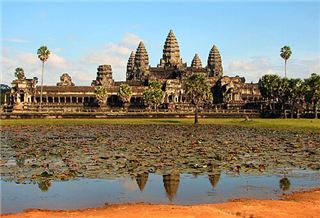
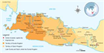
The Khmer Empire exerted profound influence across mainland Southeast Asia, shaping cultural, political and religious developments for centuries. Its capital at Angkor became one of the largest urban complexes of the pre-modern world, exemplified by Angkor Wat, built under Suryavarman II in the first half of the twelfth century and dedicated to Vishnu, and by Jayavarman VII's walled city of Angkor Thom with the Bayon at its centre. Jayavarman VII also founded a network of hospitals and rest houses across the kingdom. The empire transmitted Indian cultural elements, including Sanskrit learning, Hindu religious practice and later Buddhist traditions, while developing distinctive Khmer artistic and religious expressions. Trade connected it to China, India and maritime Southeast Asia, and the Chinese envoy Zhou Daguan left a vivid account of Angkor after his visit in 1296–1297. Khmer influence extended over present-day Thailand, Laos and southern Vietnam, shaping later states such as Ayutthaya. Its cultural and architectural achievements continue to define Cambodian national identity and attract global scholarly and popular attention.
Decline & Fall
The decline of the Khmer Empire from the fourteenth century onward resulted from a complex interplay of environmental, political and economic factors. The vast hydraulic system that had sustained agricultural productivity became increasingly difficult to maintain, and tree-ring evidence points to prolonged droughts punctuated by intense monsoons in the fourteenth and fifteenth centuries that may have damaged it further. Succession disputes and the weakening of central authority undermined administrative cohesion. The spread of Theravada Buddhism shifted ideological frameworks, reducing the emphasis on divine kingship and monumental temple construction and altering the basis of royal legitimacy. External pressure from the Thai kingdom of Ayutthaya brought repeated invasions, culminating in the capture of Angkor traditionally dated to 1431. Trade also shifted towards maritime routes, diminishing the importance of inland centres. The court gradually relocated south-east to the region of Phnom Penh, closer to the Mekong trade, marking the effective end of Angkor as an imperial capital and the fragmentation of Khmer political power.
The Khmer Empire stands as one of mainland Southeast Asia's greatest civilisations, whose divine kingship and vast hydraulic network raised Angkor Wat and Angkor Thom, and whose dependence on that network left it vulnerable when climate, politics and trade turned against it.
Test yourself
5 questions on this page, from its key events and facts.
The questions open here once the page has loaded.
References
- Briggs, L.P. (1951) The Ancient Khmer Empire. Philadelphia: American Philosophical Society.
- Chandler, D.P. (2000) A History of Cambodia. 3rd edn. Boulder: Westview Press.
- Coedès, G. (1968) The Indianized States of Southeast Asia. Translated by S.B. Cowing. Honolulu: East-West Center Press.
- Freeman, M. and Jacques, C. (1999) Ancient Angkor. London: Thames and Hudson.
- Higham, C. (2001) The Civilization of Angkor. London: Weidenfeld and Nicolson.
- Mabbett, I. and Chandler, D.P. (1995) The Khmers. Oxford: Blackwell.
Connections
Open the full connections map →