Language · Europe
Old English
At a glance
- Old English grew from the dialects of the Angles, Saxons and Jutes who settled in Britain in the 5th century, and it replaced the Common Brittonic and Latin of Roman Britain over most of what became England.
- It was a heavily inflected language, with five cases, three genders and a freer word order than Modern English; perhaps around 85% of its words are no longer in use, but those that survived are the basic elements of English vocabulary.
- Under Alfred the Great, and later the Winchester standard of Bishop Æthelwold, it became a written language of government and literature, until the Norman Conquest of 1066 made Anglo-Norman French the language of the upper classes.
Timeline
- c. 450Anglo-Saxon settlers bring to Britain the dialects that become Old English
- 658–680Cædmon composes his hymn, the oldest surviving work of Old English literature
- early 8th centuryThe Franks Casket is carved with the oldest coherent runic texts in Old English
- 9th centuryScandinavian rule and settlement begin, bringing strong Old Norse influence to the speech of eastern and northern England
- late 9th centuryAlfred the Great unites the kingdoms outside the Danelaw, and West Saxon becomes the standard language of government and literature
- late 10th centuryA new literary standard, Late West Saxon, arises at Winchester under Bishop Æthelwold
- 1019Cnut addresses a proclamation in Old English to Earl Thorkell the Tall and the English people
- 1066The Norman Conquest: Anglo-Norman replaces English as the language of the upper classes
Origins

Old English developed from a set of Anglo-Frisian or Ingvaeonic dialects, part of the North Sea Germanic group of West Germanic, spoken by the Germanic tribes traditionally known as the Angles, Saxons and Jutes. These settlers brought their speech to Great Britain in the mid-5th century, and as they became dominant their language replaced those of Roman Britain: Common Brittonic, a Celtic language, and the Latin brought by the Roman conquest. Its closest relatives were Old Frisian and Old Saxon.
The name Englisċ, from which the word English derives, means ‘pertaining to the Angles’; by the 9th century all speakers of Old English, including those who claimed Saxon or Jutish ancestry, could be called Englisċ. The tribe’s own name probably comes either from Proto-Germanic *anguz, referring to narrowness, perhaps of shallow coastal waters, or from *angô, a curve or hook, perhaps for a promontory shaped like a fishhook or for a people of fishermen.
For its first two centuries, called Prehistoric or Primitive Old English (c. 450–650), the language is mostly reconstructed, known only from a limited corpus of runic inscriptions. Literacy developed after the Christianisation of Anglo-Saxon England in the late 7th century. The oldest surviving work of literature, Cædmon’s Hymn, was composed between 658 and 680 but not written down until the early 8th century, the date of the oldest coherent runic texts, on the Franks Casket.
Sounds, Script & Grammar
Old English was first written in runes, using the futhorc, a set derived from the 24-character elder futhark and extended by five more runes for Anglo-Saxon vowel sounds. The Latin alphabet, brought by Irish Christian missionaries, was introduced in the 7th century and from around the 8th supplanted the runes. Scribes added four letters: æ (ash), ð (eth), and thorn þ and wynn ƿ, both borrowed from the runes. Spelling was reasonably regular, with few silent letters: in cniht, the ancestor of knight, both the c and the h were pronounced.
The grammar was synthetic, expressing relations through endings on words. Nouns were declined for five cases (nominative, accusative, genitive, dative and a vestigial instrumental), three genders and two numbers; adjectives agreed with them, and verbs were conjugated for three persons, two tenses and three moods. Strong verbs formed the past by changing the root vowel, weak verbs by a dental suffix such as -de, a split that survives in work and worked. Gender was grammatical: ƿīf, ‘woman’, the later wife, was neuter.
Because endings carried the meaning, word order was freer: the verb usually came second in main clauses and last in subordinate ones, questions were formed by inverting subject and verb without do, and several negatives could stack up to strengthen each other. Sound changes such as i-mutation left marks still heard today, as in mice, the plural of mouse.
Speakers & Spread

Old English came to be spoken over most of the territory of the Anglo-Saxon kingdoms that became the Kingdom of England, including most of present-day England and part of what is now south-eastern Scotland, which for several centuries belonged to the kingdom of Northumbria. Other parts of the island kept Celtic languages: Gaelic, and perhaps some Pictish, in most of Scotland, Cornish in Cornwall and parts of Devon, Cumbric perhaps to the 12th century in parts of Cumbria, and Welsh in Wales.
Its four main dialects were tied to kingdoms: Northumbrian north of the Humber, Mercian between the Humber and the Thames, West Saxon south and south-west of the Thames, and Kentish, the speech of the Jutes, in the south-east. In the 9th century the Vikings overran Northumbria south of the Tyne and most of Mercia, and Alfred the Great joined the part of Mercia that held out and all of Kent to Wessex. Scandinavian settlement in the Danelaw, and the rule of Cnut and other Danish kings in the early 11th century, brought speakers of Old Norse into close contact with English. The two were so alike that speakers roughly understood each other, differing chiefly in their endings.
After the Norman Conquest of 1066 English was replaced as the language of the upper classes for several centuries by Anglo-Norman, a type of French, and for a time ceased to matter as a literary language.
Literature & Learning
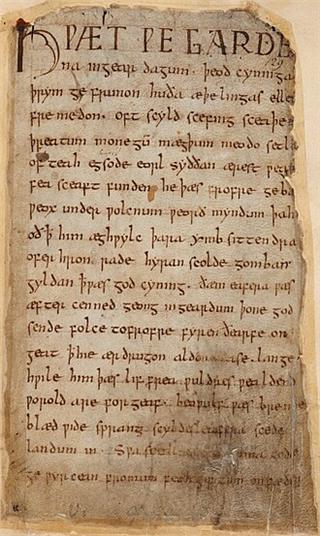
Some 400 manuscripts of Old English survive: a small corpus, but one of the most substantial bodies of literature preserved among the early Germanic peoples. Much more perished. Poetry, built on stress and alliteration, is considered its heart. Beowulf, an epic of around 3,000 lines, opens with the legendary Scyld, found as a baby washed ashore. Nearly all authors are anonymous; among the exceptions are Bede and Cædmon, and the early period also had Cynewulf and Aldhelm.
Prose came later, inspired chiefly by Alfred the Great, who in the later 9th century advocated education in English alongside Latin and had many works translated, some, such as Pope Gregory I’s Pastoral Care, apparently by himself. The Anglo-Saxon Chronicle recorded early English history. There were sermons and saints’ lives, biblical translations, the works of the early Church Fathers, laws and wills, and books on grammar, medicine and geography. The prolific Ælfric of Eynsham, ‘the Grammarian’, wrote in the late Winchester standard.
English scholars also glossed Latin texts, first in the margins or between the lines, then in word-lists such as the Épinal-Erfurt, Leiden and Corpus Glossaries, which grew into Latin–Old English glossaries with some of the character of dictionaries. Kings wrote in English too: in 1019 Cnut sent a proclamation to Earl Thorkell the Tall and the English people, promising to be a kind lord, faithful to God’s laws.
Change & Descendants
Old English was not static: its use covered some 700 years. Albert Baugh, while noting that such dates are arbitrary, places it from 450 to 1150, a period of full inflections. Scholars divide it into Prehistoric Old English (c. 450–650), Early Old English (c. 650–900), the age of the oldest manuscripts, and Late Old English (c. 900–1150), which led up to the Norman Conquest and the transition to Early Middle English.
The written standard moved too. After Alfred’s unification Early West Saxon became the language of government and literature; a later standard, Late West Saxon or the ‘Winchester standard’, arose in the late 10th century under Bishop Æthelwold of Winchester and is considered the classical form of Old English. It seems not to descend directly from Alfred’s, and Hogg has suggested calling the two Alfredian and Æthelwoldian Saxon. In speech the regions kept their dialects, and standard Middle and Modern English descend from Mercian rather than West Saxon, while Scots developed from Northumbrian.
Contact reshaped the language. Celtic left very few loanwords; Latin gave more, before the migration and again after the conversion. Old Norse most likely had a greater impact than any other language: in the mixed population of the Danelaw the endings, which stood in the way of understanding, became obscured and finally lost, moving English from a synthetic towards an analytic word order. Middle English (1150–1500) followed, then Early Modern and Modern English.
Legacy
Perhaps around 85% of Old English words are no longer in use, but those that survived are the basic elements of Modern English vocabulary. Its grammar lingers in a few pronouns, such as I, me and mine or who, whom and whose, in the possessive -’s, from the genitive ending -es, and in the plural -(e)s, from the -as of strong masculine nouns. Its compound verb constructions are the beginnings of the compound tenses of Modern English, and its strong verbs live on as today’s irregular verbs, though many have decayed into weak ones.
Its study began in the Anglo-Saxon period itself, with the glossaries, and was revived in the early modern period, when William Somner published his Dictionarium Saxonico-Latino-Anglicum. Joseph Bosworth’s Anglo-Saxon Dictionary followed in 1838, and with T. Northcote Toller the research dictionary of 1898. The Dictionary of Old English, published from Toronto since 1983 and now mainly online, generally supersedes it where available; in September 2018 it covered A to I.
Old English has also been written anew. Alistair Campbell and J. R. R. Tolkien composed texts in it, advocates of linguistic purism look to it to revive old words or coin new ones, and reenactors, Modern Pagan websites and an Old English Wikipedia use it, though one investigation found that many Neo-Old English texts online bear little resemblance to the historical language.
In the Research Series
Old English was the earliest form of English, brought to Britain by Anglo-Saxon settlers in the 5th century and spoken in England and southern and eastern Scotland until the decades after the Norman Conquest of 1066. A heavily inflected West Germanic language, it carried Beowulf, the Anglo-Saxon Chronicle and Alfred’s translations, and under Norse and Norman influence it became Middle English.
References
- Cameron, Angus, et al. (eds.), Dictionary of Old English (Toronto: Pontifical Institute of Medieval Studies, 1983–)
- Bosworth, Joseph and T. Northcote Toller, An Anglo-Saxon Dictionary (Oxford: Clarendon, 1898)
- Toller, T. Northcote, An Anglo-Saxon Dictionary: Supplement (Oxford: Clarendon, 1921)
- Clark Hall, J. R., A Concise Anglo-Saxon Dictionary, 4th rev. edn by Herbert D. Meritt (Cambridge University Press, 1969)
- Roberts, Jane and Christian Kay, with Lynne Grundy, A Thesaurus of Old English, 2 vols (Amsterdam: Rodopi, 2000)