Language · Islamic Caliphates & Middle East
Georgian
At a glance
- Georgian belongs to the small Kartvelian family with Mingrelian, Laz and Svan, and no link between this family and any other is accepted in mainstream linguistics.
- It became a written language after the Kingdom of Iberia was Christianised in the mid-4th century, replacing Aramaic as the literary language; its oldest literary work dates from the 5th century.
- Its verbs can hold up to eight parts and mark both subject and object, and its words can open with as many as eight consonants, as in gvprtskvni, “you peel us”.
Timeline
- 2nd centuryThe Roman grammarian Marcus Cornelius Fronto makes the earliest known reference to Georgian
- 4th centuryThe Christianisation of the Kingdom of Iberia makes Georgian a written language, replacing Aramaic as the literary language
- 5th centuryIakob Tsurtaveli writes the Martyrdom of the Holy Queen Shushanik, the oldest surviving literary work in Georgian
- 11th centuryOld Georgian develops into Middle Georgian, and Leonti Mroveli writes down the traditional account of the first Georgian script
- 12th centuryShota Rustaveli writes the epic poem The Knight in the Panther’s Skin
- 1629Nikoloz Cholokashvili’s Alphabetum Ibericum and Georgian–Italian dictionary, the first printed books partly in Georgian, appear for Catholic missionaries
- 1950–1964A team under Arnold Chikobava produces the eight-volume Explanatory dictionary of the Georgian language
Origins
Georgian is the most widely spoken of the Kartvelian languages, a small family whose other members, Mingrelian, Laz and Svan, are its closest relatives. No claimed genetic link between the Kartvelian languages and any other language family in the world is accepted in mainstream linguistics. Within the family Georgian is closest to the Zan languages, Mingrelian and Laz; glottochronological studies, which estimate when languages parted from the rate at which basic words are replaced, suggest that it split from them about 2,700 years ago. Svan is a more distant relative that split off much earlier, perhaps 4,000 years ago.
The earliest known reference to Georgian is in the writings of Marcus Cornelius Fronto, a Roman grammarian of the 2nd century AD. Georgian seems to have become a written language as a result of the Christianisation of the Kingdom of Iberia in the mid-4th century, when it replaced Aramaic as the literary language. Its first direct records are 5th-century inscriptions and palimpsests, manuscripts whose first text was scraped off and written over, and its oldest surviving literary work is the 5th-century Martyrdom of the Holy Queen Shushanik by Iakob Tsurtaveli. A traditional account, written down by Leonti Mroveli in the 11th century, credits the first Georgian script to Pharnavaz, the first ruler of Iberia, in the 3rd century BC, but the first examples of a Georgian script date from the 5th century AD.
Sounds, Script & Grammar
Like most languages of the Caucasus, Georgian has a large set of consonants. Its stops and affricates come in three series: fully voiced, aspirated, with a puff of breath, and ejective, made with a closed throat, though the ejectives’ glottal quality is phonetically subtle. It has no separate /f/, and /h/ occurs in very few words. There are five vowels. Words often open with clusters of consonants, as tskheni, “horse”, and mts’vane, “green”. Linguists disagree on whether Georgian has a word stress, but no two words differ in meaning by stress alone.
Georgian is agglutinative: it builds words by joining prefixes and suffixes, each adding a meaning. A verb can hold up to eight parts at once, as ageshenebinat, “you all should have built it”, a-g-e-shen-eb-in-a-t, and it can mark both its subject and its object. Nouns have seven cases, endings that show a word’s role: nominative, ergative, dative, genitive, instrumental, adverbial and vocative. In the past tense of transitive verbs the subject takes the ergative case, and with some verbs subject and object swap their usual cases, the so-called dative construction.
Adjectives come before nouns, possessors before what they possess, and postpositions take the place of prepositions. Georgian has no grammatical gender, even in its pronouns, and no articles, so “guest”, “a guest” and “the guest” are said alike.
Speakers & Spread
Georgian is the official language of Georgia and the native or primary language of 88% of its people; its speakers number about 3.8 million. It also serves as the literary language, or lingua franca, for speakers of the related Kartvelian languages, and letters that are obsolete in Georgian are still used to write Mingrelian, Laz and Svan.
The language has at least 18 dialects. Standard Georgian is based largely on the Kartlian dialect, which over the centuries has strongly influenced the others, so that all of them are generally intelligible to speakers of the standard and to one another. Regional differences live on in family names: most Georgian surnames end in -dze, “son”, in western Georgia, -shvili, “child”, in eastern Georgia, -ia in Samegrelo, -ani in Svaneti and -uri in eastern Georgia, while the ending -eli marks nobility, like French de, German von or Polish -ski.
Its speakers seem to have begun writing it when the Kingdom of Iberia was Christianised in the mid-4th century, and the Georgian Orthodox Church kept its oldest scripts in use for its writings. It was also learned by outsiders: the first printed books partly in Georgian, made in 1629, were meant to help western Catholic missionaries learn the language for preaching.
Literature & Learning
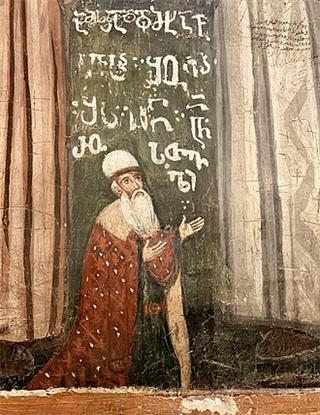
Georgian literature begins with the church. The oldest surviving literary work is the Martyrdom of the Holy Queen Shushanik, written in the 5th century by Iakob Tsurtaveli, in the period of Early Old Georgian. The writings of the Georgian Orthodox Church used the two old scripts, Asomtavruli, “capitals”, and Nuskhuri, “small letters”, together as upper and lower case, a pairing called Khutsuri, the “priest alphabet”. In the 11th century Leonti Mroveli wrote down the traditional account of the origin of the Georgian script.
The most famous work of Middle Georgian is The Knight in the Panther’s Skin, an epic poem written by Shota Rustaveli in the 12th century. The first printed books written partly in Georgian were Nikoloz Cholokashvili’s Alphabetum Ibericum sive Georgianum cum Oratione and Dittionario giorgiano e italiano of 1629.
Among modern works, one of the most important Georgian dictionaries is the Explanatory dictionary of the Georgian language, eight volumes with about 115,000 words, produced between 1950 and 1964 by a team of linguists under the direction of Arnold Chikobava. Asomtavruli and Nuskhuri now survive mostly in religious documents and architecture, and capital-like Mtavruli letters appear in page headings, chapter titles and monumental inscriptions.
Change & Descendants
The history of Georgian is conventionally divided into four phases: Early Old Georgian (5th–8th centuries), Classical Old Georgian (9th–11th centuries), Middle Georgian (11th/12th–17th/18th centuries) and Modern Georgian, from the 17th or 18th century to the present. By the 11th century Old Georgian had developed into Middle Georgian. Some sounds merged on the way: the Old Georgian uvular qʰ, written ჴ, has become the velar x, written ხ, in the modern language.
The scripts changed too. Mkhedruli is now almost completely dominant. Its 33 letters in common use correspond closely to the sounds of the language, and about half a dozen more are obsolete in Georgian. Mkhedruli has no capital letters, but a capital-like effect called Mtavruli, “title” or “heading”, is made by drawing the letters at one height, resting on the line with no descenders.
Georgian keeps a rich system of word building from roots. From -ts’er-, “write”, come ts’erili, “letter”, and mts’erali, “writer”; from -shen-, “build”, comes shenoba, “building”. Verbs can be made from nouns, as omob, “you wage war”, from omi, “war”, and from adjectives, as galamazeba, “becoming beautiful”, from lamazi, “beautiful”. Endings can also squeeze a word: megobari, “friend”, loses a vowel in megobrebi, “friends”.
Legacy
Georgian remains the state language of Georgia and a shared literary language for the speakers of the Kartvelian languages. Its alphabet has served its relatives too: letters long obsolete in Georgian are still used for Mingrelian, Laz and Svan. Mkhedruli is the script of everyday writing, and the standard Windows keyboard for it is essentially that of manual typewriters.
The language’s roots show in the names of the people and the land: from the root -kart- come Kartveli, “a Georgian person”, Kartuli, “the Georgian language”, and Sakartvelo, “the country of Georgia”. Its counting is vigesimal, based on twenty like Basque and, in part, French: numbers between 20 and 100 are said as the largest multiple of twenty plus the remainder.
Georgian draws the attention of linguists for its consonant clusters, many of which break the sonority sequencing principle, the usual rise of sounds in loudness towards the vowel. Among them are “harmonic clusters”, pairs of consonants of the same kind, both voiced, aspirated or ejective, as bg in bgera, “sound”. Its stress and word order are still studied: Stavros Skopeteas and colleagues found that Georgian tends to put the focus of a sentence just before the verb and the topic before the focus, and the grammars of Howard I. Aronson and B. G. Hewitt describe the language for learners and linguists.
In the Research Series
Georgian is the most widely spoken Kartvelian language and the official language of Georgia, with about 3.8 million speakers. It became a written language after the Christianisation of the Kingdom of Iberia in the 4th century, its oldest literary work dates from the 5th century, and its most famous work is Shota Rustaveli’s 12th-century epic The Knight in the Panther’s Skin.
References
- Aronson, Howard I. (1990). Georgian: A Reading Grammar (2nd ed.). Columbus, OH: Slavica.
- Hewitt, B. G. (1995). Georgian: A Structural Reference Grammar. Amsterdam: John Benjamins.
- Hewitt, B. G. (1996). Georgian: A Learner’s Grammar. London: Routledge.
- Fähnrich, Heinz (2013). Die ältesten georgischen Inschriften [The oldest Georgian inscriptions]. Leiden: Brill.
- Testelets, Yakov G. (2020). “Kartvelian (South Caucasian) Languages”. In Polinsky, Maria (ed.), The Oxford Handbook of Languages of the Caucasus, pp. 491–528.
- Shosted, Ryan K.; Chikovani, Vakhtang (2006). “Standard Georgian”. Journal of the International Phonetic Association 36 (2): 255–264.