
Language · Europe
Gothic
At a glance
- Gothic is the earliest Germanic language attested in sizeable texts, almost all of them copies of the Bible translated in the 4th century for the Visigothic Christians of Moesia under their Arian bishop Ulfilas.
- It is closer to Proto-Germanic than any other Germanic language except the scanty Ancient Nordic runic inscriptions, keeping a dual on its verbs, a passive voice and reduplicated past tenses that the others lost.
- It declined from the mid-6th century, after the Goths’ defeat by the Franks and their elimination in Italy; in Spain it lost its last role as a church language in 589 and lived on at home only into the 8th century.
Timeline
- 4th centuryUlfilas, Arian bishop of the Visigothic Christians in Moesia, commissions a translation of the Greek Bible into Gothic, in an alphabet most likely of his own making
- early 6th centuryThe Visigoths lose Occitania, where they had used the Gothic Bible
- 6th centuryThe Codex Argenteus, the best-preserved Gothic manuscript, is copied and kept by the Ostrogoths in Italy
- mid-6th centuryGothic is in decline after the Goths’ defeat by the Franks and their elimination in Italy
- 589The Visigoths convert from Arianism to Nicene Christianity, and Gothic loses its last role as a church language in Spain
- 8th centuryGothic is still spoken at home in the Iberian Peninsula, its last attested use there
- 840–842Walafrid Strabo reports that peoples around Tomis still speak the language of the Gothic Bible and use it in their liturgy
- mid-9th centuryGraffiti in the Gothic alphabet are written in the basilica of Mangup in Crimea, perhaps its youngest attestation
Origins

Gothic was the language of the Goths. The standard theory of the Germanic languages places it in the East Germanic branch, beside a few very scantily attested languages, apart from North Germanic (Old Norse and its descendants) and West Germanic (Old English, Old High German and the rest). Some scholars join the other two as Northwest Germanic, on the hypothesis that Gothic was the first to branch off. A minority, the Gotho-Nordic hypothesis, groups East and North Germanic, partly because the 6th-century writer Jordanes ascribed a Scandinavian origin to the Goths. The Polish linguist Witold Mańczak argued instead that Gothic is closest to Upper German, and that the Goths’ homeland lay in the south of the Germanic lands, near present-day Austria.
A few runic inscriptions found across Europe are known or suspected to be Gothic, among them the gold ring of Pietroasa, though some scholars doubt that any of them are. The oldest documents date from the fourth century and come from the work of Ulfilas, or Wulfila (311–382), the Arian bishop of a community of Visigothic Christians in the Roman province of Moesia, in present-day Serbia, Bulgaria and Romania. He commissioned a translation of the Greek Bible into Gothic, apparently made in the Balkans by several scholars in close contact with Greek Christian culture, and most likely invented an alphabet for it. Because the Goths were converted early, runic writing was soon replaced by this new script.
Sounds, Script & Grammar
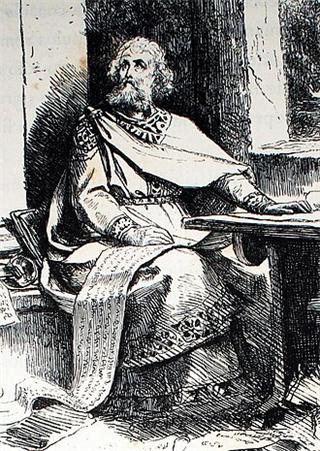
The Gothic alphabet was most likely invented by Ulfilas himself. Some scholars, such as Braune, derive it from the Greek alphabet alone; others see some letters of runic or Latin origin. It wrote long i as ei, after Greek usage, and had single letters for sounds such as ƕ, a voiceless w, as in ƕan ‘when’, and q, a kw sound, as in qiman ‘to come’. Scholars transliterate it into Latin letters, often adding accents and macrons to show how a vowel sounded or where it came from.
The grammar keeps much of its Indo-European inheritance. Nouns and adjectives had four cases (nominative, accusative, genitive and dative) with traces of a vocative, three genders and two numbers, in many declensions by the form of the stem. Pronouns and verbs kept a dual, a form for exactly two: wit meant ‘the two of us’, weis ‘we’ of more than two. Verbs had an active and a medial voice, a present and a preterite, and three moods; weak verbs formed the past with -da or -ta, strong ones by changing the root vowel, as in giban ‘to give’ and gaf, or by reduplication, repeating the first consonant of the root, as in saian ‘to sow’ and saiso.
Gothic also lacks changes found in all later Germanic languages: there is no umlaut, so fotus ‘foot’ has the plural fotjus where English has feet, and the old z did not become r. Small particles such as -u, which marks a question, stood second in the sentence and could even split a verb from its prefix: ga-u-láubjats, ‘do you both believe…?’.
Speakers & Spread
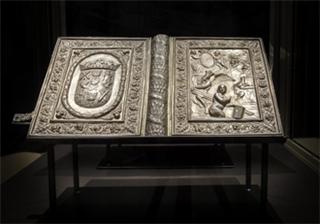
Gothic texts were carried by both great branches of the Goths. The Bible was translated among the Visigothic Christians of Moesia, while the Codex Argenteus was preserved and passed on by northern Ostrogoths in present-day Italy. The Gothic Bible was apparently used by the Visigoths in Occitania until they lost it at the start of the 6th century, in Visigothic Iberia until about 700, and perhaps for a time in Italy, the Balkans and Ukraine until at least the mid-9th century.
The language was in decline by the mid-6th century, partly because of the Goths’ military defeat by the Franks, their elimination in Italy, and geographic isolation. In Spain it lost its last, probably already declining, role as a church language when the Visigoths converted from Arianism to Nicene Christianity in 589, though it survived as a language of the home in the Iberian Peninsula as late as the eighth century. In 840–842 the Frankish monk Walafrid Strabo wrote of monks who reported that certain peoples of Scythia, in the Dobruja around Tomis, still spoke the language of the Gothic Bible and used it in their liturgy.
A language called Crimean Gothic survived in Crimea into the second half of the 18th century, but it lacks certain sound changes of Gothic and so cannot descend directly from the language of the Codex Argenteus. Medieval writers often used the word Goths for any Germanic people of eastern Europe, such as the Varangians, and some even for Slavic speakers.
Literature & Learning
Only a few documents in Gothic survive, not enough for a complete reconstruction of the language, and most are translations from Greek. The largest part comes from the Bible of Ulfilas, of which roughly three-quarters of the New Testament and some fragments of the Old Testament survive, in codices mostly of the 6th century, long after he died. The finest is the Codex Argenteus, now in Uppsala, 188 leaves holding a large part of the four gospels; its language is full of Greek words and usages, and its syntax often copies the Greek directly. The Codex Ambrosianus in Milan and the Codex Taurinensis in Turin, 193 leaves in five parts, hold passages from the gospels, the Epistles and Nehemiah.
Smaller pieces add to them: a Gothic-Latin leaf of Luke found at Arsinoë in Egypt in 1907 and destroyed by water damage in 1945, after it had been copied; four leaves of Romans at Wolfenbüttel; a lead plate from Pannonia with verses of the gospels; a calendar, glosses, and two deeds on papyrus from Naples and Arezzo. The only lengthy text known to have been composed in Gothic is the Skeireins, a few pages of commentary on the Gospel of John.
New finds still appear. The Gothica Bononiensia, a palimpsest discovered in 2009, holds what seems to be a sermon quoting parts of the Bible not otherwise known in Gothic, such as Psalms and Genesis. Five graffiti discovered in 2015 in the basilica of Mangup in Crimea, from the mid-9th century, include a quotation of Psalm 76 and prayers in a language hardly different from Wulfila’s.
Change & Descendants
Gothic is known almost only in one form, the language of Ulfilas’s translation as copied two centuries later, so little can be said of how it changed over time. Its sounds, though, show change in progress. Latin writers rendered Germanic au in Gothic names as au until the 4th century and as o later, so that Austrogoti became Ostrogoti, which suggests that the old diphthongs had only just become simple vowels when Gothic spelling was fixed. Gothic used a stress fixed on the first syllable of simple words in place of the free accent of Proto-Indo-European, and shortened or lost vowels in unstressed final syllables. A change found in no other Germanic language turned fl into þl in some words, as in þliuhan ‘flee’.
For the history of the Germanic languages Gothic is a fixed point. It is significantly closer to Proto-Germanic than any other Germanic language except the scantily attested Ancient Nordic runic inscriptions, and it serves as the primary foundation for reconstructing Proto-Germanic, which departs from Gothic only where other branches clearly show the Gothic form to be secondary. Features it shares with Old Norse, such as Holtzmann’s Law, which gave Gothic triggws ‘faithful’ and Old Norse tryggr beside English true, have been taken as signs of a special link, but most are shared retentions, which do not prove one.
Gothic left no descendants. It faded after the defeats of the 6th century, its last traces the home speech of 8th-century Iberia and the liturgy reported around Tomis and written at Mangup in the 9th century.
Legacy
Gothic words live on in other languages. Reconstructed Proto-Slavic has several apparent borrowings from East Germanic, presumably Gothic, such as *xlěbъ ‘bread’, beside Gothic hlaifs. The Romance languages keep others: Portuguese ganso ‘goose’ from Gothic *gans, luva ‘glove’ from lōfa ‘palm of the hand’, trégua ‘truce’ from triggwa ‘treaty, covenant’ and agasalho ‘warm clothing’ from *gasalja ‘companion’; French broder ‘to embroider’ and gaffe; and Italian bega ‘quarrel’.
Because its texts are so early, Gothic is of considerable interest in comparative linguistics. The Romantic age also wrote in it: on 10 February 1841 the Bavarian Academy of Sciences and Humanities published a reconstruction in Gothic of the Creed of Ulfilas, and Hans Ferdinand Massmann, the first publisher of the Skeireins, wrote an alliterative poem in Gothic for a feast in honour of Thorvaldsen that year, having translated the student song Gaudeamus into it in 1837.
Writers have kept it alive as a language of play. J. R. R. Tolkien wrote “Bagme Bloma”, ‘Flower of the Trees’, published privately in 1936, and Gothic was the primary inspiration for his invented language Taliska. Thomas le Marchant Douse put part of Pilgrim’s Progress into Gothic in 1886, David Carlton translated Alice in Wonderland in 2015, and in 2026 a Gothic language option was added to Minecraft.
Gothic was the East Germanic language of the Goths, known almost entirely from the Bible translation commissioned by Bishop Ulfilas in the 4th century and copied in the 6th. Closer to Proto-Germanic than any other recorded Germanic language, it declined after the Goths’ defeats in the 6th century, lingered in Iberia into the 8th and in liturgy into the 9th, and left no descendants.
References
- Prokosch, Eduard, A Common Germanic Grammar
- Wright, Joseph, Grammar of the Gothic Language
- Douse, Thomas le Marchant, An Introduction, Phonological, Morphological, Syntactic to the Gothic of Ulfilas (1886)