
Language · Oceania
Hawaiian
At a glance
- Hawaiian grew from the speech of Polynesian settlers, Marquesans arriving in roughly 300 CE by one account, and is closest to Marquesan and Tahitian.
- Written down by New England missionaries from the 1820s, it became the language of a literate kingdom, of its constitution, newspapers and schools.
- After the overthrow of the monarchy, the Republic of Hawaii’s Act 57 of 1896 made English the language of the schools and children were punished for speaking Hawaiian; immersion schools since 1984 have begun to bring it back.
Timeline
- c. 300Marquesans colonise the Hawaiian Islands, by one account, followed by later waves from the Society Islands and Samoa-Tonga
- 1778James Cook’s expedition makes Europe’s first recorded contact with Hawaiʻi and writes the island’s name as Owhyhee
- 1820Protestant missionaries from New England arrive and set about creating a written Hawaiian
- 1834The first Hawaiian-language newspapers are published
- 1839The Hawaiian Bible is completed, and King Kamehameha III establishes the first Hawaiian-language constitution, in 1839 and 1840
- 1896The Republic of Hawaii’s Act 57 makes English the medium of instruction in all public and private schools
- 1984The ʻAha Pūnana Leo opens its first Hawaiian-language immersion preschool
- 1987Hawaiian is again allowed as a medium of instruction in public schools, after 91 years
Origins
Hawaiian, ʻŌlelo Hawaiʻi in the language itself, is a Polynesian language of the Austronesian family, native to the Hawaiian Islands and the historic language of the Hawaiian people. Its relatives include Samoan, Marquesan, Tahitian, Māori, Rapa Nui and Tongan. According to Albert Schütz, Marquesans colonised the archipelago in roughly 300 CE, followed by later waves from the Society Islands and Samoa-Tonga, and their languages in time became Hawaiian. Linguists agree that it is closely related to Eastern Polynesian, with a particularly strong link to the Southern Marquesas and a secondary one to Tahiti, perhaps from voyaging between Hawaiʻi and the Society Islands. A 1962 study by Jack H. Ward found Hawaiian 41.2% mutually intelligible with Marquesan, 37.5% with Tahitian, 25.5% with Samoan and 6.4% with Tongan.
For centuries Hawaiian was spoken, not written: apart from petroglyph symbols the Hawaiians had no writing before Western contact. Religion, traditions, history and their view of the world passed from generation to generation in stories and in hula, which, in Nathaniel B. Emerson’s words, “kept the communal imagination in living touch with the nation’s legendary past”.
The language takes its name from the largest island, Hawaiʻi. When James Cook’s crew first wrote it, in 1778, they spelled it Owhyhee, catching the little word ʻo that comes before a proper name: ʻO Hawaiʻi, “[This] is Hawaiʻi”.
Sounds, Script & Grammar
Hawaiian has very few consonants, only eight: m, n, p, k, the glottal stop, w, l and h, several with more than one pronunciation. Its k is also heard as t, and w as v; this t–k variation is unusual among the world’s languages, and arose after the old k had become a glottal stop and the old t moved towards k. The glottal stop, a catch in the throat like the break in English oh-oh, is a true consonant, written with the ʻokina, so that Hawaiʻi and Oʻahu show where it falls. There are five short and five long vowels, the long ones marked with the kahakō, a macron, plus diphthongs. Every syllable is a vowel or a consonant and a vowel, so words end only in vowels.
The grammar works with small words rather than endings. Hawaiian is analytic, with no inflection of verbs, and its order is verb, subject, object. Particles around the verb mark tense, aspect and mood: ua for a completed action, e … ana for one not complete, ke … nei for one going on, mai for “do not”. Nouns take articles, ka or ke for “the” and nā for the plural, as ka honu, “the turtle”, and nā honu, “the turtles”. Pronouns distinguish singular, dual and plural, and an inclusive from an exclusive “we”.
The language is rich in names for the natural world, with thousands for kinds of wind, rain, sea, mountain peaks and sky: hoʻomalumalu is a “sheltering cloud”, hoʻoweliweli a “threatening cloud”.
Speakers & Spread

Cook’s arrival in 1778 began a new phase for Hawaiian. Over the next forty years Spanish, Russian, French and German arrived with explorers and merchants, and Hawaiians who took jobs on their ships carried the language abroad. One of them, the teenage ʻŌpūkahaʻia, known as Obookiah, reached New England, studied at the Foreign Mission School in Cornwall, Connecticut, inspired the mission to Hawaiʻi and told the missionaries about the language before they sailed in 1819.
Under the kingdom Hawaiian was a written national language. Literacy spread so fast that the minister of Public Instruction, Richard Armstrong, boasted in his report for 1853 that 75% of adults could read, and the use of the language may have peaked around 1881. Yet native speakers declined from the 1830s to the 1950s, and as early as 1854 some feared it was “soon destined to extinction”. Native Hawaiians were becoming a minority in their own land as foreign labourers arrived: pure Hawaiian students made up 56% of school enrolment in 1890, 32% in 1900 and 16.9% in 1910. Mixed households, where Hawaiian had low prestige, adopted English, and children of many mother tongues spoke English, or Pidgin, together; within a generation it was the main language of all children.
In 2001 native speakers were less than 0.1% of the state’s people. English has largely displaced Hawaiian on six of the seven inhabited islands, and Hawaiian Pidgin is more spoken than Hawaiian; only on Niʻihau, off Kauaʻi, is it still the language of daily life.
Literature & Learning
Hawaiian literature began as oral tradition, and its writing began with the Bible. Protestant missionaries from New England arrived in 1820 and within a few years converted the chiefs, who converted their people. A complete Hawaiian Bible required a standard spelling as easy to learn as possible, and literacy spread rapidly. The first thing the missionaries printed in Hawaiʻi, in 1822, was the alphabet itself. Missionaries working with Hawaiians published the first Hawaiian-language newspapers in 1834, a vocabulary in 1836, a grammar in 1854 and a dictionary in 1865, Lorrin Andrews’s A Dictionary of the Hawaiian Language; the Bible was complete in 1839. In Berlin Adelbert von Chamisso published his grammar Über die Hawaiische Sprache in 1837.
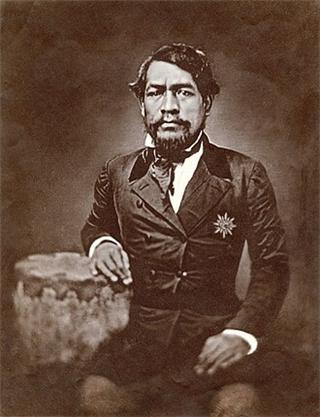
The kingdom governed in Hawaiian. King Kamehameha III established the first Hawaiian-language constitution in 1839 and 1840, and in 1840, taking over the mission’s schools, the legislature made state-funded education compulsory for all children under 14, girls included, twelve years before any such law in the United States. A law of 1842 required those born after 1819 to be literate before they could marry. By 1887 Liliʻuokalani’s song “Aloha ʻOe” was already famous in the United States.
Scholars kept the language on record: William DeWitt Alexander’s grammar of 1864 treated the glottal stop as a true consonant, and the Andrews-Parker dictionary followed in 1922.
Change & Descendants
Hawaiian took shape through sound changes from its Polynesian parent: the glottal stop developed from an old k, and the loss of consonants between vowels gave Hawaiian its long vowels and diphthongs. Its dialects have never been systematically studied; Samuel Elbert and Mary Kawena Pukui called that of Niʻihau “the most aberrant and the one most in need of study”.
Contact transformed the written language. The missionaries’ first alphabet had B, D, R, T and V beside the present consonants; in 1826 they voted to drop letters for interchangeable sounds, coming close to one letter for one sound, so that a word once spelled pule, bule, pure and bure became pule alone. Hundreds of words were borrowed rapidly from English, Greek, Hebrew, Latin and Syriac, sometimes keeping their foreign letters: Brazil became Palakila, or Barazila. The glottal stop was marked only now and then from 1823, as with an apostrophe to tell koʻu, “my”, from kou, “your”; the ʻokina became usual only in later dictionaries, and its use still varies.
Today the Hawaiian of most elders and the Hawaiian taught in schools, sometimes called “University Hawaiian”, differ so much that some Native Hawaiian children feel scared or ashamed to speak it at home, and there is debate over which is authentic. A university Lexicon Committee coins words for new things, such as “computer” and “cell phone”, which the Niʻihau dialect, coining its own, generally does not take up.
Legacy
The suppression of Hawaiian followed the coup that overthrew the Hawaiian monarchy. Act 57 of the 1896 Laws of the Republic of Hawaiʻi made English “the medium and basis of instruction in all public and private schools”. The law did not make Hawaiian illegal, but it was taken as licence to extinguish the language in early schooling: children who spoke it, even on the playground, were disciplined, with corporal punishment and visits to their homes urging them to stop speaking it there. From 1900 Mary Kawena Pukui was rapped on the forehead, fed only bread and water at lunch and denied home visits for speaking it, and in 1937 Winona Beamer was expelled from the Kamehameha Schools for chanting in Hawaiian. Not until 1987, 91 years later, was Hawaiian again a medium of instruction in public schools.
Revival came slowly, then strongly. In 1949 the territorial legislature commissioned Pukui and Samuel Hoyt Elbert to write a new dictionary, published in 1957; the Hawaiian renaissance of the 1970s followed, and in 1984 the ʻAha Pūnana Leo, “language nest”, opened its first preschool, where elders spoke Hawaiian to children every day. Immersion schools followed, and a college of Hawaiian language at Hilo is the only one in the United States offering master’s and doctoral degrees in an Indigenous language.
Hawaiian is official, with English, in the state of Hawaiʻi. The 2011 census counted 2,000 native speakers among 24,000 fluent ones, yet UNESCO still classes the language as critically endangered.
In the Research Series
Hawaiian is the Polynesian language of the Hawaiian Islands, brought by voyagers perhaps in roughly 300 CE and first written by New England missionaries in the 1820s, after which literacy spread quickly. After the monarchy was overthrown, the 1896 law making English the language of the schools hastened its decline; since the 1970s a revival and immersion schools have brought new speakers, though it remains critically endangered.
Test yourself
5 questions on this page, from its key events and facts.
The questions open here once the page has loaded.
References
- Albert J. Schütz, The Voices of Eden: A History of Hawaiian Language Studies (University of Hawaiʻi Press, 1994)
- Samuel H. Elbert and Mary Kawena Pukui, Hawaiian Grammar (University Press of Hawaii, 1979)
- Mary Kawena Pukui and Samuel H. Elbert, Hawaiian Dictionary (University of Hawaiʻi Press, 1986)
- Lorrin Andrews, A Dictionary of the Hawaiian Language (Henry M. Whitney, 1865)
- Leanne Hinton and Kenneth Hale, The Green Book of Language Revitalization in Practice (Academic Press, 2001)