Inventions & Discoveries · Writing and counting
Clay tokens
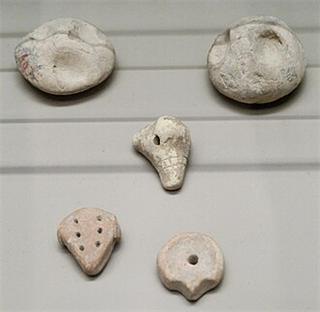
Clay tokens are small shaped pieces of clay that stood for animals and goods, first used to keep records in the ancient Near East around 8000–7500 BCE; the earliest known come from the Zagros region of Iran. For trade they were sealed in hollow clay balls, or bullae, to prevent deception. Marks impressed and later drawn on clay tablets replaced them, and around 3100 BCE, when signs for numbers appeared, the tokens gave way to pictographic tablets, the beginning of Sumerian cuneiform.
On the inventions tree
- First known
- c. 8000 BCE
- Where
- The Zagros, Iran
Built onAgriculturec. 10,000 BCE
Led toCuneiformc. 3300 BCE
Mentioned in 1 profile
See also







Cite this entry
- APA
- The Epoch Institute. (2026). Clay tokens. In The Epoch Institute Encyclopedia. https://the-epoch-institute.org/encyclopedia/clay-tokens
- MLA
- “Clay tokens.” The Epoch Institute Encyclopedia, The Epoch Institute, 2026, https://the-epoch-institute.org/encyclopedia/clay-tokens. Accessed .
- Chicago
- The Epoch Institute. “Clay tokens.” The Epoch Institute Encyclopedia. 2026. https://the-epoch-institute.org/encyclopedia/clay-tokens.
- Harvard
- The Epoch Institute (2026) ‘Clay tokens’, The Epoch Institute Encyclopedia. Available at: https://the-epoch-institute.org/encyclopedia/clay-tokens (Accessed: ).
Last reviewed October 2026Random entry ↻