
Language · South & Southeast Asia
Malay
At a glance
- Malay is an Austronesian language whose ancestor, Proto-Malayic, was spoken in western Borneo at least by 1000 BCE; its oldest record is the Kedukan Bukit inscription of 683 in Sumatra.
- Srivijaya spread Old Malay as a lingua franca of traders; under the Malacca Sultanate (1402–1511) it took in Arabic words with Islam and became Classical Malay, the language of courts and letters.
- Written first in Indian-derived scripts, then in Jawi and now mainly in the Latin script, Malay is spoken by close to 300 million people as Standard Malay and as Indonesian.
Timeline
- 683The Kedukan Bukit inscription near Palembang, the earliest known stone inscription in Old Malay, is written in the Pallava script
- c. 1303The Terengganu Inscription Stone, the earliest evidence of Classical Malay and of Jawi writing, urges the spread of Islam and sets out ten Sharia laws
- 1345–1377In the reign of Adityawarman of the Melayu Kingdom the Tanjung Tanah Law, a pre-Islamic legal text, is produced for the Minangkabau
- 1402–1511Classical Malay becomes the lingua franca of the region under the Malacca Sultanate
- 1511The Portuguese capture Malacca; the court moves to Johor and Malay literary centres scatter across the archipelago
- 1824The Anglo-Dutch Treaty divides the Malay world between Dutch and British rule, both of which use Malay to centralise and modernise
- 1945Indonesia’s constitution makes Indonesian, developed from Riau Malay, the national language
- 1968Malay becomes the sole official language of Peninsular Malaysia
Origins

Malay belongs to the Austronesian family, which stretches from Southeast Asia across the Pacific and includes Malagasy, spoken far to the west in Madagascar. Malay is one of its more conservative members: many of its roots have come down with little change from Proto-Austronesian, and its words for kinship, health, body parts, common animals and above all numbers resemble those of its distant relatives. Proto-Malayo-Polynesian, the descendant of Proto-Austronesian from which Malay comes, began to break up by at least 2000 BCE, possibly as Austronesian peoples spread south from Taiwan into Maritime Southeast Asia.
Malay historical linguists agree that the homeland of the Malayic languages was probably western Borneo, where Proto-Malayic, argued to be the ancestor of all of them, was spoken at least by 1000 BCE. Malay traders from Sumatra later carried the Malayic languages across Malaya and the Indonesian archipelago.
The first written Malay is Old Malay, believed to be the ancestor of Classical Malay. Its earliest known stone inscription, found by the Dutchman C. J. Batenburg in 1920 at Kedukan Bukit on the Tatang River near Palembang in South Sumatra, is written in the Pallava variety of the Grantha alphabet and dated 1 May 683. Old Malay was influenced by Sanskrit, the ancient Indo-Aryan language of India, and its vocabulary already holds Sanskrit loanwords.
Sounds, Script & Grammar
Malay has been written in several scripts. Old Malay used the Pallava and Kawi scripts, known from inscription stones, and Rencong was also used. From the era of the kingdom of Pasai and through the golden age of Malacca, Jawi, an Arabic script, gradually replaced them, and from the 17th century, under Dutch and British influence, Jawi gave way in turn to Rumi, the Latin script. Rumi is now official in Malaysia, Singapore and Indonesia and is the most used; Jawi is co-official in Brunei and Malaysia and is used fully in the religious schools.
Malay originally had four vowels; Standard Malay now has six, as i split into i and e and u into u and o. A rule of vowel harmony, by which the vowels of a word must agree, requires the non-open vowels of two-syllable words to match in height, so hidung, “nose”, is allowed but *hedung is not.
The grammar is agglutinative: new words are made by adding affixes to a root, by compounding and by reduplication, the repeating of a word or part of it. There is no grammatical gender, so dia means both “he” and “she”, and no grammatical plural, so orang is “person” or “people”. Verbs are not marked for person, number or tense; time is shown by words such as sudah, “already”, and belum, “not yet”, while a rich set of verb affixes marks voice and whether an act was intended or accidental.
Speakers & Spread
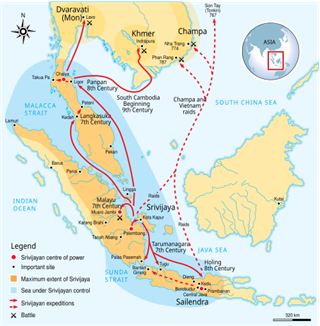
For centuries Srivijaya, a maritime empire based on Sumatra from the 7th to the 11th centuries, spread Old Malay through the Malay Peninsula and the archipelago by its expansion and economic power, and Old Malay served as the lingua franca of traders in ports and markets across the region. Under the Malacca Sultanate (1402–1511), a hub of international trade and Islamic learning on the Strait of Malacca, Classical Malay became the lingua franca of the region.
After the Portuguese captured Malacca in 1511, the royal court re-established itself as the Johor Sultanate and kept Classical Malay as its language of literature and government. In the 19th century the Anglo-Dutch Treaty of 1824 divided the region: the Dutch colonised the East Indies to the south, while the British held colonies and protectorates in the peninsula and Borneo to the north. Both powers used Malay as a tool of centralisation and modernisation, and each drew on the other’s scholarship to standardise it.
Today Malay is spoken as a first language by about 80 million people and as a first or second language by close to 300 million, in Brunei, Indonesia, Malaysia, Singapore, Timor-Leste, the southeastern Philippines and southern Thailand. Most people of Thailand’s five southernmost provinces, once largely part of the Malay kingdom of Pattani, speak a dialect called Yawi, which has no official status. The Batavian and eastern varieties are sometimes regarded as creoles, as their speakers are not ethnically Malay.
Literature & Learning

The written tradition of Malay begins with inscriptions. After Srivijaya came the Hindu-Buddhist Melayu Kingdom of Sumatra, where during the reign of Adityawarman (1345–1377) the Tanjung Tanah Law, a pre-Islamic legal text, was produced for the Minangkabau people. The Terengganu Inscription Stone, a granite stele dated to about 702 AH (1303 CE), is the oldest known evidence of Jawi writing and the earliest of Classical Malay: in it a ruler called Seri Paduka Tuan urges his subjects to uphold and spread Islam and sets out ten basic Sharia laws.
Under the Malacca Sultanate the language developed rapidly under the influence of Islamic literature, taking in a mass of Arabic vocabulary while it went on drawing words from Sanskrit and Tamil, and in this time it became recognisable to speakers of modern Malay. Classical Malay, also called Court Malay, was the literary standard of Malacca and then of Johor, which is why it is sometimes called Malacca, Johor or Riau Malay. Letters were written in it too, among them those of Sultan Abu Hayat of Ternate to the king of Portugal around 1521–1522, after contact with the explorer Francisco Serrão.
The fall of Malacca scattered the literary centres, as writers and scholars fled to places beyond the reach of European colonial powers, and new Malay works began to appear in Aceh, Java, Makassar, the Moluccas and Champa. The flourishing of pre-modern Malay literature in the 19th century led to new intellectual movements and new communities of Malay linguists.
Change & Descendants
The history of Malay is divided into five periods: Old Malay, the Transitional Period, Classical Malay, Late Modern Malay and Modern Malay. Old Malay, rich in Sanskrit loans, led to Classical Malay, shaped by Islam and Arabic in the age of Malacca, and from Classical Malay came a lingua franca on which several Malay trade and creole languages, such as Ambonese Malay, are based.
Malay is a macrolanguage: a dialect continuum of mutually intelligible varieties with no traditional name in common, some of which their speakers count as separate languages. Brunei Malay and Kedah Malay are not readily intelligible with the standard. Eastern varieties differ clearly from western ones: kita means “we, us” in the west but “I, me” in Manado, where “we” is torang, shortened from kita orang, “we people”, and “my name” is kita pe nama rather than the western namaku.
Several varieties became national standards. Malaysia, Singapore and Brunei use Standard Malay, called Bahasa Melayu or in Malaysia sometimes Bahasa Malaysia; Indonesia’s standard, Indonesian, developed from the Riau Malay dialect. The two standards differ systematically: Indonesian tends to coin new words from Sanskrit, under Javanese and Balinese influence, and took its terms of administration, business and law from Dutch, while Malaysian and Bruneian Malay prefer Arabic for new words and took those terms from English.
Legacy
Malay has given words to its neighbours. Through early contact with the Philippines, words such as dalam hati, “sympathy”, luwalhati, “glory”, tengah hari, “midday”, and sedap, “delicious”, entered Tagalog and other Philippine languages, and the early settlement of a Cape Malay community in Cape Town brought many Classical Malay words into Afrikaans. Malay itself borrowed from Arabic, above all religious terms, from Sanskrit, Tamil, Chinese and Persian, the languages of a trading hub, and later from Portuguese, Dutch and English.
In the modern states it holds a central place. Malay is the national language of Malaysia by Article 152 of its constitution, the sole official language of Peninsular Malaysia from 1968 and gradually of East Malaysia from 1974, though English is still widely used in business and the superior courts. In Singapore, where Malay was long the lingua franca of many peoples, English has largely replaced it, but it remains the national language: the anthem, Majulah Singapura, is entirely in Malay. Indonesian became the lingua franca of Indonesia’s many islands and peoples, and is a working language of Timor-Leste, governed as a province of Indonesia from 1976 to 1999.
Indonesian is broadcast by the VOA and the BBC, has been taught in Australian schools and universities since the 1950s, and since 2023 has been an official language of the General Conference of UNESCO.
In the Research Series
Malay is an Austronesian language whose oldest record is the Kedukan Bukit inscription of 683 in Sumatra. Carried by the traders of Srivijaya and the court of Malacca, where Islam gave it a wealth of Arabic words, it became the lingua franca of Maritime Southeast Asia. Today, as Standard Malay and as Indonesian, it is spoken by close to 300 million people.
Test yourself
5 questions on this page, from its key events and facts.
The questions open here once the page has loaded.
References
- K. Alexander Adelaar, “Where does Malay come from? Twenty years of discussions about homeland, migrations and classifications”, Bijdragen tot de Taal-, Land- en Volkenkunde 160 (2004)
- Vladimir Braginsky (ed.), Classical Civilizations of South-East Asia (Routledge, 2013; first published 2002)
- E. D. Edwards and C. O. Blagden, “A Chinese Vocabulary of Malacca Malay Words and Phrases Collected between A. D. 1403 and 1511 (?)”, Bulletin of the School of Oriental Studies 6 (1931)
- Richard James Wilkinson, A Malay-English Dictionary (Kelly & Walsh, 1901–1903)