Language · Americas
Quechua
At a glance
- Quechua, a family of closely related languages that grew in central Peru in the first millennium CE, became the common language of the Inca empire, which carried it along the Andes from Ecuador to Chile.
- After the Spanish conquest, missionaries used it to preach across the Andes, spreading it further than ever, and it was written in the Latin alphabet in grammars, sermons, chronicles and plays.
- Spoken today by millions of people in six countries, it is the most widely spoken Indigenous language family of the Americas, and words such as llama, condor, puma and quinoa come from it.
Timeline
- c. 600–1000The Wari state of the central Andes may have carried early Quechua across much of Peru
- 1438The Inca ruler Pachacuti begins the expansion that makes Quechua the language of an empire, by tradition
- 1560Domingo de Santo Tomás publishes the first grammar and dictionary of Quechua
- 1584A catechism in Spanish, Quechua and Aymara becomes the first book printed in South America
- c. 1608The Huarochirí Manuscript records the myths and rituals of an Andean province in Quechua
- c. 1615Felipe Guaman Poma de Ayala completes his illustrated chronicle of Andean life, with passages in Quechua
- 1975Peru makes Quechua an official language
- 2019A doctoral thesis written entirely in Quechua is defended for the first time, at the University of San Marcos in Lima
Origins
Quechua is not a single language but a family of closely related languages and dialects, some of which are not mutually intelligible. Its speakers call it runa simi, “the people’s speech”; the name Quechua probably comes from qhichwa, the temperate valleys of the Andes. Linguists divide it into two main branches: Central Quechua, spoken in the highlands of central Peru, and a second branch that includes the Quechua of northern Peru, Ecuador and Colombia and the Southern Quechua of Cusco, Ayacucho, Bolivia and Argentina. Quechua has been in close contact with the Aymaran languages for many centuries, and they share much vocabulary and structure, though whether they are related by descent is debated.
The diversity of Quechua in central Peru suggests that the family arose there, probably in the first millennium CE. Linguists and archaeologists have linked its early spread to the expansion of the Wari state in the central Andes between about 600 and 1000, though this remains a hypothesis, and to the trade and pilgrimage networks of the region.
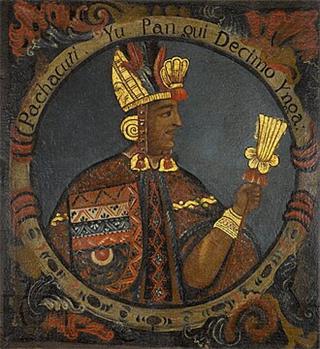
The Incas, whose state grew from the valley of Cusco, adopted Quechua as the common language of their empire; some linguists believe that the Inca nobility had originally spoken another language. From the reign of Pachacuti, who by tradition began the empire’s expansion in 1438, the Incas built in less than a century the largest state of the Americas, Tawantinsuyu, stretching some four thousand kilometres from southern Colombia to central Chile.
The Incas spread Quechua as a language of administration, resettling whole communities across the empire and teaching the language to the sons of conquered rulers in Cusco. They had no writing in the usual sense; their officials kept census, tribute and calendar records on khipus, cords of coloured and knotted strings, which recorded numbers in a decimal system and perhaps other information, a question still studied today.
Sounds, Script & Grammar
Quechua has a simple vowel system of three vowels, a, i and u, which are pronounced more open near the uvular consonant q, much as e and o. Southern Quechua distinguishes plain, aspirated and ejective consonants, so that k, kh and k' are different sounds, a feature it shares with Aymara.
Its grammar is agglutinative: words are built from a root followed by a series of suffixes, each with its own meaning, in a fixed order. Wasi means “house”, wasikuna “houses”, and wasikunapi “in the houses”; a verb can carry suffixes for direction, person, tense, mood and more. The usual word order puts the verb at the end of the sentence.
Quechua obliges its speakers to say how they know what they assert. Suffixes called evidentials mark whether the speaker saw something themselves, with -mi, heard it from others, with -si, or is guessing, with -chá. It also distinguishes two words for “we”: one that includes the person spoken to and one that excludes them.
After the conquest, Spanish priests and Quechua-speaking scholars wrote the language in the Latin alphabet, though spellings varied widely for centuries; modern official alphabets were adopted in Peru and Bolivia in the 20th century. Over five centuries Quechua has borrowed many Spanish words, while keeping its grammar intact.
Speakers & Spread
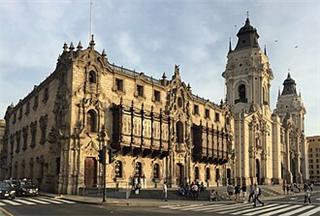
When the Spanish arrived in 1532, Quechua was the common language of the Inca empire, spoken alongside many local languages. The conquerors and above all the Church found it useful: rather than teaching Spanish to millions of Andean people, priests learned Quechua to preach in it. The Third Council of Lima, in 1582 and 1583, adopted a standard form of Quechua for the catechism, and the trilingual catechism printed in Lima in 1584, in Spanish, Quechua and Aymara, was the first book printed in South America. As a result, Quechua spread under colonial rule to regions where it had not been spoken before, such as parts of Bolivia and north-western Argentina.
Quechua-speaking nobles, scholars and writers took part in colonial culture, writing chronicles, poems and plays. After the great rebellion led by Túpac Amaru II in 1780 and 1781, however, the colonial authorities suppressed expressions of Inca identity, and the use of Quechua in writing declined.
After independence, the republics of the Andes were governed in Spanish, and Quechua speakers, most of them rural Indigenous peasants, faced discrimination. In the 20th century, migration to the cities, schooling in Spanish and social pressure led many families to stop passing Quechua to their children.
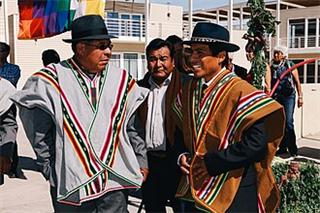
Today Quechua is spoken by perhaps 8 million people, mainly in Peru, Bolivia and Ecuador, where it is called Kichwa, and in smaller numbers in Argentina, Colombia and Chile, making it the most widely spoken Indigenous language family of the Americas. Peru made it an official language in 1975, and Bolivia’s constitution of 2009 recognises it among the country’s official languages; Ecuador’s constitution recognises Kichwa as a language of intercultural relations.
Literature & Learning
The Inca Quechua tradition was oral: songs, prayers, poems of love and mourning, and recitations of history and myth, performed and memorised by specialists. Some of these were recorded by Spanish and Andean writers after the conquest, such as the prayers to the creator god collected by the priest Cristóbal de Molina in the 1570s.
The colonial period produced the first written works in Quechua. Domingo de Santo Tomás published a grammar and dictionary in 1560, and Diego González Holguín a grammar and a great dictionary in 1607 and 1608. Around 1608 an anonymous Andean author wrote the Huarochirí Manuscript, the only extensive text in Quechua describing the myths, gods and rituals of an Andean people, among them the mountain god Pariacaca.
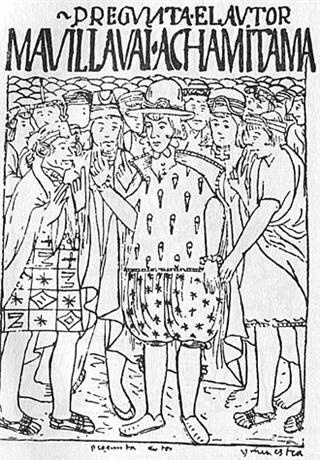
The Andean nobleman Felipe Guaman Poma de Ayala completed around 1615 an immense illustrated chronicle addressed to the king of Spain, written in Spanish mixed with Quechua, which describes Inca history and denounces colonial abuses. Plays were written in Quechua in the 17th and 18th centuries, among them Ollantay, the drama of an Inca general’s love for the daughter of Pachacuti, whose origins and date are still debated.
In the 20th century the Peruvian writer José María Arguedas, who grew up speaking Quechua, wrote poetry in it and translated the Huarochirí Manuscript into Spanish, and a modern Quechua literature of poetry, stories and songs has grown, together with radio, music and online media in the language.
Change & Descendants
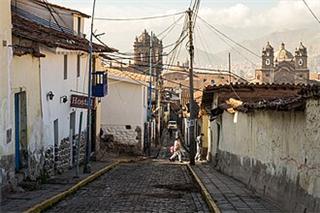
Quechua’s varieties have continued to diverge, and the Quechua spoken in Ecuador, Cusco and central Peru can differ as much as related Romance languages. All have been influenced by Spanish, from which they have borrowed many words, and Andean Spanish has in turn absorbed Quechua words and grammatical features.
Spanish in South America uses many Quechua words: papa, “potato”, choclo, “maize cob”, palta, “avocado”, cancha, “field”, from kancha, “enclosure”, chacra, “farm”, and guagua, “baby”, in the Andes. Through Spanish, Quechua words entered English and many other languages: llama, condor, puma, vicuña, coca, quinoa, guano, pampa and jerky.
Like many Indigenous languages, Quechua has been losing speakers as young people shift to Spanish, and UNESCO considers several of its varieties endangered. Since the late 20th century, intercultural bilingual education, standard alphabets, radio and television programmes, music and online content have sought to strengthen it; in 2016 Peru’s state television began a daily news programme in Quechua.
These efforts aim to give Quechua a place in education, government and modern culture, after centuries in which it was spoken by millions but rarely recognised in official life.
Legacy

Quechua is the language of the Inca empire, the greatest state of the pre-Columbian Americas, and remains at the heart of Andean identity. The names of places, mountains, plants and gods across the Andes, from Cusco and Machu Picchu to the many words for potatoes and maize, carry the memory of the Inca world.
Its colonial texts, such as the Huarochirí Manuscript and Guaman Poma’s chronicle, are among the most important sources for the Andean world before and after the conquest, written from an Andean point of view.
The foods and animals of the Andes, potatoes, quinoa, llamas and alpacas, have spread across the world, and with them Quechua words. Andean music and textiles, rich in Quechua names and meanings, are known far beyond the region.
In 2019 a doctoral thesis written entirely in Quechua was defended at the National University of San Marcos in Lima, founded in 1551, a sign of the language’s growing recognition. Millions of people still speak it at home, in markets and in fields, keeping alive the language of the Incas.
Quechua, a family of Andean languages that grew in central Peru in the first millennium CE, became the common language of the Inca empire and spread further under Spanish rule as a language of preaching. Written in the Latin alphabet since the 16th century, it is spoken today by millions of people from Ecuador to Argentina, the most widely spoken Indigenous language family of the Americas.
References
- Adelaar, W.F.H. with Muysken, P.C. (2004) The Languages of the Andes. Cambridge: Cambridge University Press.
- Cerrón-Palomino, R. (1987) Lingüística quechua. Cusco: Centro de Estudios Rurales Andinos Bartolomé de las Casas.
- Heggarty, P. and Beresford-Jones, D. (eds) (2012) Archaeology and Language in the Andes. Oxford: Oxford University Press for the British Academy.
- Mannheim, B. (1991) The Language of the Inka since the European Invasion. Austin: University of Texas Press.
- Salomon, F. and Urioste, G.L. (trans.) (1991) The Huarochirí Manuscript: A Testament of Ancient and Colonial Andean Religion. Austin: University of Texas Press.
- Urton, G. (2003) Signs of the Inka Khipu: Binary Coding in the Andean Knotted-String Records. Austin: University of Texas Press.