Ancient Near East
Assyrian Empire
At a glance
- From the city of Assur on the Tigris, Assyria grew from a merchant network into the largest empire the world had yet seen.
- Its provinces, royal couriers, siege engineers and mass deportations became models for Babylon and Persia.
- Overstretched and hated by its subjects, it was destroyed by Medes and Babylonians in barely sixty years after its peak.
Rise & Fall
- c. 2025 BCEAssur emerges as an independent city-state after the fall of the Third Dynasty of Ur
- c. 1225 BCETukulti-Ninurta I conquers Babylon and captures its Kassite king
- 911 BCEAdad-nirari II launches the Neo-Assyrian revival
- 745 BCETiglath-pileser III takes the throne and reorganises army and provinces
- 722 BCESamaria falls and the population of the Kingdom of Israel is deported
- 671 BCEEsarhaddon conquers Egypt, bringing the empire to its greatest extent
- 612 BCEBabylonians and Medes destroy the Assyrian capital Nineveh
- 609 BCEAshur-uballit II fails to retake Harran and vanishes from the record
Foundation

The Assyrian Empire's origins trace back to the city of Assur on the west bank of the Tigris in northern Mesopotamia, which emerged as an independent city-state around 2025 BCE following the collapse of the Third Dynasty of Ur. Puzur-Ashur I founded a dynasty that gave remarkable continuity to later Assyrian kingship, though the early centuries were defined by commercial rather than military power: a network of Assyrian merchant colonies in Anatolia, of which the karum at Kanesh (modern Kültepe in Turkey) was the most important, created a commercial reach of extraordinary scope. More than 20,000 cuneiform tablets from Kanesh document Assyrian merchants bringing tin from the east, probably from Iran and Central Asia, and textiles from Babylonia and Assur itself, exchanging them for Anatolian silver and gold; modern estimates suggest that around 100 tons of tin and some 100,000 textiles passed through the network over the half-century best covered by the archives. This was commercial empire rather than territorial conquest, power exercised through trade relationships rather than garrisons. The first phase of territorial ambition came under the Amorite conqueror Shamshi-Adad I (r. c. 1808–1776 BCE), who seized Assur, styled himself "King of the Universe" and built a kingdom of Upper Mesopotamia stretching from the Zagros foothills to the Euphrates and Mari. This kingdom fell apart soon after his death. After a long period of weakness, ending in subjection to Mitanni, the Middle Assyrian kingdom emerged under Ashur-uballit I (r. c. 1365–1330 BCE), who exploited the Hittite defeat of Mitanni to assert independence and claim equality with the great kings of Egypt and Babylon. The empire's greatest phase came with the Neo-Assyrian revival from 911 BCE under Adad-nirari II, culminating in Esarhaddon's conquest of Egypt in 671 BCE, the moment at which Assyria became the largest empire the world had yet seen.
Socioeconomy
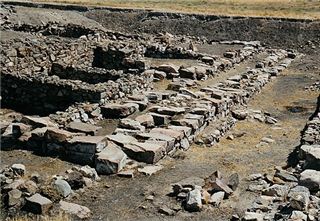
The Assyrian economy underwent fundamental transformations across a history of some fourteen centuries, from the commercial network of the Old Assyrian period to the tribute-extraction system of the Neo-Assyrian Empire. The early period's commercial sophistication, evidenced by thousands of business tablets from Kanesh recording contracts, loans, partnerships and family correspondence, represents one of the earliest examples of organised long-distance private enterprise in world history, with merchants operating under a legal framework that protected contracts and settled disputes through the city assembly of Assur and the colonies' own councils. The Middle and Neo-Assyrian periods shifted the economic model towards agricultural surplus extraction and tribute from conquered peoples: the empire's systematic deportation policy, which moved whole communities from conquered territories to the Assyrian heartland and to under-populated provinces, served both to break potential resistance and to supply agricultural and craft labour where the state needed it. At its peak the Neo-Assyrian economy channelled the agricultural surpluses of Mesopotamia, the timber of Lebanon, the metals of Anatolia, the horses of the Zagros and the luxury goods of Phoenician trade into the construction of enormous royal cities at Nimrud, Khorsabad and Nineveh. The reforms of Tiglath-pileser III from the 740s BCE, which broke up large provinces and turned many vassal states into directly administered territories, greatly increased the flow of revenue to the centre and funded the campaigns that carried the empire to its territorial maximum. The Library of Ashurbanipal at Nineveh, whose remains comprise some 30,000 tablets and fragments, represents the intellectual dimension of this concentration of wealth and learning at the imperial centre.
Military
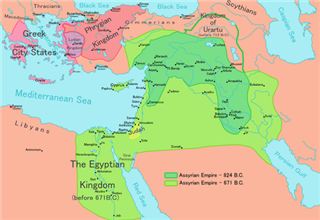
The Assyrian army was the most formidable and systematically organised fighting force of its age, and its innovations in tactics, logistics, siege warfare and intelligence shaped the practice of warfare in the Near East for centuries. The Neo-Assyrian army reorganised under Tiglath-pileser III (r. 745–727 BCE) combined a standing professional core, the kisir sharruti or king's cohort, with provincial levies and allied contingents, organised into specialised units of chariotry, cavalry, infantry, engineers and siege troops, and equipped on a large scale with iron weapons. Assyrian siege warfare was without precedent: engineers deployed wheeled battering rams, siege towers, ramps and mining techniques capable of reducing heavily fortified cities, as the reliefs of Sennacherib's siege of Lachish in 701 BCE vividly record, and the empire's reputation for systematic brutality against resisting populations served as a deliberate psychological weapon to encourage surrender. A network of royal roads, relay stations and informants allowed the king to coordinate operations across an empire spanning thousands of kilometres with a speed unmatched by earlier states. Key military achievements included Tukulti-Ninurta I's conquest of Babylon (c. 1225 BCE) and capture of the Kassite king Kashtiliash IV, which made him the first Assyrian king to rule Babylon, and Esarhaddon's conquest of Egypt in 671 BCE, which made the Neo-Assyrian Empire the largest the world had yet seen. Ashurbanipal's destruction of the Elamite capital Susa around 647 BCE, at the end of a devastating war that ended Elam as a major power, demonstrated the army's capacity for warfare of annihilation. The army's ultimate failure came against the Medo-Babylonian coalition of the 610s BCE, when the combined forces of Cyaxares the Mede and Nabopolassar of Babylon overwhelmed even Assyria's fortified heartland.
Governance & Law
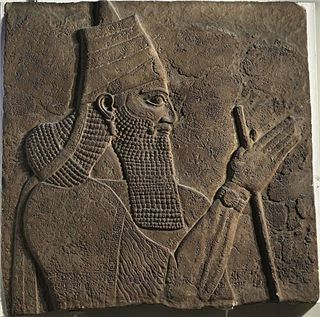
The Assyrian system of government evolved over a millennium and a half from the oligarchic city-state institutions of Old Assyrian Assur, with its city assembly, annual eponym official (limmu) chosen by lot, and council of elders, into the most sophisticated territorial administration the ancient world had yet produced under the Neo-Assyrian kings. The provincial system, most fully elaborated by Tiglath-pileser III from the 740s BCE, divided the empire into provinces under appointed governors answerable directly to the king, many of them eunuchs without dynastic ambitions, curbing the power of hereditary magnates who might develop independent ambitions. A relay system of royal couriers, supplemented by fire signals, connected provincial governors to the palace with a speed that allowed the king to respond to threats within days rather than weeks, and thousands of surviving letters attest to the intensity of this correspondence. Mass deportation was not merely punitive but administratively strategic: it broke the kinship networks that sustained resistance, mixed populations in ways that weakened local identities, and supplied labour where the empire needed it most. Royal ideology was carefully constructed through monumental art and inscription: palace reliefs depicting the king in battle, the hunt and ritual, such as the celebrated lion hunt reliefs of Ashurbanipal now in the British Museum, proclaimed royal power as at once military, cosmic and divinely sanctioned, the king acting as the earthly agent of the god Ashur. Ashurbanipal's library at Nineveh, built up by systematically collecting and copying texts from across Mesopotamia, embodied the ambition of a state that sought to control not merely territory and tribute but the entire scholarly heritage of Mesopotamian civilisation.
Global & Regional Impact
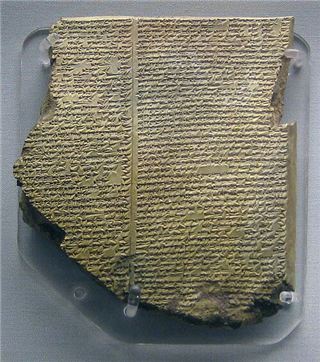
The Assyrian Empire's impact on later civilisation was profound and many-sided, operating through the administrative and military templates it established and the cultural mixing it forced through deportation and conquest. Neo-Assyrian practices, including provincial government, relay communications, intelligence networks and the use of Aramaic alongside Akkadian in administration, were inherited by the Neo-Babylonian Empire and then by the Achaemenid Persians, who built consciously on Mesopotamian imperial precedent. Tiglath-pileser III's deportations from Galilee in 732 BCE and the fall of Samaria in 722 BCE, followed by Sargon II's deportation of the population of the Kingdom of Israel, the "Ten Lost Tribes" of biblical tradition, profoundly marked the history of Israel and Judah; the Assyrian crisis is reflected in the prophetic books of Isaiah, Hosea and Micah, and in the biblical account of Sennacherib's siege of Jerusalem in 701 BCE. The Library of Ashurbanipal, rediscovered at Nineveh by Austen Henry Layard and Hormuzd Rassam in the mid-nineteenth century, preserved the standard version of the Epic of Gilgamesh, one of the oldest surviving works of literature, along with thousands of texts on Mesopotamian divination, medicine and religion that might otherwise have been lost. Assyrian siege techniques and military organisation were adopted successively by the Babylonians and Persians, forming part of a continuous tradition of military engineering that extended to the Hellenistic world. The fearsome reputation Assyria built through its documented brutality, cities razed, populations deported and enemies impaled as shown in palace reliefs, shaped Near Eastern political memory for generations and established deterrence through publicised atrocity as a deliberate instrument of imperial rule.
Decline & Fall
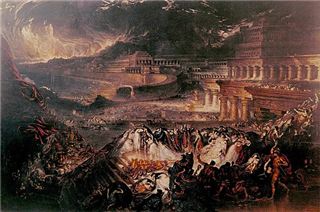
The Neo-Assyrian Empire's collapse was one of antiquity's most dramatic and debated events: a state that had stood at the apex of world power in 671 BCE was annihilated within little more than sixty years, its capital cities destroyed and its ruling class extinguished so thoroughly that no Assyrian successor state emerged. The causes were multiple and mutually reinforcing. Ashurbanipal's long reign (669–c. 631 BCE) left an empire at its greatest extent but overstretched, and the final decades of his rule are so poorly documented that even the date of his death is uncertain. The alienation of conquered peoples, Babylonians who remembered Sennacherib's sacrilegious destruction of their city in 689 BCE, Elamites whose kingdom had been devastated, and the Israelites and other deported populations of the Levant, meant that the empire had accumulated enemies with strong motives for revenge. The civil war of 652–648 BCE between Ashurbanipal and his brother Shamash-shum-ukin, king of Babylon, had already shown the fragility of Assyrian control in the south, and the succession disputes that followed Ashurbanipal's death created the opening that Nabopolassar, traditionally regarded as a Chaldean chieftain, exploited to seize Babylon in 626 BCE and declare independence. His alliance with Cyaxares of Media produced a coalition whose combined strength proved irresistible. The Medes sacked Assur in 614 BCE, the Babylonians and Medes together destroyed Nineveh in 612 BCE, and the last Assyrian king, Ashur-uballit II, abandoned his refuge at Harran in 610 BCE and, after the fall of Harran, failed with Egyptian help to retake it in 609. He then disappears from the historical record without a documented death, an apt ending for an empire that had defined itself by spectacular displays of power and was erased so completely that its great cities lay buried until archaeologists uncovered them in the nineteenth century.
The Assyrian Empire's most enduring legacy is the paradox at its core: the state that made systematic terror an instrument of imperial rule also assembled the first great systematically collected library, preserved the Epic of Gilgamesh for posterity, and established templates of provincial administration and record-keeping on which the empires of the ancient Near East were built.
References
- Grayson, A.K. (1991–1996) Assyrian Rulers of the Early First Millennium BC. 2 vols. Toronto: University of Toronto Press.
- Kuhrt, A. (1995) The Ancient Near East c. 3000–330 BC. London: Routledge.
- Liverani, M. (2017) Assyria: The Imperial Mission. Translated by A. Tramontana. Winona Lake: Eisenbrauns.
- Radner, K. (2015) Ancient Assyria: A Very Short Introduction. Oxford: Oxford University Press.
- Reade, J. (1983) Assyrian Sculpture. London: British Museum Press.
- Saggs, H.W.F. (1984) The Might That Was Assyria. London: Sidgwick and Jackson.
- Tadmor, H. and Landsberger, B. (1994) The Inscriptions of Tiglath-Pileser III, King of Assyria. Jerusalem: Israel Academy of Sciences and Humanities.
Connections
Open the full connections map →