Ancient Near East
Dilmun
At a glance
- A Bronze Age merchant state centred on Bahrain, linking Mesopotamia with the copper of Magan and the luxuries of the Indus.
- Its springs, harbour, stamp seals and weight standard made it the clearing house of Gulf trade around 2000–1750 BCE.
- Later ruled by Kassite governors and then a tributary of Assyria and Babylon, it vanished as a polity in the 6th century BCE.
Rise & Fall
- c. 2500 BCEUr-Nanshe of Lagash records ships of Dilmun bringing him timber
- c. 2050 BCEQal’at al-Bahrain becomes a walled town; temples rise at Barbar
- c. 1750 BCEGulf trade contracts as the Indus cities decline and Babylon rises
- c. 1450 BCEKassite Babylonia installs a governor on Bahrain
- 709 BCEKing Uperi of Dilmun sends gifts to Sargon II of Assyria
- 538 BCEDilmun passes with Babylonia to the Achaemenid Empire
- 1953Danish expedition under P.V. Glob and Geoffrey Bibby begins excavations
Foundation
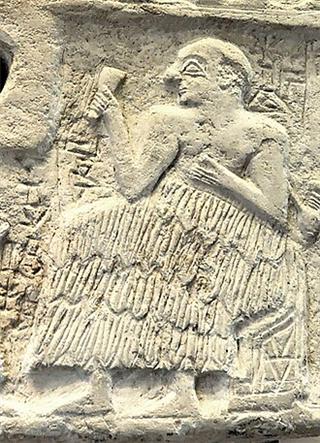
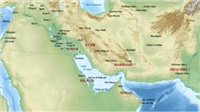
Dilmun is named in Mesopotamian texts long before it can be located with certainty. Archaic tablets from Uruk of the late fourth millennium BCE already mention it, and Ur-Nanshe of Lagash (c. 2500 BCE) recorded that the ships of Dilmun brought him timber from foreign lands. Sargon of Akkad later boasted that ships from Dilmun, Magan and Meluhha moored at the quay of his capital Agade. In the third millennium the name probably covered parts of the eastern Arabian coast, including Tarut Island, before it came to centre on the island of Bahrain. Around 2200 BCE the settlement at Qal’at al-Bahrain on the north coast began to grow, and by about 2050 BCE it was a walled town with paved streets, houses and storerooms, the core of what archaeologists call the Early Dilmun or Barbar culture. Temples rose at Barbar and Diraz, and a planned village with its own temple developed at Saar. The island’s great asset was fresh water: artesian springs on land and even beneath the sea made it a natural harbour and watering station on the route between southern Mesopotamia and the copper and stone sources of Magan, in present-day Oman, and the Indus Valley beyond.
Socioeconomy

Dilmun lived by the sea trade. Its merchants carried copper from Magan, carnelian, ivory and other luxuries from Meluhha, the Indus region, and pearls, called “fish-eyes” in Mesopotamian texts, while they brought back barley, wool, textiles, oil and silver from Sumer. Tablets from Ur record Dilmun voyagers, and the Old Babylonian merchant Ea-nasir of Ur, known from a famous letter of complaint about poor-quality copper, traded with Dilmun around 1750 BCE. Dilmun used a weight system related to the Indus standard, known in Mesopotamia as the “Dilmun standard”, and developed its own round stamp seals with a domed back and carved scenes of animals, drinkers and gods, which spread around the Gulf. Agriculture rested on date palms and gardens watered by springs, supplemented by fishing. Religion centred on the god Inzak, with his consort Meskilak, and on Enki, the Sumerian god of fresh water; the temple at Barbar was built around a sacred spring-fed pool. The most striking remains are the burial mounds, originally numbering many tens of thousands, that cover northern Bahrain, from small individual tombs to the large royal mounds at A’ali, which reveal a prosperous and stratified society.
Military
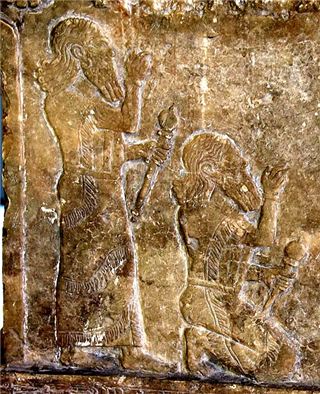
Almost nothing is known of a Dilmunite army, and the state’s security rested above all on its island position and its usefulness to stronger neighbours. The town at Qal’at al-Bahrain was enclosed by a stone wall around 2050 BCE, and its fortifications were rebuilt in later periods, but there is no record of Dilmun waging wars of conquest. Mesopotamian rulers generally treated it as a trading partner rather than a target during the third and early second millennia BCE, and its prosperity depended on keeping sea lanes open rather than on military strength. Outside powers nonetheless claimed authority over it. The Kassite kings of Babylon placed a governor on the island in the fifteenth and fourteenth centuries BCE, and the Middle Assyrian king Tukulti-Ninurta I (r. c. 1243–1207 BCE) styled himself king of Dilmun and Meluhha, a claim probably more boastful than real. Neo-Assyrian kings described Dilmun as lying far off in the midst of the sea and received gifts from its rulers rather than sending armies there. According to an inscription of Sennacherib, after the destruction of Babylon in 689 BCE the people of Dilmun sent men with bronze tools to help, a sign of how readily its rulers accommodated imperial power.
Governance & Law
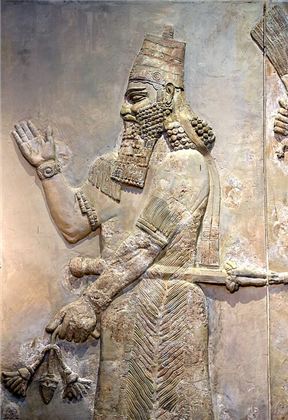
Dilmun’s political institutions are known only in fragments. The royal mounds at A’ali, the palace-like buildings at Qal’at al-Bahrain and the temple complexes suggest a kingship that controlled trade, water and religious life during the Early Dilmun period, roughly 2050–1750 BCE. A stone inscription found in the nineteenth century by the British officer E.L. Durand names a palace of a man called Rimum, “servant of Inzak”, showing that rulers presented themselves as agents of the island’s chief god. Failaka Island off Kuwait, with its Dilmun-period temple and seal workshop, was part of the same political and commercial sphere. Around 1450 BCE Kassite Babylonia brought Dilmun under direct rule. Letters found at Nippur from Ili-ippashra, a governor in Dilmun, to Enlil-kidinni, governor of Nippur, complain that nomadic Ahlamu were stealing the date harvest, and a large Kassite administrative building at Qal’at al-Bahrain probably served the date trade. In the first millennium BCE Dilmun had kings again, but as tributaries. Sargon II recorded gifts from Uperi in 709 BCE, and Ashurbanipal received tribute from a later king, Hundaru. Under the Chaldean dynasty of Babylon a governor of Dilmun is named in a sixth-century document, indicating its absorption as a province.
Global & Regional Impact
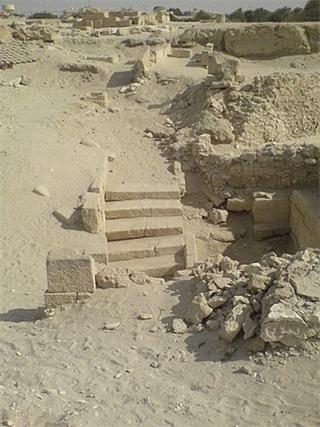
Dilmun was the main intermediary of one of the earliest long-distance maritime trade systems, linking Mesopotamia, Magan and the Indus civilisation, and its weights, seals and harbour made Gulf commerce possible for several centuries. Its place in Mesopotamian imagination was even larger. The Sumerian myth of Enki and Ninhursag describes Dilmun as a pure, clean and bright land where there was no sickness or old age, and in the Sumerian flood story the gods settled the flood hero Ziusudra in Dilmun, “where the sun rises”, granting him eternal life. These texts made Dilmun a kind of paradise in Near Eastern literature, and some writers have linked it, without firm evidence, to the biblical Eden. The island remained a trading centre after Dilmun disappeared, known to Greek authors as Tylos. Modern knowledge of Dilmun owes much to the Danish expedition led by P.V. Glob and Geoffrey Bibby from 1953, which identified Bahrain as Dilmun’s centre and excavated Qal’at al-Bahrain, Barbar and many tombs. Qal’at al-Bahrain became a UNESCO World Heritage Site in 2005 and the Dilmun Burial Mounds followed in 2019, and Dilmun is today a central part of Bahrain’s national identity and heritage.
Decline & Fall
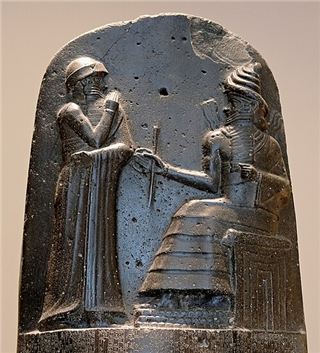
Dilmun’s commercial golden age ended around 1750 BCE. The Indus cities were in decline, the old Sumerian ports of the south lost importance as power shifted north under Hammurabi of Babylon and his successors, and direct sea trade between Mesopotamia and the Gulf contracted. At Qal’at al-Bahrain building activity slowed, and the temples at Barbar and Saar went out of use. The Kassite occupation from about 1450 BCE brought a revival based on dates and administration, but as a dependency rather than an independent trading state. After the Kassite period the sources fall almost silent for several centuries, and Dilmun re-emerges in the eighth century BCE as a minor kingdom paying tribute to the Neo-Assyrian Empire, which valued its position but did not occupy it. After Assyria fell in 612 BCE the island passed under Babylonian control, and by the reign of Nebuchadnezzar II or his successors it was ruled by a Babylonian governor. When Cyrus the Great took Babylon in 539 BCE Dilmun passed to the Achaemenid Empire, and it disappears from the record as a political entity. The island lived on under Seleucid, Characenian and Sasanian influence as Tylos and later as part of the region known as Bahrain.
Dilmun, centred on the island of Bahrain, was the hub of the Bronze Age sea trade linking Mesopotamia with Magan and the Indus, a merchant state with its own seals and weights whose tens of thousands of burial mounds survive and whose name became a byword for paradise in Sumerian myth.
References
- Bibby, G. (1969) Looking for Dilmun. New York: Alfred A. Knopf.
- Crawford, H. (1998) Dilmun and its Gulf Neighbours. Cambridge: Cambridge University Press.
- Potts, D.T. (1990) The Arabian Gulf in Antiquity. 2 vols. Oxford: Clarendon Press.
- Laursen, S. and Steinkeller, P. (2017) Babylonia, the Gulf Region, and the Indus: Archaeological and Textual Evidence for Contact in the Third and Early Second Millennia B.C. Winona Lake: Eisenbrauns.
Connections
Open the full connections map →