
Language · Ancient Near East
Akkadian
At a glance
- Akkadian, the oldest recorded Semitic language, was the language of the empires of Akkad, Babylon and Assyria, written in cuneiform for more than two and a half thousand years.
- In the 2nd millennium BCE it was the international language of diplomacy, used in the letters exchanged between the pharaohs of Egypt and the kings of the Near East.
- Its literature, from the Epic of Gilgamesh and the Babylonian creation epic to the laws of Hammurabi, and its records of astronomy, medicine and mathematics were recovered when scholars deciphered cuneiform in the 19th century.
Timeline
- c. 2300 BCESargon of Akkad unites Mesopotamia and makes Akkadian a language of empire
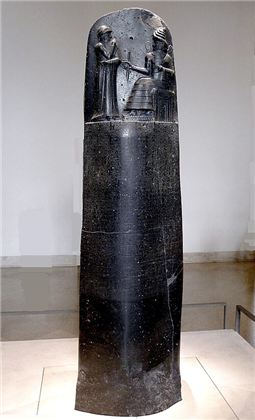
- c. 1754 BCEHammurabi of Babylon has his laws inscribed in Akkadian on stone stelae
- 14th century BCEThe Amarna letters show Akkadian as the language of diplomacy between Egypt and the kingdoms of the Near East
- 7th century BCEAshurbanipal gathers his library of cuneiform tablets at Nineveh
- 539 BCECyrus the Great takes Babylon and records his conquest in Akkadian on the Cyrus Cylinder
- c. 80The last datable cuneiform tablet, an astronomical almanac, is written at Uruk
- 1857Four scholars independently translate an Assyrian inscription, proving the decipherment
- 2010The Chicago Assyrian Dictionary is completed after nearly ninety years of work
Write in Akkadian
Type in the script itself: every key shows a sign with its value and how it sounds. Then make a picture of what you wrote, to save, copy or share.
The keyboard opens here once the page has loaded.
Origins

Akkadian takes its name from Akkad, or Agade, the city, still unlocated, that Sargon made the capital of the first empire of Mesopotamia around 2300 BCE. It is the oldest recorded member of the Semitic languages, the family that includes Aramaic, Hebrew and Arabic, and the chief representative of their eastern branch, together with Eblaite, the language of the Syrian city of Ebla, known from archives of the 24th century BCE.
Speakers of Akkadian lived in Mesopotamia alongside the Sumerians from at least the early 3rd millennium BCE, above all in the north. Their names appear in Sumerian texts from about 2600 BCE, and some early kings of the region bore Akkadian names. The two peoples lived so closely together for so long that their languages influenced each other deeply: Akkadian borrowed hundreds of Sumerian words and perhaps its word order, with the verb at the end of the sentence, unusual among Semitic languages.
Akkadian speakers took over the Sumerian cuneiform script and adapted it to their own language, a task made difficult by the differences between the two. Under Sargon and his successors, such as his grandson Naram-Sin, royal inscriptions, letters and administrative texts were written in Old Akkadian, and the language spread with the empire across Mesopotamia and beyond.
After the fall of the Akkadian empire and the Third Dynasty of Ur, Akkadian replaced Sumerian as the spoken language of Mesopotamia in the early 2nd millennium BCE, dividing into two main dialects: Babylonian in the south and Assyrian in the north.
Sounds, Script & Grammar
Like other Semitic languages, Akkadian built its words from roots of usually three consonants, which carried a basic meaning, combined with patterns of vowels, prefixes and suffixes. From the root p-r-s, “to divide” or “decide”, came iprus, “he decided”, iparras, “he decides”, parsum, “decided”, and purussûm, “decision”. Nouns had three cases, marked in the older language by the endings -um, -am and -im, and verbs had a rich system of stems expressing causative, passive and intensive meanings.
Compared with its Semitic relatives, Akkadian had lost most of the guttural sounds, perhaps under the influence of Sumerian, and placed the verb at the end of the sentence.
Akkadian was written in cuneiform, which used several hundred signs in three ways: as syllables, such as ba, ab or bab; as word signs, often the Sumerian word used for its Akkadian equivalent, so that the sign LUGAL, Sumerian for “king”, was read šarrum; and as silent classifiers that marked categories such as gods, cities or men. Many signs had several readings, and reading cuneiform required long training.
Scholars divide the language into Old Akkadian, of the 3rd millennium BCE, and the Babylonian and Assyrian dialects, each with old, middle and new phases. A literary form known as Standard Babylonian, based on the Old Babylonian of the age of Hammurabi, was used for literature and scholarship throughout Mesopotamia in the 1st millennium BCE, much as classical languages were used elsewhere.
Speakers & Spread
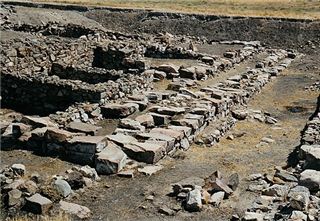
Akkadian was the language of the great states of Mesopotamia for two thousand years. Assyrian merchants of the early 2nd millennium BCE carried it to Anatolia, where some 23,000 of their letters and contracts have been found at Kanesh, near present-day Kayseri in Turkey. Hammurabi of Babylon, in the 18th century BCE, ruled an empire whose language of law and government was Old Babylonian, later regarded as the classical form of Akkadian. The palace archives of Mari on the Euphrates, of the same period, preserve thousands of letters in Akkadian.
In the second half of the 2nd millennium BCE, Akkadian became the international language of the Near East. Rulers who spoke Egyptian, Hittite, Hurrian or Canaanite languages corresponded in Akkadian, and scribal schools across the region, from Hattusa in Anatolia to Ugarit on the Syrian coast and Amarna in Egypt, trained scribes to read and write it. The Amarna letters, found in Egypt in 1887, contain the correspondence of the pharaohs Amenhotep III and Akhenaten with the kings of Babylon, Assyria, Mitanni and the Hittites and with the rulers of Canaan, almost all in Akkadian.
In the 1st millennium BCE the Neo-Assyrian and Neo-Babylonian empires, the greatest powers of their time, used Akkadian for their royal annals, inscriptions and administration. Yet their own policies of deporting conquered peoples spread Aramaic, which gradually replaced Akkadian as the spoken language; Assyrian palace reliefs show scribes writing Aramaic on scrolls beside others writing Akkadian on clay.
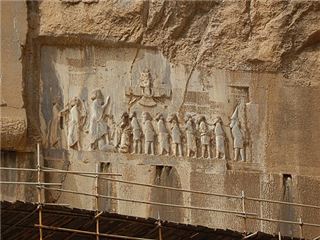
When Cyrus the Great took Babylon in 539 BCE he recorded his conquest in Akkadian, and the Persian kings used it in their inscriptions beside Old Persian and Elamite, as in the great trilingual inscription of Darius at Behistun. After the conquests of Alexander, Akkadian survived only among the temple scholars of Babylonia, who used it for astronomy, ritual and divination until the 1st century CE.
Literature & Learning
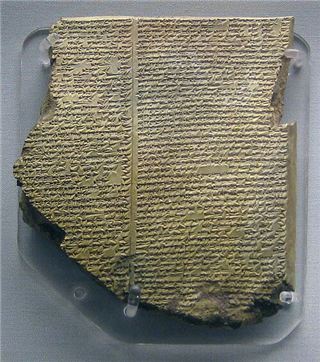
Akkadian has one of the richest literatures of the ancient world. Its masterpiece is the Epic of Gilgamesh, the story of the king of Uruk who seeks immortality after the death of his friend Enkidu. It was first composed in Old Babylonian, drawing on Sumerian poems, and was later reworked into a standard version of twelve tablets, attributed to the scholar Sin-leqi-unninni, which was found in Ashurbanipal’s library; its eleventh tablet tells the story of a great flood.
Other works include the Enuma Elish, the Babylonian epic of creation, in which the god Marduk defeats the sea monster Tiamat and creates the world from her body; the Atrahasis epic, with its own account of the creation of humanity and the flood; the Descent of Ishtar to the underworld; and wisdom texts such as the poem of the righteous sufferer, often compared with the Book of Job.
The laws of Hammurabi, inscribed on a stone stele now in the Louvre, set out some 280 laws, including the principle of “an eye for an eye”. Thousands of letters, contracts, chronicles and royal annals record the political and daily life of Mesopotamia in unprecedented detail.
Akkadian was also the language of Mesopotamian science. Babylonian scholars compiled vast collections of omens, medical diagnoses and treatments, and mathematical texts, among them the famous tablet Plimpton 322, with its list of numbers related to right-angled triangles. Babylonian astronomers recorded the movements of the moon and planets in astronomical diaries kept for six centuries, from the 7th to the 1st century BCE, and developed mathematical methods to predict them. The library assembled by the Assyrian king Ashurbanipal at Nineveh in the 7th century BCE, now in the British Museum, preserved tens of thousands of tablets of this learning.
Change & Descendants
Akkadian changed over its long history, as its Babylonian and Assyrian dialects developed through their old, middle and new stages. In the 1st millennium BCE it was increasingly displaced as a spoken language by Aramaic, which used a simple alphabet of twenty-two letters written with ink on leather, papyrus and potsherds, and became the common language of the Assyrian, Babylonian and Persian empires. By the time of Alexander the Great, Akkadian was probably spoken by few if any people.
It survived as a written language of scholarship and religion in the temples of Babylon and Uruk, where scribes copied and composed astronomical, astrological and ritual texts. The last datable cuneiform tablet, an astronomical almanac from Uruk, was written for the year 79 to 80 CE, and then knowledge of Akkadian was lost for some seventeen hundred years.
Akkadian left no direct descendants, but its influence survived in Aramaic and through it in Hebrew, Syriac and Arabic. The months of the Jewish calendar, among them Nisan, Tammuz and Elul, take their names from the Babylonian months, adopted during the Babylonian exile. Words such as cumin and sesame probably reached Greek, and through it English, from Akkadian or a related Semitic source.
The decipherment of Akkadian was one of the great achievements of 19th-century scholarship. Building on the decipherment of Old Persian, scholars used the Babylonian version of the trilingual inscription of Behistun, copied by Henry Rawlinson at great risk on a cliff face in western Iran, to unlock the script. Edward Hincks, Rawlinson, Jules Oppert and William Henry Fox Talbot worked out its principles in the 1850s, and in 1857 their independent translations of the same inscription confirmed their success. In 1872 George Smith of the British Museum discovered the Babylonian flood story on a tablet from Nineveh, and the excitement it caused made Assyriology famous.
Legacy

Akkadian is the key to three thousand years of Mesopotamian civilisation. Hundreds of thousands of cuneiform tablets in Akkadian, from royal archives, temple libraries and private houses, have made Mesopotamia one of the best-documented societies of the ancient world, with records of its economy, law, religion, science and everyday life.
Its literature has become part of world literature: the Epic of Gilgamesh is read and translated today as one of the first great works of its kind, and the Babylonian accounts of creation and the flood have transformed the study of the Bible, whose stories they parallel.
Babylonian astronomy, recorded in Akkadian, passed to the Greeks: Greek astronomers used Babylonian observations and methods, and the zodiac of twelve signs, with its division into degrees, is a Babylonian creation. The laws of Hammurabi remain one of the most famous legal texts in history.
The Chicago Assyrian Dictionary, begun in 1921 and completed in 2010, together with other dictionaries and digital corpora, has made Akkadian one of the best-understood languages of antiquity, and new tablets continue to be found and published.
Akkadian, the oldest recorded Semitic language, was the language of Akkad, Babylon and Assyria, written in cuneiform from the 3rd millennium BCE to the 1st century CE and used as the diplomatic language of the ancient Near East. Replaced in speech by Aramaic, it was recovered by decipherment in the 19th century and reveals the literature, laws and science of Mesopotamia, from Gilgamesh to Babylonian astronomy.
References
- Dalley, S. (trans.) (1989) Myths from Mesopotamia: Creation, the Flood, Gilgamesh, and Others. Oxford: Oxford University Press.
- George, A.R. (2003) The Babylonian Gilgamesh Epic: Introduction, Critical Edition and Cuneiform Texts. Oxford: Oxford University Press.
- Huehnergard, J. (2011) A Grammar of Akkadian. 3rd edn. Winona Lake: Eisenbrauns.
- Hunger, H. and de Jong, T. (2014) 'Almanac W22340a from Uruk: The Latest Datable Cuneiform Tablet', Zeitschrift für Assyriologie, 104(2), pp. 182–194.
- Moran, W.L. (1992) The Amarna Letters. Baltimore: Johns Hopkins University Press.
- Radner, K. and Robson, E. (eds) (2011) The Oxford Handbook of Cuneiform Culture. Oxford: Oxford University Press.