Language · Islamic Caliphates & Middle East
Arabic
At a glance
- Arabic, first recorded in inscriptions of the Arabian peninsula and its desert borderlands, became a world language with the Qur’an and the Islamic conquests of the 7th century.
- As the language of the caliphates it carried philosophy, science, medicine and mathematics, translated from Greek, Persian and Sanskrit and developed by scholars from Spain to Central Asia, and its literature is one of the richest in the world.
- Today spoken by some 400 million people in a family of varieties, with a shared standard written language, it is the language of prayer for Muslims everywhere and has lent words from algebra to coffee to the languages of the world.
Timeline
- 853 BCEAn Assyrian inscription names “Gindibu the Arab” among the enemies of Shalmaneser III, the first known mention of Arabs
- 328The Namara inscription, the epitaph of Imru' al-Qays, “king of all the Arabs”, is carved in Arabic in Nabataean letters
- 512The Zabad inscription, in Greek, Syriac and Arabic, is one of the oldest dated texts in the Arabic script
- 610–632The Qur’an is revealed to Muhammad, according to Muslim belief, and becomes the first book in Arabic
- c. 700The Umayyad caliph Abd al-Malik makes Arabic the language of government
- Late 8th centurySibawayh writes the first comprehensive grammar of Arabic
- c. 820Al-Khwarizmi writes his book on algebra in Baghdad
- 1973Arabic becomes an official language of the United Nations
Write in Arabic
Type in the script itself: every key shows a sign with its value and how it sounds. Then make a picture of what you wrote, to save, copy or share.
The keyboard opens here once the page has loaded.
Origins

Arabic belongs to the Semitic family, together with Akkadian, Aramaic and Hebrew; within it, it forms with Aramaic, Hebrew and Phoenician the Central Semitic group. Arabs appear in history long before their language is recorded: an Assyrian inscription of 853 BCE names “Gindibu the Arab”, who brought a thousand camels to fight Shalmaneser III at the battle of Qarqar in Syria.
Ancient Arabia was home to many languages. In the south, the kingdoms of Saba and its neighbours wrote their own Semitic languages in the South Arabian script; in the oases and deserts of the north, peoples wrote related dialects in scripts derived from it. Tens of thousands of short inscriptions carved by nomads in the deserts of southern Syria and Jordan, in the Safaitic script, from around the 1st century BCE to the 4th century CE, are regarded by many scholars as the earliest substantial records of Old Arabic.
Arabic was also written in other scripts: in Greek letters, and in the Nabataean script of the kingdom of Petra, whose people spoke Arabic but wrote official texts in Aramaic. The most famous early text is the Namara inscription of 328 CE, found in southern Syria, the epitaph of Imru' al-Qays, who is called “king of all the Arabs”, written in Arabic in Nabataean letters.
From the Nabataean script developed the Arabic alphabet. Its earliest dated inscriptions, at Zabad in Syria in 512, Jabal Usays in 528 and Harran in 568, show it taking shape in the century before Islam. In the same period, poets across Arabia composed in a shared poetic language, recited from memory, which later generations regarded as the purest Arabic.
Sounds, Script & Grammar
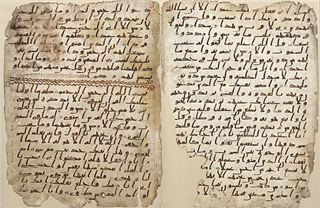
Arabic is famous for its sounds, among them the emphatic consonants, pronounced with a constriction of the throat, and the deep guttural consonants ʿayn and ḥā'. Arabs have long called their language “the language of the ḍād”, after an emphatic sound once thought to exist in no other language.
Like other Semitic languages, Arabic builds words from roots of usually three consonants, which carry a core meaning, set in patterns of vowels and affixes. From the root k-t-b, “writing”, come kataba, “he wrote”, kitāb, “book”, kātib, “writer”, maktab, “office”, and maktaba, “library”. Classical Arabic marks three cases with short vowel endings, has a dual as well as a plural, forms many plurals by changing the inside of the word, as kitāb, “book”, becomes kutub, “books”, and has a system of derived verb forms expressing causation, intensity, reflexivity and other meanings.
The Arabic alphabet has twenty-eight letters, written from right to left and joined to one another in cursive form. It records consonants and long vowels; short vowels can be marked by signs above and below the letters, used in the Qur’an, poetry and books for learners. Systems of dots to distinguish letters of the same shape were refined by early scholars, and the vowel signs used today go back to the grammarian al-Khalil ibn Ahmad in the 8th century. Arabic calligraphy, in styles such as the angular Kufic and the rounded Naskh and Thuluth, became one of the great arts of the Islamic world.
Arabic is today a family of varieties. Modern Standard Arabic, the descendant of the classical language, is used in writing, news, education and formal speech across the Arab world, while people speak regional varieties, such as Egyptian, Levantine, Gulf, Iraqi and Maghrebi Arabic, which differ from each other and from the standard in sounds, grammar and vocabulary, so that speakers from distant regions may find each other’s dialects hard to understand. This coexistence of a formal and an everyday language is known as diglossia.
Speakers & Spread
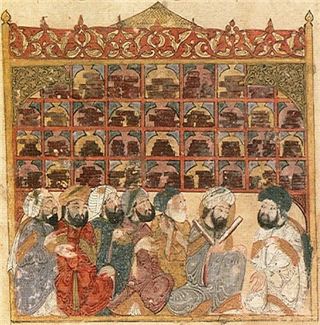
Before Islam, Arabic was the language of the tribes of Arabia and its desert borders. In the 7th century everything changed. The Qur’an, revealed, according to Muslim belief, to the Prophet Muhammad between 610 and 632, made Arabic the language of a new religion, and the conquests that followed his death carried it from Spain and Morocco to Central Asia within a century.
Around 700 the Umayyad caliph Abd al-Malik made Arabic the language of government in place of Greek and Persian, and over the following centuries, as more people converted to Islam, Arabic became the everyday language of Syria, Iraq, Egypt and North Africa, replacing Aramaic, Coptic, Greek and Latin and, more slowly, many Berber languages. In Iran, Persian survived and was reborn in a new form, but Arabic remained the language of religion and learning there and across the Islamic world.
Under the Abbasid caliphs, who founded Baghdad in 762, Arabic became the international language of science and scholarship. In the translation movement of the 8th to 10th centuries, scholars translated into Arabic the works of Greek philosophy, medicine, mathematics and astronomy, often through Syriac, as well as Persian and Indian works, and built on them. For centuries scholars from al-Andalus to Bukhara, whatever their mother tongue, wrote in Arabic.
Arabic spread further with trade and religion: across the Sahara and the Sahel, where scholars of cities such as Timbuktu wrote in it, along the coast of East Africa and to South and Southeast Asia. In Sicily and Malta, Arabic was spoken after the Arab conquests, and Maltese, written in Latin letters, descends from it. From the 16th century the Ottoman Turks ruled most of the Arab world, but in the 19th century a cultural revival, the Nahda, renewed Arabic literature and created Modern Standard Arabic, with newspapers, printing and new vocabulary for the modern world.
Today Arabic is the first language of some 400 million people, the official language of the more than twenty member states of the Arab League, and since 1973 one of the six official languages of the United Nations.
Literature & Learning
The oldest Arabic literature is the poetry of the 6th century, composed and recited by tribal poets: odes, qasidas, of love, desert journeys, praise and pride. The most celebrated, the Mu’allaqat, “the suspended odes”, among them the poems of Imru' al-Qays and Antara, were transmitted orally and written down in the 8th and 9th centuries.
The Qur’an is the first book written in Arabic and its supreme model of eloquence; Muslims regard its language as inimitable. The need to read and understand it correctly gave birth to Arabic grammar, codified by Sibawayh in the late 8th century, and to lexicography, begun by al-Khalil ibn Ahmad, whose Book of the ʿAyn was the first Arabic dictionary.
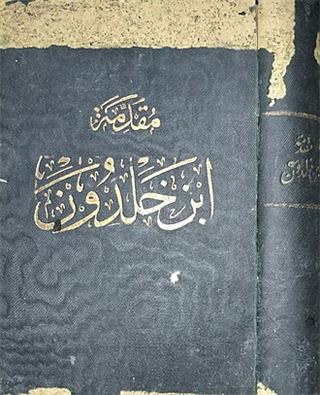
The literature of the classical age includes the poetry of Abu Nuwas and al-Mutanabbi, the essays of al-Jahiz, the rhymed prose tales, the maqamat, of al-Hamadhani and al-Hariri, the love poetry of al-Andalus, the Thousand and One Nights, whose stories gathered over centuries, and history and travel, such as the Muqaddimah of Ibn Khaldun, of 1377, a pioneering theory of history and society, and the travels of Ibn Battuta.
Arabic was the language of medieval science. Al-Khwarizmi’s book on algebra, written in Baghdad around 820, gave the subject its name; Ibn al-Haytham’s Book of Optics transformed the study of light; and the Canon of Medicine of Ibn Sina and the commentaries of Ibn Rushd on Aristotle, translated into Latin, shaped European learning for centuries. In the 20th century, Arabic literature produced writers such as Taha Hussein, the poet Mahmoud Darwish and the novelist Naguib Mahfouz, who won the Nobel Prize in Literature in 1988.
Change & Descendants
Classical Arabic, codified by the grammarians on the model of the Qur’an and the old poetry, changed little in its written form over thirteen centuries, while the spoken language evolved freely. Already in the early Islamic centuries, the speech of the conquered cities simplified the classical grammar, dropping the case endings and developing new words and forms, and these changes gave rise to the regional varieties spoken today.
In the 19th and 20th centuries, writers, translators and language academies, such as those founded in Damascus in 1919 and Cairo in 1932, modernised the vocabulary of the classical language for science, politics and technology, sometimes by reviving old words with new meanings, creating Modern Standard Arabic.
Arabic has influenced the vocabulary of many languages. Persian, Turkish, Urdu, Swahili, Hausa, Malay and Indonesian have borrowed thousands of Arabic words, and Swahili takes its very name from the Arabic word for “coasts”. Spanish and Portuguese, after centuries of Muslim rule in Iberia, contain several thousand words of Arabic origin, such as Spanish aceite, “oil”, and ojalá, “hopefully”, from an Arabic phrase meaning “if God wills”. English has borrowed, often through Spanish, Italian or Latin, words such as algebra, alcohol, admiral, coffee, cotton, sugar and zero.
The Arabic script has been adapted to write many other languages, among them Persian, Urdu, Pashto, Kurdish, Uyghur, Ottoman Turkish, Malay, Swahili and Hausa, making it one of the most widely used scripts in the world.
Legacy

Arabic is the language of Islam. Muslims, nearly two billion people, recite the Qur’an and their daily prayers in Arabic whatever their mother tongue, and the study of Arabic has spread with Islam across Africa and Asia.
In the Middle Ages, Arabic was the language through which much of the learning of antiquity was preserved, developed and transmitted to Europe. Latin translations of Arabic works on mathematics, astronomy, medicine and philosophy, made in Spain and Italy from the 12th century, transformed European science, and the numerals known in Europe as Arabic numerals, originally from India, reached it through Arabic books.
The names of many stars, such as Aldebaran, Betelgeuse, Rigel and Altair, and scientific words such as algorithm, alkali, zenith and nadir, recall the place of Arabic in the history of science.
Arabic calligraphy decorates mosques, palaces, manuscripts and objects across the Islamic world, and Arabic literature, from the odes of the desert poets and the Thousand and One Nights to the modern novel, is part of the world’s heritage. Each year on 18 December, the anniversary of its adoption by the United Nations, the world celebrates World Arabic Language Day.
Arabic, the Semitic language of the Arabs, first recorded in inscriptions of the Arabian deserts, became a world language with the Qur’an and the Islamic conquests of the 7th century. The language of the caliphates’ science, philosophy and literature from Spain to Central Asia, it is spoken today by some 400 million people, is the language of prayer for the world’s Muslims and has enriched the languages of three continents.
References
- Al-Jallad, A. (2015) An Outline of the Grammar of the Safaitic Inscriptions. Leiden: Brill.
- Allen, R. (2000) An Introduction to Arabic Literature. Cambridge: Cambridge University Press.
- Gutas, D. (1998) Greek Thought, Arabic Culture: The Graeco-Arabic Translation Movement in Baghdad and Early ʿAbbāsid Society. London: Routledge.
- Holes, C. (2004) Modern Arabic: Structures, Functions, and Varieties. Rev. edn. Washington, DC: Georgetown University Press.
- Hoyland, R.G. (2001) Arabia and the Arabs: From the Bronze Age to the Coming of Islam. London: Routledge.
- Versteegh, K. (2014) The Arabic Language. 2nd edn. Edinburgh: Edinburgh University Press.