Work / monument · text
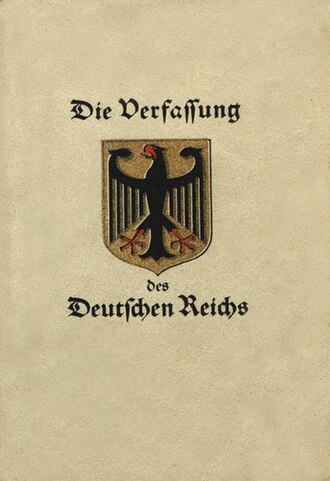
Weimar Constitution
The Weimar Constitution, formally the Constitution of the German Reich, governed Germany during the Weimar Republic. Drafted chiefly by Hugo Preuss and adopted by the National Assembly at Weimar on 31 July 1919 by 262 votes to 75, it created a federal semi-presidential republic with a Reichstag elected by universal suffrage and proportional representation, and guaranteed freedom of speech and of religion. Its Article 48 gave the president broad emergency powers; it was invoked 205 times before Adolf Hitler became chancellor and in 1933 was the basis of the Reichstag Fire Decree. Set aside in practice by the Enabling Act of 1933, the constitution was replaced in 1949.
Mentioned in 2 profiles
See also







Cite this entry
- APA
- The Epoch Institute. (2026). Weimar Constitution. In The Epoch Institute Encyclopedia. https://the-epoch-institute.org/encyclopedia/weimar-constitution
- MLA
- “Weimar Constitution.” The Epoch Institute Encyclopedia, The Epoch Institute, 2026, https://the-epoch-institute.org/encyclopedia/weimar-constitution. Accessed .
- Chicago
- The Epoch Institute. “Weimar Constitution.” The Epoch Institute Encyclopedia. 2026. https://the-epoch-institute.org/encyclopedia/weimar-constitution.
- Harvard
- The Epoch Institute (2026) ‘Weimar Constitution’, The Epoch Institute Encyclopedia. Available at: https://the-epoch-institute.org/encyclopedia/weimar-constitution (Accessed: ).
Last reviewed October 2026Random entry ↻