Culture · Central & East Asia
Sanxingdui culture
At a glance
- Sanxingdui was a Bronze Age culture in Sichuan, contemporary with the Shang dynasty, that cast bronzes in a style of its own: great masks with bulging eyes, a life-sized standing figure and a bronze tree almost 4 m high.
- Its people built a walled city of 3.6 square kilometres, ringed by canals and divided into districts, and the culture is thought to have been governed by a strong central theocracy.
- Many Chinese archaeologists identify it with the early kingdom of Shu, whose legendary founder Cancong was said to have protruding eyes like those of the bronze masks.
Timeline
- c. 1600 BCEA walled city is founded at Sanxingdui on the banks of the Yazi River
- 12th–11th centuries BCEThe date radiocarbon dating gives the gold, bronze, jade and pottery objects later found in the sacrificial pits
- 316 BCEThe state of Qin conquers the region of the kingdom of Shu
- 1927A farmer dredging an irrigation ditch unearths a large cache of jade objects
- 1934David Crockett Graham of West China Union University organises the first archaeological excavation
- 1986Local workers find two sacrificial pits filled with broken and burned gold, bronze, jade and pottery objects
- 1997The Sanxingdui Museum opens near the site
- 2020–2022Six more sacrificial pits are excavated, yielding a gold mask, ivory, bronzes and traces of silk
Origins
Sanxingdui, “Three Star Mound”, is an archaeological site in Guanghan, Sichuan, and the type site of the Bronze Age culture named after it. The Sanxingdui culture is an archaeologists’ label for the makers of the objects found there, and it corresponds to periods II and III of the site. The earliest layer, period I, belongs to the Baodun culture, and after the final phase, period IV, the culture was succeeded by the state of Ba and the kingdom of Shu. It was contemporary with the Shang dynasty but developed a style of bronze-making different from that of the Shang.
The first evidence came in 1927, when a farmer dredging an irrigation ditch unearthed a large cache of jade objects, many of which passed over the years into the hands of private collectors. In 1931 the find was brought to the attention of Vyvyan Donnithorne, an Anglican missionary at the Gospel Church of Guanghan, who contacted a local magistrate and Daniel Sheets Dye, a professor of geology at West China Union University. Together they visited, photographed and measured the site, and a few objects went to the university’s museum. In 1934 the museum’s new director, David Crockett Graham, organised the first archaeological excavation.
The great discoveries came in 1986, when local workers found by chance a sacrificial pit full of gold, bronze, jade and pottery objects; a second pit, with about 800 objects, was found on 14 August 1986, a little less than a month later and only 20–30 metres away. Radiocarbon dating placed these objects in the 12th–11th centuries BCE, and digs showed that a walled city had been founded about 1600 BCE. Researchers were astonished to find an artistic style completely unknown in the history of Chinese art.
Society
The city of Sanxingdui stood on the banks of the Yazi River and enclosed part of its tributary, the Mamu River, within its walls. It was trapezoidal in plan: the east and south walls each ran about 2,000 metres and the west wall 1,600 metres, enclosing 3.6 square kilometres, similar in scale to the inner city of the Shang city at Zhengzhou. The walls were 40 metres wide at the base and 20 metres at the top and stood 8–10 metres high, and a smaller set of inner walls lay within.
Canals 20–25 metres wide and 2–3 metres deep surrounded the walls and served for irrigation, inland navigation, defence and flood control. Inside, the city was divided into residential, industrial and religious districts arranged around a dominant central axis, and most of the pits lie along this axis, on four terraces. The buildings were rectangular halls of timber-framed adobe; the largest, a meeting hall, covered about 200 square metres.
The culture is thought to have been governed by a strong central theocracy, and its workshops supported a well-developed bronze-casting industry. As no written records remain, the purposes of many of its objects are difficult to determine.
Beliefs & Worldview
The objects of the Sanxingdui pits had been broken, perhaps ritually disfigured, then burned and carefully buried. Without written records, what they meant has to be inferred from the objects themselves, and several interpretations have been offered. Eye-shaped objects were also found, which may suggest a worship of eyes. According to the French sinologist Corinne Debaine-Francfort, the paint on the bronze faces, black on the eyes and eyebrows and vermilion on the lips, nostrils and ear holes, is evidence of rituals very different from those of the Shang: she reads the vermilion as something offered for the head to taste, smell and hear, or as giving it the power to breathe, hear and speak. Archaeologists believe the heads were mounted on wooden supports or totems, perhaps dressed in clothing.
Liu Yang concludes that masked ritual played a vital role in the community life of Sanxingdui, and suggests that the masks may have been worn by a shi, the “personator” of early Chinese ritual: usually a close young relative who stood for a dead ancestor to whom sacrifice was offered. On this view the masked figures impersonated supernatural beings in order to bring about some communal good. Another scholar compares the bulging-eyed heads with the “eye-idols” of Julian Jaynes’s bicameral mentality hypothesis.
Some see a picture of the cosmos in the finds. Birds, dragons, snakes and tigers predominate, and since East Asians had long linked four animals with the four quarters of the sky (the Azure Dragon, the Vermilion Bird, the White Tiger and the Black Tortoise), the bronzes might represent the universe, though whether they served to communicate with spirits is unclear. The bronze tree has been identified by some with the Fusang tree of Chinese mythology, and the many fish- and bird-shaped objects have been suggested as totems of the legendary Shu rulers Boguan and Yufu, whose name means “fish cormorant”.
Arts & Knowledge
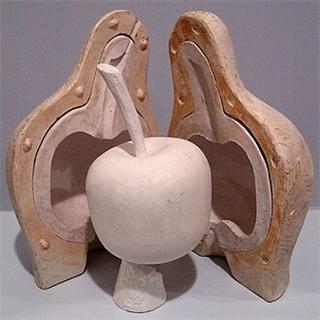
Sanxingdui had a well-developed bronze-casting industry. Its works include the world’s oldest life-sized standing human statue, 260 centimetres tall and weighing 180 kilograms, and a bronze tree 396 centimetres high with birds, flowers and ornaments. The most striking finds are dozens of large bronze masks and heads with angular human features, exaggerated almond-shaped eyes, some with protruding pupils, and large upper ears; at least six heads originally had gold foil masks attached. Other bronzes show birds with eagle-like bills, tigers, a large snake, dragons and chicks, together with zoomorphic masks, bells, axes and what looks like a spoked wheel but is more likely decoration from a shield.
Gold was made into tables, masks and belts. In March 2021 more than 500 objects were reported from six newly found sacrificial pits, among them a gold mask about 3,000 years old, made of about 84% gold and weighing 280 grams. These pits, excavated between 2020 and 2022, also held fragments of a gold mask, traces of silk, bronzes depicting animals, jade tools and ivory carvings.
Jade from Sanxingdui includes axes, tablets, rings, knives and tubes, among them cong and zhang of types consistent with earlier Neolithic cultures in China. The pits also held many ivory carvings and clam shells. Of all these finds, the bronzes have drawn exceptional scholarly attention.
Contact & Exchange
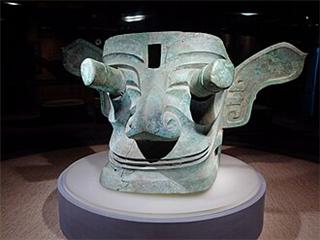
Sanxingdui was not isolated. The culture had trade links that brought bronze from Yin and ivory from South Asia. Its jades, including cong and zhang, follow forms known from earlier Neolithic cultures elsewhere in China, and its walled city was similar in scale to the inner city of the Shang at Zhengzhou. Yet its bronze art was its own, unlike that of the Shang, and its ritual practices, as read from the painted bronze heads, differed from theirs.
Later Chinese texts place the region in the wider politics of the time. Many Chinese archaeologists identify the Sanxingdui culture with the ancient kingdom of Shu, which the Shiji and the Shujing mention as an ally of the Zhou, who defeated the Shang. The Chronicles of Huayang, compiled under the Jin dynasty (266–420 CE), name its legendary rulers: Cancong, the founder, described as having protruding eyes, then Boguan, Yufu and Duyu. The clan of Yufu has been suggested as the one most likely to be linked with Sanxingdui.
Similar discoveries were made at Jinsha, 40 km away, which has links to the Sanxingdui culture and is thought to have been the relocated capital of the kingdom of Shu, perhaps the centre of the Duyu clan. How the Sanxingdui culture ended is not known: evidence of massive flooding and of an earthquake has prompted the idea of a natural disaster, while others suggest an invasion by another culture. The finds point to a distinct civilisation in the region before the state of Qin conquered it in 316 BCE.
Legacy
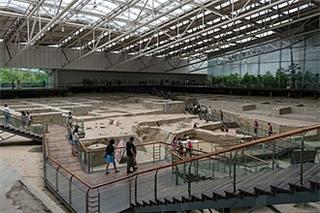
After its final phase the Sanxingdui culture was succeeded by the state of Ba and the kingdom of Shu, and Jinsha may mark where the Shu capital moved. The finds suggest that a civilisation of its own existed in the Sichuan region before the Qin conquest of 316 BCE.
The bronzes were first exhibited in Beijing in 1987 and 1990 and at the Olympic Museum in Lausanne in 1993. The site itself suffered from flooding and pollution, and in 1996 it was included in the World Monuments Watch of the World Monuments Fund; American Express offered funds to build a protective dike. In 1997 the Sanxingdui Museum opened near the original site, close to the city of Guanghan, as the central store and exhibition hall for all Sanxingdui artefacts.
Excavation continues. Six new sacrificial pits found between 2020 and 2022 have added hundreds of objects, among them a gold mask, ivory and traces of silk. Sanxingdui is on UNESCO’s tentative list of World Heritage Sites, together with the Jinsha site and the tombs of boat-shaped coffins.
The Sanxingdui culture was a Bronze Age culture of Sichuan in south-west China, contemporary with the Shang dynasty and identified by many archaeologists with the early kingdom of Shu. Its people built a walled city near present-day Guanghan and buried thousands of broken and burned objects in sacrificial pits. Its bronze masks, life-sized figure and bronze tree, in a style previously unknown in Chinese art, are shown in the Sanxingdui Museum.
Test yourself
5 questions on this page, from its key events and facts.
The questions open here once the page has loaded.
References
- Bagley, Robert (ed.) (2001) Ancient Sichuan: Treasures from a Lost Civilization. Princeton, New Jersey: Seattle Art Museum and Princeton University Press.
- Xu, Jay (2001) “Bronze at Sanxingdui”, in Bagley, Robert (ed.) Ancient Sichuan: Treasures from a Lost Civilization. Seattle Art Museum and Princeton University Press, 59–152.
- Debaine-Francfort, Corinne (1999) The Search for Ancient China. Translated by Paul G. Bahn. London: Thames & Hudson.
- Liu Yang and Capon, Edmund (eds) (2000) Masks of Mystery: Ancient Chinese Bronzes from Sanxingdui. Sydney: Art Gallery of New South Wales.
- Carr, Michael (2007) “The Shi ‘Corpse/Personator’ Ceremony in Early China”, in Reflections on the Dawn of Consciousness: Julian Jaynes’s Bicameral Mind Theory Revisited. Julian Jaynes Society, 343–416.
- Paper, Jordan D. (1995) The Spirits Are Drunk: Comparative Approaches to Chinese Religion. State University of New York Press.