
Culture · Europe
Nuragic civilisation
The story of the Nuragic civilisation
About 3,800 years ago, people on Sardinia began to build stone towers called nuraghi.
Chiefs lived in the biggest towers, and others lived nearby in round stone houses.
Water was at the heart of their religion, and they built holy wells over sacred springs.
Their metalworkers cast small bronze statues of chiefs, warriors, musicians, animals and ships.
Sardinia was rich in copper, and its people became some of Europe’s main metal makers.
Bronze needs tin, which Sardinia hardly had, so they traded for it.
Their pottery and bronzes travelled by sea to the Aegean, Cyprus, Spain and Italy.

Mercenary War CNG, CC BY-SA 2.5 Later, Carthage took the coasts, and then Rome took the whole island.
Nuragic ways lasted long in the mountains, and more than 7,000 towers still dot Sardinia.
At a glance
- The Nuragic people of Sardinia built the nuraghe, a stone tower with vaulted inner chambers, in large numbers from about 1800 BCE, and more than 7,000 still dot the island.
- They were skilled metalworkers, among the main metal producers of Europe, and their pottery and bronzes reached the Aegean, Cyprus, Spain and the Etruscan cities of Italy.
- Ancient DNA shows strong continuity with Sardinia’s Neolithic farmers and almost no steppe-related ancestry, unlike many other Bronze Age peoples of Europe.
Timeline
- c. 1800–1600 BCEThe first proto-nuraghi are built in the late Bonnanaro culture
- mid-2nd millennium BCEThe classic nuraghe, a tower with tholos chambers, evolves from the proto-nuraghe
- 13th century BCENuragic pottery reaches Tiryns, Kommos and Cyprus along the sea routes to the eastern Mediterranean
- 12th–11th century BCEThe building of new nuraghi stops
- c. 900 BCEPhoenicians begin to visit Sardinia more often, as the Iron Age era of the aristocracies begins
- 540 BCEA Carthaginian expedition under Malchus against a still strongly Nuragic Sardinia fails
- 238 BCECarthage surrenders Sardinia to Rome during the Mercenary War
- 1974The Giants of Mont’e Prama are found near Cabras
Origins
The Nuragic civilisation formed on Sardinia in the Bronze Age. Its name is modern, taken from its most characteristic monument, the nuraghe, and is neither what its people called themselves nor the name of a people. The island had been settled since the Paleolithic and Neolithic, and the cultures that followed, among them the Ozieri culture (3200–2700 BCE), left menhirs, dolmens, more than 2,400 rock-cut tombs called domus de Janas and the stepped platform of Monte d’Accoddi. The Beaker culture reached Sardinia about 2000 BCE, first from Spain and southern France and then from Central Europe through Italy. Its last form on the island, the Bonnanaro culture (c. 1800–1600 BCE), resembled the Polada culture of northern Italy, and in its later phase the first proto-nuraghi were probably built.
Its origins are debated. Giovanni Lilliu proposed in 1966 that it grew from several migrations from the west of people related to the Beaker culture, who conquered the local Copper Age cultures; other scholars argue for a local origin. A 2020 study of ancient DNA found strong continuity with the island’s Neolithic farmers, who resembled those of Iberia and southern France, with about 80% early European farmer and 20% western hunter-gatherer ancestry and almost no steppe-related ancestry; a 2021 study found a possible small flow of ancestry from the Italian peninsula from the Chalcolithic on.
The language of Bronze Age Sardinia is unknown. Eduardo Blasco Ferrer saw Paleo-Sardinian as akin to Proto-Basque and ancient Iberian; a link with Etruscan has been proposed without consensus.
Society
Nuragic society was probably based on clans, each led by a chief who lived in a complex nuraghe, while ordinary people lived in nearby villages of stone roundhouses with straw roofs. The nuraghe, which from the middle of the 2nd millennium BCE replaced the stockier proto-nuraghe, was a tower shaped like a truncated cone with at least one vaulted tholos chamber; the largest, such as Nuraghe Arrubiu, rose about 25–30 metres, with five main towers and dozens more inside layers of walls. Their purpose was long argued over, but the modern consensus is that they were defensible homes with barns and silos. Villages around them grew, and late in the Bronze Age and early in the Iron Age some became proto-urban, with paved squares, streets and workshops; at Sant’Imbenia storehouses stood around a large square read as a marketplace.
Bronze statuettes show chief-kings with cloaks and staffs, and miners, artisans, musicians, wrestlers and many warriors, which suggests a warlike society. Religion was so prominent that some scholars propose a theocracy, and the priestly role may have been held by women. In the Iron Age, called the era of the aristocracies, Lilliu saw a village council of chiefs and leading men as the key political change. Genetic data suggest a patrilocal society.
The economy rested on farming, herding and fishing. They grew vines, perhaps the first in the western Mediterranean, made wine and beer and grew melons, and roads for wagons existed by the 14th century BCE.
Beliefs & Worldview
Religion had a strong place in Nuragic life. Fertility seems to have been central, linked to the male power of the Bull-Sun and the female power of the Water-Moon, and scholars infer a Mediterranean-type Mother Goddess and a Father God, Babai, along with heroes such as Norax, Sardus, Iolaos and Aristeus who were also treated as gods. The bull, the dove and figures half man, half bull appear in bronze.
Water stood at the centre of worship. The holy wells, built like the nuraghi with a vaulted round chamber reached by a monumental stair, gathered the water of sacred springs; once dated to the 8th–6th centuries BCE, they most likely belong to the 14th–13th centuries BCE. The well of Santa Cristina is aligned so that the moon shines through its opening every 18.5 years. There were also roundhouses with a central basin, such as Sa Sedda ’e Sos Carros near Oliena, where lead pipes carried water to ram-headed spouts, and rectangular megaron temples within sacred precincts, in which many scholars see Aegean influence. At certain times of year people gathered at common sanctuaries; Santa Vittoria at Serri covered more than 20 hectares, and Lilliu thought the clans of the centre of the island met there to make alliances, decide on war and agree on trade.
The dead were laid in collective “giants’ graves”, built in the shape of a bull’s head with slender standing stones, betili, by the entrance, until individual graves replaced them in the Iron Age.
Arts & Knowledge
The Nuragic people were builders in stone. Besides the towers they raised holy wells, temples and tombs, some of finely cut stone, as at the giants’ graves of Madau and Iloi, and they managed water: most complex nuraghi had at least a well, Arrubiu had a drainage system, and Gremanu has the only known Nuragic aqueduct.
Their best-known art is the bronzetti, statuettes cast by the lost-wax method up to 39 cm high, showing scenes of everyday life, people of different ranks, animals, gods and ships. Most come from Sardinia, but a sizeable minority were found in Etruscan tombs at Vulci, Vetulonia and Populonia, in Campania and at the Greek colony of Crotone. Bronze workshops also made swords, daggers and axes, pins, rings and bracelets, and votive boats that show the people’s closeness to the sea.
The Giants of Mont’e Prama, 32 or 40 stone statues up to 2.5 metres tall found near Cabras in 1974, show warriors, archers, wrestlers, boxers and models of nuraghi, with disc-shaped eyes. Dated between the 11th and the 8th centuries BCE, they would, if radiocarbon dating is confirmed, be the oldest statues of people in the Mediterranean after those of Egypt, older than the Greek kouroi; they may show heroes guarding a tomb. Potters decorated vessels for ritual, some perhaps broken at its end, and made lamps, askoi and pear-shaped jugs found only in Sardinia.
Contact & Exchange
Sardinia was rich in copper and lead, and the Nuragic people became among the main metal producers of Europe, building furnaces for alloys that were traded across the Mediterranean. Bronze needed tin, which the island hardly had, so they had to trade for it. Their markets included lands poor in metal, the Mycenaean world, Cyprus, Crete and Iberia, and Mycenaean, Cretan and Cypriot pottery and local copies gathered at half a dozen “gateway communities” on the island. Nuragic pottery of the 13th century BCE has been found at Tiryns, Kommos, Hala Sultan Tekke and in Sicily, and pottery like it at Marsa Matruh in Egypt; a 2013 study found that most of the copper of Bronze Age Scandinavia came from Sardinia and Iberia. Anchors of up to 100 kg suggest ships perhaps 15 metres long.
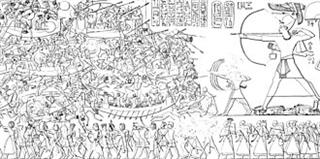
Giovanni Ugas and other scholars identify the Sherden, one of the Sea Peoples of Egyptian sources, with the Nuragic Sardinians; others think the Sherden came to the island after failing to invade Egypt, and both views remain controversial. Simonides of Ceos and Plutarch told of Sardinian raids on Crete.
From about 900 BCE Phoenicians visited more often, at Caralis, Nora, Sulci, Tharros and other ports. Justin describes a failed Carthaginian expedition under Malchus in 540 BCE; Mago returned in 509 BCE, and Carthage at last conquered the coasts, the mines of the Iglesiente and the southern plains, while Nuragic culture may have survived in the mountains.
Legacy
In 238 BCE, after its defeat in the First Punic War, Carthage surrendered Sardinia to Rome during the Mercenary War, and with Corsica the island became the Roman province of Corsica et Sardinia. Nuragic culture did not end at once. Strabo confirms that it survived in the interior at least into the early Imperial period; some scholars date it to the 2nd century CE, and in the Barbagia to the 6th or even the 11th century CE, though no new nuraghi had been built since the 12th–11th century BCE. Roman sources describe many tribes, among them the Balares, the Corsi and the Ilienses, who resisted Romanisation in the area called Civitatas Barbarie, now the Barbagia.
The monuments remain. More than 7,000 nuraghi still dot Sardinia, among them Su Nuraxi at Barumini, Santu Antine at Torralba, Nuraghe Losa and Arrubiu at Orroli, and some sanctuaries were reused as Christian churches, such as San Salvatore in Sinis at Cabras. Some Sardinian villages may descend directly from Nuragic ones, perhaps those whose names hold the root Nur- or Nor-, such as Nurri and Nuraminis. Early Greek writers wondered at the towers, calling them daidaleia after Daedalus, who was said to have come to Sardinia after building the labyrinth in Crete.
The Nuragic past lives on in modern culture, from Ennio Porrino’s 1959 opera I Shardana to films and music inspired by it.
The Nuragic civilisation flourished on Sardinia from about 1800 BCE, building thousands of stone towers, holy wells and giants’ graves and casting bronzes that reached Etruria and the Aegean. Its metalworkers and seafarers took part in a trade that spanned the Mediterranean. Carthage took the coasts in the 6th century BCE and Rome the island in 238 BCE, but Nuragic ways lasted long in the mountainous interior.
References
- Balmuth, Miriam S. (1987). Nuragic Sardinia and the Mycenaean World. Oxford: B.A.R.
- Zedda, Mauro Peppino (2016). “Orientation of the Sardinian Nuragic ‘meeting huts’”. Mediterranean Archaeology & Archaeometry 16 (4): 195–201.