
Culture · Central & East Asia
Erlitou culture
The story of the Erlitou culture
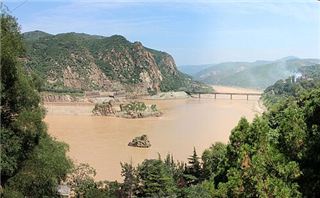
Yellow River fading, CC BY-SA 3.0 About 3,700 years ago, the Erlitou culture grew up in the Yellow River valley of China.
Its main city, Erlitou, stood on the Yi River and grew to perhaps 24,000 people.

Copper Jonathan Zander; derivative work by Materialscientist, CC BY-SA 3.0 The land around the city had no copper, so the ore had to be brought from mountains farther away.
Tracks found near its palace are the oldest signs of wagons with wheels in China.
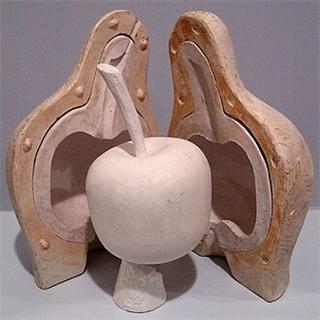
Bronze casting José-Manuel Benito, CC BY-SA 2.5 Erlitou was the first culture in China to make bronze on a large scale.
Its workers cast bronze in moulds to make tools, bells, weapons and special pots for ceremonies.

Erligang culture Kanguole, CC BY-SA 3.0 About 3,600 years ago a new culture, the Erligang, grew strong, and later Erlitou stopped making bronzes.
There is no sign of fire or war, but its palaces were left empty and the city became a village.

Records of the Grand Historian Zhonghua Book Company, Public domain Much later, old books told of an early line of kings called the Xia.
Many scholars think Erlitou was a Xia city, but others say no writing has been found to prove it.
Among its finds are the oldest bronze ding found in China, a kind of pot for ceremonies.
Today more than 2,000 objects from Erlitou are shown in a museum in Luoyang.
At a glance
- Most archaeologists consider the Erlitou culture, centred on a palace city in Henan, the first state-level society in China.
- Erlitou was the earliest large-scale bronze-producing culture in China, and the city monopolised the casting of ritual bronze vessels, among them the earliest ding.
- Chinese archaeologists generally identify it with the later part of the Xia dynasty, but some Western scholars call this premature, since no contemporary writing has been found to prove the link.
Timeline
- c. 1920 BCEAn outburst flood at Jishi Gorge destroys the Lajia site on the upper Yellow River, a flood some authors link to the later Xia flood myth
- c. 1750 BCEBy radiocarbon dating the Erlitou culture begins, and Erlitou grows quickly into a regional centre of several thousand people
- c. 1600 BCEA walled city is built at Yanshi, 6 km northeast of Erlitou, which the Xia–Shang–Zhou Chronology Project takes as the founding of the Shang
- 1450–1300 BCEIn the Upper Erligang phase all the palaces of Erlitou are abandoned and the city shrinks to a village of 30 ha
- 1959Xu Xusheng discovers the Erlitou site and suggests it was Bo, the first capital of the Shang
- late 1970sArchaeologists in China begin to identify Erlitou with Zhenxun, the last capital of the Xia
- 2007Radiocarbon studies narrow the culture’s dates to 1750–1500 BCE
- October 2019The Erlitou Site Museum of the Xia Capital, with more than 2,000 objects from the site, opens in Luoyang
Origins
The Erlitou culture was an early Bronze Age society and archaeological culture of the Yellow River valley, named after the site of Erlitou in Yanshi, Henan. Early estimates dated it from about 1900 to 1500 BCE; radiocarbon studies since 2007 have given a narrower span of 1750–1500 BCE. It may have grown out of the matrix of the Longshan culture. First centred on Henan and Shanxi, it later spread to Shaanxi and Hubei.
Its rise followed the decline of the Longshan culture on the North China Plain. A large outburst flood at Jishi Gorge, which destroyed the Lajia site on the upper Yellow River, has been dated to about 1920 BCE, shortly before the rise of the Erlitou culture in the middle Yellow River valley and of the Yueshi culture in Shandong. The authors of that dating suggest that the flood may lie behind the later myth and helped bring about the change of cultures, though no evidence of widespread flooding at that time has yet been found on the North China Plain.
Erlitou was discovered in 1959 by Xu Xusheng. It is the largest site of the culture, with palace buildings and bronze workshops, and most archaeologists consider the Erlitou culture the first state-level society in China.
Society
The city of Erlitou stood on the Yi River, a tributary of the Luo, which flows into the Yellow River. It measured 2.4 by 1.9 km, though flood damage has left only 3 km² of it. Its growth falls into four phases. In Phase I it covered 100 ha and was a fast-growing regional centre of several thousand people, not yet an urban civilisation. Urban life began in Phase II, when it grew to 300 ha and around 11,000 people: a 12-hectare palace area was marked out by four roads, holding Palace 3, three courtyards along a 150-metre axis, and Palace 5, with a bronze foundry controlled by the elite to the south. Tracks of vehicles near the palace are the earliest evidence of wheeled wagons in China.
The city peaked in Phase III, with perhaps 24,000 people. A rammed-earth wall two metres thick enclosed the palaces; Palace 1, the largest, covered 9,600 m², and Palaces 3 and 5 gave way to Palace 2 and Palace 4. In Phase IV the population fell to around 20,000, but building went on, with Palaces 6, 10 and 11. The Luoyang Plain has no copper, so ore had to be brought in, perhaps from the Zhongtiao Mountains of southern Shanxi, where the city probably also obtained its salt.
Beliefs & Worldview
Ritual at Erlitou is known from its objects and buildings rather than from any text. The palace complex, with its courtyards laid out along a long axis, was the heart of the city, and Erlitou monopolised the making of ritual bronze vessels, including the earliest ding found in China, from its fourth phase. Like other cultures of its time, the Erlitou culture worked jade into ritual objects: ceremonial blades called zhang and ritual dagger-axes, or ge. Three jade ge were found at the Erlitou site beside its bronze ones.
Symbols on pottery from Erlitou sites have prompted speculation about links with early Chinese characters, which appear several centuries later in the same region. No clear connection has been shown, and the symbols are treated as markings or proto-writing.
Arts & Knowledge
The Erlitou culture was the earliest large-scale bronze-producing culture in China. Its casters used a new section-mould process to make ritual vessels and other bronzes. Bronze remains are known from the Qijia and Siba cultures, but Erlitou’s are much more advanced and plentiful: tools, bells, weapons, distinctive animal-faced plaques and more than ten kinds of vessel, a range that shows a diverse and systematic craft. More than 200 bronze objects had been found at the site by 2002.
Erlitou bronzes plainly imitate pottery, with plain surfaces or simple geometric patterns; in the third phase the perforated decoration popular throughout the culture appeared on the bronze jue. Many archetypal Chinese objects are first found at Erlitou sites. The earliest bronze ding, from the fourth phase, are decorated with striped grids. The earliest metal bells, one from Taosi and four from Erlitou, dated to about 2000 BCE, may derive from earlier pottery ones. The first bronze dagger-axe, the ge, appeared at Erlitou, where two were found.
Its builders laid out palaces around courtyards, the largest covering 9,600 m², and enclosed them with a wall of rammed earth.
Contact & Exchange
Erlitou drew on a wider region for its materials. The Luoyang Plain has no copper, and the ore may have come from the Zhongtiao Mountains of southern Shanxi, where Erlitou probably obtained salt as well. Its bronze working had forerunners in the Qijia and Siba cultures, whose bronzes are fewer and simpler.
Its end came with the rise of the Erligang culture. Phase IV at Erlitou overlaps the Lower Erligang (1600–1450 BCE), and around 1600 BCE a walled city was built at Yanshi, about 6 km northeast of Erlitou. Production of bronzes and other elite goods at Erlitou stopped at the end of Phase IV, at the same time as the Erligang city of Zhengzhou was established 85 km to the east. There is no evidence of destruction by fire or war, but during the Upper Erligang phase (1450–1300 BCE) all the palaces were abandoned and Erlitou was reduced to a village of 30 ha, still inhabited.
Legacy
A major goal of Chinese archaeology has been to find the capitals of the Xia and Shang dynasties that traditional accounts place in the Yellow River valley. Those accounts, at first oral, were written down much later, in the Bamboo Annals (c. 300 BCE) and the Records of the Grand Historian (1st century BCE), and the Doubting Antiquity School challenged their history, above all for the Xia. Oracle-bone writing proved Yinxu at Anyang the last Shang capital, but no such evidence exists for earlier sites.
Because the Erlitou culture lies in the same area, southern Shanxi and western Henan, and the same period, the early 2nd millennium BCE, as the texts give for the Xia, many scholars, especially in China, see it as the Xia’s material remains and Erlitou as its capital. Xu Xusheng first took the site for Bo, the first Shang capital under King Tang; since the late 1970s Chinese archaeologists have tended to see it as Zhenxun, the last Xia capital, and different authors have matched the Shang overthrow of the Xia to the end of each of its four phases. The Xia–Shang–Zhou Chronology Project called all four phases Xia and the walled city at Yanshi the founding of the Shang. Other scholars, particularly outside China, point to the lack of firm evidence and argue that this historiographical focus unduly limits Chinese archaeology.
The Erlitou culture was an early Bronze Age society of the Yellow River valley, c. 1750–1500 BCE by radiocarbon dating, centred on a palace city at Erlitou in Henan. It was the first large-scale bronze-casting culture in China, and most archaeologists see it as China’s first state-level society. Chinese scholars generally identify it with the Xia dynasty, a link others think unproven without written evidence.
References
- Allan, Sarah (2007). "Erlitou and the Formation of Chinese Civilization: Toward a New Paradigm". The Journal of Asian Studies. 66 (2): 461–496.
- Liu, Li; Xu, Hong (2007). "Rethinking Erlitou: legend, history and Chinese archaeology". Antiquity. 81 (314): 886–901.
- Liu, Li (2004). The Chinese Neolithic: trajectories to early states. Cambridge University Press. ISBN 978-0-521-81184-2.
- Liu, Li; Chen, Xingcan (2012). The Archaeology of China: From the Late Paleolithic to the Early Bronze Age. Cambridge University Press. ISBN 978-0-521-64310-8.
- Li, Xueqin (2002). "The Xia-Shang-Zhou Chronology Project: Methodology and Results". Journal of East Asian Archaeology. 4: 321–333.
- Shelach-Lavi, Gideon (2015). The Archaeology of Early China. Cambridge University Press. ISBN 978-0-521-19689-5.