Glossary · Term · government
Athenian democracy
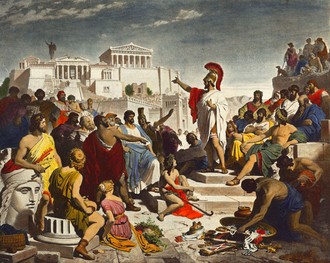
Athenian democracy was the system of government that developed from around the 6th century BCE in the Greek city-state of Athens and its territory of Attica, open only to free adult male citizens, probably no more than 30 percent of adults. Its development is credited to Solon in 594 BCE, Cleisthenes in 508–507 BCE, who organised citizens into ten groups by where they lived, and Ephialtes in 462 BCE. It was direct rather than representative: citizens attended the assembly by right, and most officials and large juries were chosen by lot. Twice interrupted by oligarchic revolutions, in 411 and 404 BCE, its forms persisted until Philip II of Macedon conquered Athens in 338 BCE.
Mentioned in 4 profiles
See also







Cite this entry
- APA
- The Epoch Institute. (2026). Athenian democracy. In The Epoch Institute Encyclopedia. https://the-epoch-institute.org/encyclopedia/athenian-democracy
- MLA
- “Athenian democracy.” The Epoch Institute Encyclopedia, The Epoch Institute, 2026, https://the-epoch-institute.org/encyclopedia/athenian-democracy. Accessed .
- Chicago
- The Epoch Institute. “Athenian democracy.” The Epoch Institute Encyclopedia. 2026. https://the-epoch-institute.org/encyclopedia/athenian-democracy.
- Harvard
- The Epoch Institute (2026) ‘Athenian democracy’, The Epoch Institute Encyclopedia. Available at: https://the-epoch-institute.org/encyclopedia/athenian-democracy (Accessed: ).
Last reviewed October 2026Random entry ↻