Event
Brown v. Board of Education
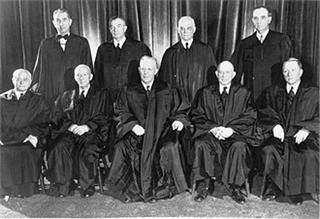
Brown v. Board of Education was a unanimous ruling of the United States Supreme Court on 17 May 1954 that state laws establishing racial segregation in public schools violated the Fourteenth Amendment's Equal Protection Clause. The case began in Topeka, Kansas, was heard with four similar cases and was argued by the NAACP's chief counsel Thurgood Marshall. In Chief Justice Earl Warren's words, "separate educational facilities are inherently unequal"; the decision partially overruled Plessy v. Ferguson of 1896. A second decision in 1955 only ordered states to desegregate "with all deliberate speed".
Mentioned in 1 profile
See also






Cite this entry
- APA
- The Epoch Institute. (2026). Brown v. Board of Education. In The Epoch Institute Encyclopedia. https://the-epoch-institute.org/encyclopedia/brown-v-board-of-education
- MLA
- “Brown v. Board of Education.” The Epoch Institute Encyclopedia, The Epoch Institute, 2026, https://the-epoch-institute.org/encyclopedia/brown-v-board-of-education. Accessed .
- Chicago
- The Epoch Institute. “Brown v. Board of Education.” The Epoch Institute Encyclopedia. 2026. https://the-epoch-institute.org/encyclopedia/brown-v-board-of-education.
- Harvard
- The Epoch Institute (2026) ‘Brown v. Board of Education’, The Epoch Institute Encyclopedia. Available at: https://the-epoch-institute.org/encyclopedia/brown-v-board-of-education (Accessed: ).
Last reviewed October 2026Random entry ↻