Work / monument · text
Equal Rights Amendment
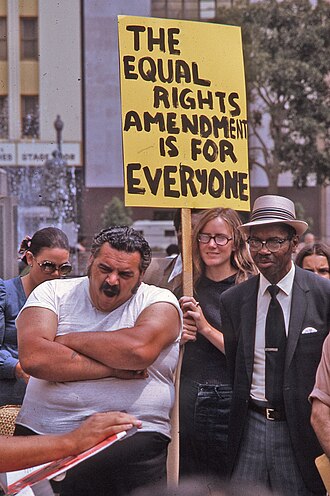
The Equal Rights Amendment is a proposed amendment to the United States Constitution that would explicitly prohibit sex discrimination. Written by Alice Paul and Crystal Eastman, it was first introduced in Congress in December 1923 and, with the rise of the women's movement, passed the House of Representatives in 1971 and the Senate in 1972. Its ratification deadline of 1979, later extended to 1982, passed with the amendment three states short of the 38 needed, after opposition led by Phyllis Schlafly. Nevada, Illinois and Virginia ratified it between 2017 and 2020, but its status is still debated and it is not part of the Constitution.
Mentioned in 2 profiles
See also








Cite this entry
- APA
- The Epoch Institute. (2026). Equal Rights Amendment. In The Epoch Institute Encyclopedia. https://the-epoch-institute.org/encyclopedia/equal-rights-amendment
- MLA
- “Equal Rights Amendment.” The Epoch Institute Encyclopedia, The Epoch Institute, 2026, https://the-epoch-institute.org/encyclopedia/equal-rights-amendment. Accessed .
- Chicago
- The Epoch Institute. “Equal Rights Amendment.” The Epoch Institute Encyclopedia. 2026. https://the-epoch-institute.org/encyclopedia/equal-rights-amendment.
- Harvard
- The Epoch Institute (2026) ‘Equal Rights Amendment’, The Epoch Institute Encyclopedia. Available at: https://the-epoch-institute.org/encyclopedia/equal-rights-amendment (Accessed: ).
Last reviewed October 2026Random entry ↻