Work / monument · artifact
Mesha Stele
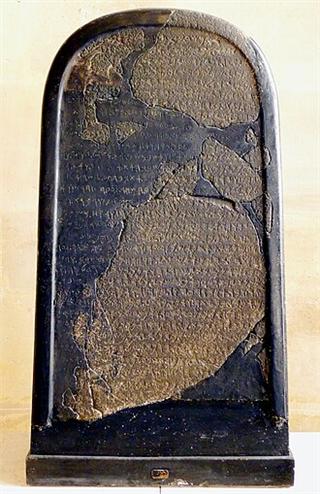
The Mesha Stele, or Moabite Stone, is a basalt slab inscribed around 840 BCE for King Mesha of Moab, found at Dhiban in Jordan in 1868 and now in the Louvre. Its text, in the Moabite language and alphabet, celebrates Mesha's revolt against the Kingdom of Israel, founded by Omri, and his building works. It is the longest Iron Age inscription from the region and one of the earliest references outside the Bible to Israel and its god.
Mentioned in 1 profile
Mentioned in 1 state history
See also






Cite this entry
- APA
- The Epoch Institute. (2026). Mesha Stele. In The Epoch Institute Encyclopedia. https://the-epoch-institute.org/encyclopedia/mesha-stele
- MLA
- “Mesha Stele.” The Epoch Institute Encyclopedia, The Epoch Institute, 2026, https://the-epoch-institute.org/encyclopedia/mesha-stele. Accessed .
- Chicago
- The Epoch Institute. “Mesha Stele.” The Epoch Institute Encyclopedia. 2026. https://the-epoch-institute.org/encyclopedia/mesha-stele.
- Harvard
- The Epoch Institute (2026) ‘Mesha Stele’, The Epoch Institute Encyclopedia. Available at: https://the-epoch-institute.org/encyclopedia/mesha-stele (Accessed: ).
Last reviewed October 2026Random entry ↻