Inventions & Discoveries · Farming and food
Noria
A noria is a water wheel turned by a river's current whose rim carries pots, buckets or compartments that lift water into a small aqueduct, for irrigation or to supply towns. Paddle-driven water-lifting wheels had appeared in Egypt by the 4th century BCE; the Roman architect Vitruvius described the noria in the 1st century BCE, and around 300 CE the Romans tied ceramic pots to an open-framed wheel. Muslim engineers adopted and improved it: Ibn Bassal of al-Andalus fitted a flywheel, and Ismail al-Jazari a crank in 1206. The norias of Hama in Syria were 20 metres across.
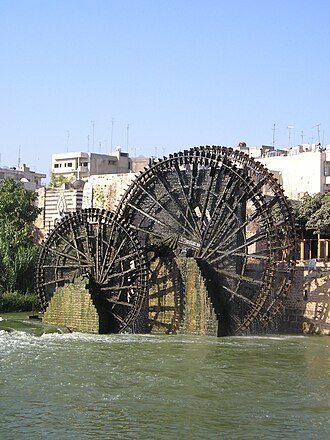
On the inventions tree
- First known
- by the 4th century BCE
- Where
- Egypt
- Credited to
- Ibn Bassal · Ismail al-Jazari
NoteSome accounts date the noria proper from around 300 CE, when the Romans replaced its wooden compartments with ceramic pots tied to the outside of an open-framed wheel.
See also




Cite this entry
- APA
- The Epoch Institute. (2026). Noria. In The Epoch Institute Encyclopedia. https://the-epoch-institute.org/encyclopedia/noria
- MLA
- “Noria.” The Epoch Institute Encyclopedia, The Epoch Institute, 2026, https://the-epoch-institute.org/encyclopedia/noria. Accessed .
- Chicago
- The Epoch Institute. “Noria.” The Epoch Institute Encyclopedia. 2026. https://the-epoch-institute.org/encyclopedia/noria.
- Harvard
- The Epoch Institute (2026) ‘Noria’, The Epoch Institute Encyclopedia. Available at: https://the-epoch-institute.org/encyclopedia/noria (Accessed: ).
Last reviewed October 2026Random entry ↻