Inventions & Discoveries · Communication and computing
Phonograph
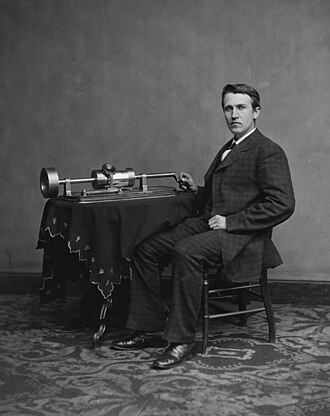
The phonograph is a device for the mechanical and analogue recording and reproduction of sound, in which a stylus traces a groove cut into a rotating cylinder or disc. Thomas Edison, working to play back recorded telegraph messages and to automate speech for the telephone, announced it in November 1877 and patented it in 1878; his first machines recorded on tinfoil wrapped round a grooved cylinder. Alexander Graham Bell's Volta Laboratory improved it in the 1880s with the graphophone and wax-coated cylinders, and in the 1890s Emile Berliner moved from cylinders to flat discs, naming his machine the gramophone. The disc record was the main commercial audio format for most of the 20th century.
On the inventions tree
- First known
- 1877
- Credited to
- Thomas Edison
NoteThe phonautograph, patented in 1857 by Édouard-Léon Scott de Martinville, recorded sound but could not play it back, and Charles Cros described a way of reproducing sound in a sealed letter of April 30, 1877, which he later had read to claim priority of conception.
See also





Cite this entry
- APA
- The Epoch Institute. (2026). Phonograph. In The Epoch Institute Encyclopedia. https://the-epoch-institute.org/encyclopedia/phonograph
- MLA
- “Phonograph.” The Epoch Institute Encyclopedia, The Epoch Institute, 2026, https://the-epoch-institute.org/encyclopedia/phonograph. Accessed .
- Chicago
- The Epoch Institute. “Phonograph.” The Epoch Institute Encyclopedia. 2026. https://the-epoch-institute.org/encyclopedia/phonograph.
- Harvard
- The Epoch Institute (2026) ‘Phonograph’, The Epoch Institute Encyclopedia. Available at: https://the-epoch-institute.org/encyclopedia/phonograph (Accessed: ).
Last reviewed October 2026Random entry ↻