Work / monument · artifact
Tripitaka Koreana
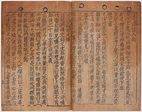
The Tripitaka Koreana is a complete Buddhist canon carved on 81,258 wooden printing blocks by the Goryeo court between 1236 and 1251, in the hope of divine protection against the Mongol invasions. It replaced an earlier set burned by the Mongols in 1232. Kept at Haeinsa temple in South Korea, it is the most complete canon in Chinese script and is listed by UNESCO.

Mentioned in 2 profiles
Mentioned in 1 state history
See also




Cite this entry
- APA
- The Epoch Institute. (2026). Tripitaka Koreana. In The Epoch Institute Encyclopedia. https://the-epoch-institute.org/encyclopedia/tripitaka-koreana
- MLA
- “Tripitaka Koreana.” The Epoch Institute Encyclopedia, The Epoch Institute, 2026, https://the-epoch-institute.org/encyclopedia/tripitaka-koreana. Accessed .
- Chicago
- The Epoch Institute. “Tripitaka Koreana.” The Epoch Institute Encyclopedia. 2026. https://the-epoch-institute.org/encyclopedia/tripitaka-koreana.
- Harvard
- The Epoch Institute (2026) ‘Tripitaka Koreana’, The Epoch Institute Encyclopedia. Available at: https://the-epoch-institute.org/encyclopedia/tripitaka-koreana (Accessed: ).
Last reviewed October 2026Random entry ↻