
Religion · South & Southeast Asia
Buddhism
At a glance
- Buddhism grew from the teaching of Siddhartha Gautama, the Buddha, in north-east India in the 5th century BCE: suffering arises from craving, and a path of ethics, meditation and insight leads to its end.
- Royal patrons such as Ashoka, monks and merchants carried it to Sri Lanka, Central Asia, China, Korea, Japan, Tibet and Southeast Asia, where it took the Theravada, Mahayana and Vajrayana forms.
- It faded from India after about 1200 but remained a major religion of Asia, was revived in India by B. R. Ambedkar in 1956 and reached Europe and the Americas in the 20th century.
Timeline
- c. 5th century BCESiddhartha Gautama attains awakening at Bodh Gaya and gives his first teaching at Sarnath
- c. 260 BCEThe Mauryan emperor Ashoka turns to the Buddha’s teaching and promotes it across his empire
- 1st century BCEThe Pali Canon is written down in Sri Lanka, by tradition at the Aluvihara monastery
- 1st century CEBuddhism reaches China along the trade routes of Central Asia
- 538 or 552Buddhism is brought to Japan from the Korean kingdom of Baekje
- c. 779Samye, the first Buddhist monastery in Tibet, is consecrated
- c. 1200The great monastery of Nalanda is sacked, and Buddhism fades from most of India
- 1956B. R. Ambedkar and hundreds of thousands of his followers become Buddhists at Nagpur
Spread through the centuries
Where it began, how it spread, and where it was a main faith (a bright glow) or held communities (a faint one), century by century to today. Press Play or move the slider, turn the globe, and tap a glow or a mark to read about it.
The map opens here once the page has loaded.
Origins
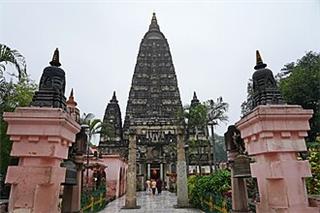
Buddhism began with the life and teaching of Siddhartha Gautama, a member of the Shakya clan who was born, according to tradition, at Lumbini in what is now southern Nepal. His dates are uncertain. Buddhist traditions and older scholarship place his life in the 6th and early 5th centuries BCE; many historians now prefer a later reckoning, with his death around 400 BCE. All agree that he lived and taught in the Ganges plain of north-east India, in the kingdoms of Magadha and Kosala, at a time of growing cities, new states and lively debate among wandering ascetics about the nature of the self and the way to release from rebirth.
The traditional account tells how the young prince, raised in comfort, encountered old age, sickness and death, left his home and family, and spent years in severe ascetic practice before rejecting it as fruitless. Seated in meditation beneath a fig tree at Bodh Gaya, he attained awakening and became the Buddha, the “awakened one”. He gave his first teaching to five former companions in the deer park at Sarnath near Varanasi, an event remembered as the first turning of the wheel of the Dharma.
For some forty-five years he taught across the Ganges valley, gathering a community, the Sangha, of monks and later nuns, supported by lay followers who included merchants and kings. He died at Kushinagar at about eighty years of age. Buddhists call his death the parinirvana, his final release.
The early tradition was preserved orally. According to Buddhist accounts, his disciples met in council at Rajagriha soon after his death to recite his teachings and the rules of the order, and a second council at Vaishali about a century later dealt with disputes over monastic discipline. Disagreements of this kind led to the first divisions of the community into schools. The teaching itself was carried in the vernacular languages of north India, among them the forms of Middle Indo-Aryan from which the scriptural language Pali derives.
Buddhism was one of several movements of the time that rejected the authority of the Vedas and the sacrificial ritual of the Brahmin priests. Its closest contemporary rival was Jainism, taught by Mahavira, which shared much of its vocabulary and its rejection of animal sacrifice.
Beliefs & Practice

At the heart of the Buddha’s teaching, as the early texts present it, are the Four Noble Truths: life is marked by suffering or unsatisfactoriness (dukkha); suffering arises from craving; craving can cease; and there is a path that leads to its cessation. That path is the Noble Eightfold Path of right view, intention, speech, action, livelihood, effort, mindfulness and concentration, usually grouped as ethics, meditation and wisdom.
Buddhism shares with other Indian traditions the belief in rebirth governed by karma, the moral consequences of intentional action. Its distinctive claim is that there is no permanent, unchanging self (anatman) that passes from life to life: a person is a changing stream of physical and mental processes. All conditioned things are impermanent, and clinging to them brings suffering. The goal is nirvana, the extinction of craving, hatred and delusion and release from the cycle of rebirth.
Practice combines ethical precepts with meditation. Lay Buddhists undertake five precepts: to refrain from killing, stealing, sexual misconduct, false speech and intoxicants. Monks and nuns follow the far longer rules of the Vinaya. Meditation trains calm and concentration and cultivates insight into impermanence and non-self. Devotion has also been central from early times: the veneration of the Buddha’s relics in stupas, pilgrimage to the places of his life, offerings of flowers and lamps, and the recitation of texts.
Later traditions developed these ideas in different directions. The Mahayana, which emerged around the turn of the Common Era, made its ideal the bodhisattva, who seeks awakening for the sake of all beings, and taught that all phenomena are empty (shunyata) of fixed essence. It recognised many Buddhas and bodhisattvas, among them Amitabha, whose Pure Land became a focus of devotion in East Asia, and Avalokiteshvara, the bodhisattva of compassion. The Vajrayana, which arose in India from about the 6th century, added tantric rituals, mantras and visualisation practices taught by a guru.
In the Theravada countries, and increasingly elsewhere, the full moon of Vesak, in April or May, marks the Buddha’s birth, awakening and death together; East Asian traditions celebrate these events on separate days.
Texts & Teachers

The Buddha’s teachings were transmitted orally for several centuries. The oldest complete collection to survive is the Pali Canon of the Theravada tradition, known as the Tipitaka or “three baskets”: the Vinaya, the rules of monastic life; the Sutta Pitaka, the discourses of the Buddha; and the Abhidhamma, systematic analyses of mind and experience. According to the Sri Lankan chronicles, the canon was written down at the Aluvihara monastery in the 1st century BCE, when war and famine threatened the monks who had memorised it.
Other early schools kept their own canons in Sanskrit and other Indian languages; much of this survives only in Chinese and Tibetan translation, or in fragments such as the birch-bark scrolls from Gandhara, which date from the 1st century CE and are among the oldest Buddhist manuscripts known.
The Mahayana produced a large new literature of sutras presented as the Buddha’s words, among them the Perfection of Wisdom sutras, including the Diamond Sutra and the Heart Sutra, the Lotus Sutra and the Pure Land sutras. Philosophers systematised its ideas. Nagarjuna, in the 2nd or 3rd century CE, founded the Madhyamaka, or “middle way”, school with his analysis of emptiness; the brothers Asanga and Vasubandhu, in the 4th or 5th century, shaped the Yogacara school, which explored the workings of consciousness. Buddhaghosa, working in Sri Lanka in the 5th century, wrote the Visuddhimagga and commentaries that defined Theravada orthodoxy.
Translation carried these texts across Asia. Kumarajiva, who arrived in Chang’an in 401, and Xuanzang, who returned from India in 645 with hundreds of manuscripts, produced Chinese versions that remain standard. The Chinese canon was printed in its entirety in the 10th century, and the Korean Tripitaka Koreana, carved on more than 80,000 wooden blocks in the 13th century, is preserved at Haeinsa. Tibetan scholars translated the Indian texts into the two great collections of the Kangyur and Tengyur.
Teachers in later centuries added their own classics, among them the Japanese monks Shinran and Dogen and the Tibetan scholar Tsongkhapa, founder of the Gelug school.
Spread
Buddhism’s first great patron was Ashoka, the Mauryan emperor of the 3rd century BCE, who after his bloody conquest of Kalinga turned to the Buddha’s teaching. His inscriptions, carved on rocks and pillars across the subcontinent, urge restraint, honesty and kindness to living beings. Buddhist tradition credits him with sending missions abroad, including his son Mahinda to Sri Lanka, which became a lasting centre of the Theravada.
From the north-west of India, Buddhism spread with merchants and monks along the trade routes of Central Asia. It flourished under the Kushan Empire, whose territories in Gandhara and Bactria produced a Buddhist art shaped by Greek and Roman models, and it reached China by the 1st century CE. Over the following centuries it became one of the great religions of China, adapting to Chinese culture and producing schools of its own such as Chan, known in Japan as Zen, and Pure Land.
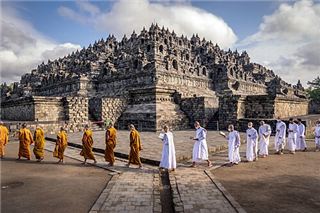
From China it passed to Korea in the 4th century and to Japan in the 6th, introduced from the Korean kingdom of Baekje in 538 or 552 and promoted by Prince Shotoku. Tibet received it in the 7th and 8th centuries; the monastery of Samye was founded around 779, and Buddhism later became the foundation of Tibetan culture and government. In Southeast Asia, Mahayana and Hindu traditions mingled in the courts of Srivijaya, the Khmer Empire and Java, where Borobudur was built around 800, while from the 11th century the Theravada, renewed from Sri Lanka, became the religion of Burma, Thailand, Laos and Cambodia.
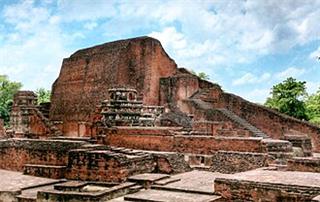
In India itself Buddhism declined. Royal patronage shifted to Hindu devotional traditions, and the great monastic universities in the east, which depended on that patronage, were sacked during the Turkic conquests around 1200; Nalanda was among them. By the 13th century Buddhism had largely disappeared from the land of its birth, surviving on its Himalayan fringes, while it continued to flourish in Sri Lanka and across the rest of Asia.
In modern times it returned to India and travelled west. Western scholars translated its texts in the 19th century; in 1956 B. R. Ambedkar, the jurist and campaigner for the rights of the Dalits, became a Buddhist at Nagpur with hundreds of thousands of followers; and in the 20th century Buddhist teachers and Asian migrants established communities in Europe, North America and Australia.
Community & Society
The Buddha’s community, the Sangha, was from the start a community of renunciants supported by the laity. Monks and nuns gave up property and family life, kept the rules of the Vinaya and depended on alms; lay followers gave food, robes and land, and in return received teaching and the merit that Buddhism teaches comes from generosity. This exchange of material support for spiritual guidance has shaped Buddhist societies ever since.
Monasteries grew into great institutions. In India, centres such as Nalanda attracted students from across Asia to study philosophy, grammar, logic and medicine; Xuanzang spent years there in the 7th century. In Sri Lanka, Burma and Thailand, monasteries became schools for village children, and young men commonly spent a period as novices. In China and Japan, monasteries held land, ran charitable works and sometimes wielded political and military power; in Tibet, the great monasteries and their lamas became the core of the state, and from the 17th century the Dalai Lamas held both religious and political authority.
Kings found in Buddhism a model of righteous rule, the “wheel-turning” monarch who governs by the Dharma, and many supported the Sangha, purified it when they judged it lax, and gained legitimacy from it in turn. Buddhism also met opposition: Chinese emperors restricted monasteries several times, most severely in the persecution of 845, and in the 20th century communist governments in China, Mongolia and Cambodia suppressed it.
The order of nuns, founded according to tradition when the Buddha accepted his aunt and foster mother Mahaprajapati, flourished in India and East Asia, but the full ordination of women died out in the Theravada and was never established in Tibet; its revival has been a subject of debate and practice in recent decades.
Lay practice varies widely: offerings at temples, festivals, pilgrimages, meditation retreats, the chanting of texts and the observance of precepts on holy days. In East Asia, Buddhist rites have long been central to funerals and the remembrance of ancestors.
Legacy

Buddhism is one of the great religious traditions of the world and the source of much of the art, thought and literature of Asia. Its monuments include the stupa of Sanchi, the painted caves of Ajanta, the colossal Buddhas of Bamiyan, destroyed by the Taliban in 2001, the temple-mountain of Borobudur, the pagodas of Bagan and the temples of Kyoto and Lhasa. Its images of the Buddha, first carved in human form in Gandhara and Mathura in the early centuries CE, became one of the most widespread artistic forms in history.
Buddhist philosophy produced sophisticated theories of mind, perception and language, and Buddhist monasteries preserved and spread learning, medicine and the technologies of the written word; printing in East Asia developed largely to reproduce Buddhist texts and charms. Chan and Zen shaped the poetry, painting, gardens and tea culture of China and Japan.
In politics, Buddhism has inspired both quietism and activism. It has served as the religion of kingdoms and nations, from medieval Sri Lanka to modern Thailand and Bhutan, and has been invoked in movements of national identity, sometimes in ways that have deepened conflict with religious minorities. The Tibetan tradition, led since 1959 by the 14th Dalai Lama in exile in India, has won wide sympathy abroad.
Since the 19th century Buddhist ideas have travelled far beyond Asia. Meditation practices adapted from the Theravada and Zen traditions underlie the modern secular practice of mindfulness, which entered medicine and psychology in the late 20th century. The ideals of non-violence, compassion and the impermanence of all things continue to give the tradition a wide appeal among people of many faiths and none.
Buddhism, founded on the teaching of Siddhartha Gautama in north-east India in the 5th century BCE, offers a path of ethics, meditation and insight to end suffering. Carried across Asia by kings, monks and merchants, it shaped the art, learning and politics of Sri Lanka, China, Japan, Korea, Tibet and Southeast Asia, faded from India after about 1200 and in modern times has spread worldwide.
References
- Gethin, R. (1998) The Foundations of Buddhism. Oxford: Oxford University Press.
- Gombrich, R. (2006) Theravada Buddhism: A Social History from Ancient Benares to Modern Colombo. 2nd edn. London: Routledge.
- Harvey, P. (2013) An Introduction to Buddhism: Teachings, History and Practices. 2nd edn. Cambridge: Cambridge University Press.
- Lopez, D.S., Jr. (2001) The Story of Buddhism: A Concise Guide to Its History and Teachings. San Francisco: HarperSanFrancisco.
- Williams, P. (2009) Mahayana Buddhism: The Doctrinal Foundations. 2nd edn. London: Routledge.
- Zürcher, E. (2007) The Buddhist Conquest of China. 3rd edn. Leiden: Brill.