
Religion · South & Southeast Asia
Jainism
At a glance
- Jainism, taught by Mahavira in north-east India in the same age as the Buddha, holds that every living being has a soul and that release from rebirth comes through non-violence, truth and the renunciation of possessions.
- Its monks and nuns live by five great vows of extreme strictness, while its lay followers, many of them merchants and bankers, became one of the most prosperous and influential communities of India.
- Divided since about the 1st century CE into the Digambara and Svetambara traditions, it built temples of rare beauty and influenced Gandhi’s ideal of non-violence.
Timeline
- c. 8th–7th century BCEParshvanatha, the 23rd Tirthankara, teaches in the Ganges valley, by Jain tradition
- c. 6th–5th century BCEMahavira attains omniscience and teaches the path of non-violence; he dies at Pavapuri
- c. 3rd century BCEBy Digambara tradition, Bhadrabahu leads monks to the south, joined by Chandragupta Maurya
- 2nd or 1st century BCEKing Kharavela of Kalinga honours the Jinas in his Hathigumpha inscription
- c. 1st century CEThe community divides into the Digambara and Svetambara traditions
- 453 or 466A council at Valabhi writes down the Svetambara canon
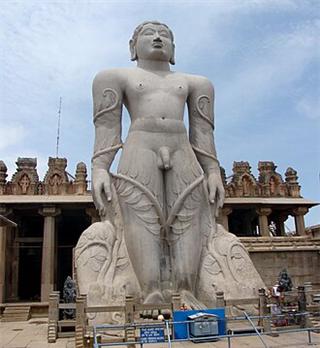
- c. 983The statue of Bahubali is carved at Shravanabelagola
- 12th centuryKing Kumarapala of Gujarat embraces Jainism under the teacher Hemachandra
Spread through the centuries
Where it began, how it spread, and where it was a main faith (a bright glow) or held communities (a faint one), century by century to today. Press Play or move the slider, turn the globe, and tap a glow or a mark to read about it.
The map opens here once the page has loaded.
Origins

Jainism takes its name from the Jina, the “conqueror”: a person who has conquered the inner enemies of passion and attachment and attained perfect knowledge. Jains call these teachers Tirthankaras, “ford-makers”, who build a crossing over the river of rebirth. According to Jain tradition, twenty-four Tirthankaras have appeared in the present age of the world, beginning with Rishabhanatha, an immeasurably distant figure, and ending with Mahavira. Jains do not regard their religion as founded by Mahavira but as an eternal truth that he revealed again.
The twenty-third Tirthankara, Parshvanatha, may have been a historical teacher who lived two or three centuries before Mahavira in the Ganges valley. Mahavira himself, whose personal name was Vardhamana, was a prince of the Jnatrika clan born near Vaishali in what is now Bihar. Jain tradition dates his life to 599–527 BCE; many scholars place it somewhat later, making him a contemporary of the Buddha, with whom he shared the world of the kingdoms of Magadha and Kosala and of the wandering ascetics who rejected the Vedic sacrifices.
At about thirty Mahavira renounced his home and practised severe austerities for some twelve years, fasting, meditating and enduring hardship without shelter, until he attained kevala jnana, omniscience. He then taught for about thirty years, gathering monks, nuns and lay followers, and died, attaining final liberation, at Pavapuri in Bihar.
The early community spread through the Ganges plain under the patronage of kings and merchants. By Jain tradition the Mauryan emperor Chandragupta, founder of the Mauryan Empire, became a Jain monk at the end of his life and followed the teacher Bhadrabahu south during a famine, dying by ritual fasting at Shravanabelagola in present-day Karnataka. Whatever the truth of the story, Jainism became strong in the south as well as the west and north of India.
In the early centuries of the Common Era a long-developing division hardened into two traditions: the Digambaras, “sky-clad”, whose monks renounce even clothing, and the Svetambaras, “white-clad”, whose monks and nuns wear simple white robes. Jain tradition dates the split to the end of the 1st century CE.
Beliefs & Practice
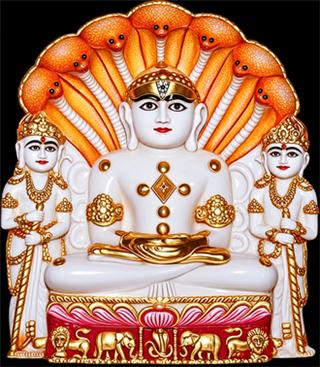
Jainism teaches that the universe is eternal and uncreated, without a creator god. It is made of living souls, jiva, and non-living substances, ajiva. Every living being, from humans and animals to plants, insects and the tiniest beings in earth, water, fire and air, has a soul, which is by nature pure, omniscient and blissful but is weighed down by karma.
In Jain teaching karma is a subtle form of matter that clings to the soul as a result of actions driven by passions such as anger, pride, deceit and greed. It binds the soul to the cycle of rebirth. Liberation comes by stopping the inflow of new karma and burning away the old through right conduct and austerity, until the freed soul rises to the summit of the universe and dwells there for ever in omniscience and bliss.
The path is summed up in the “three jewels”: right faith, right knowledge and right conduct. Its ethics rest on ahimsa, non-violence toward all living beings, which Jains carry further than any other tradition: monks and nuns may sweep the ground before them to avoid crushing insects, strain their water and in some communities wear a cloth over their mouths. Jains are strict vegetarians, and many avoid root vegetables, whose harvesting destroys whole plants and the tiny beings in the soil, as well as eating after dark.
Monks and nuns take five great vows: non-violence, truthfulness, not stealing, chastity and non-possession. Lay Jains keep lesser versions of the same vows and supporting rules of conduct. Fasting is a central practice, especially during the festival of Paryushana in late summer, which ends with the asking and granting of forgiveness. At the end of life some Jains undertake sallekhana, a gradual and voluntary fast unto death, regarded as the ideal of a peaceful passing.
Jain philosophy is known for the doctrine of anekantavada, “non-one-sidedness”: reality is complex, and every statement about it is true only from a particular point of view, a principle that encourages tolerance of other opinions. The Tirthankaras, who have passed beyond the world, are venerated as models rather than petitioned as gods, though many Jains also honour protective deities.
Texts & Teachers

Mahavira’s teachings were first preserved by memory among his disciples, the ganadharas. The Svetambaras hold that much of this oral canon survived and was recited and written down at councils held at Pataliputra, Mathura and finally Valabhi in Gujarat, in 453 or 466 CE, where it was fixed in the form known today: the Agamas, about forty-five texts in Ardhamagadhi Prakrit, among them the Acaranga Sutra, which describes Mahavira’s ascetic life, and the Kalpa Sutra, recited during Paryushana, which tells the lives of the Tirthankaras.
The Digambaras believe that the original canon was lost during the famines and migrations of the early centuries. They revere instead texts composed by later teachers, among them the Shatkhandagama, one of the oldest Digambara works, and the writings of Kundakunda, a teacher of the early centuries CE whose works on the soul and spiritual discipline remain central to Digambara thought.
The Tattvartha Sutra of Umasvati, written in Sanskrit perhaps in the 4th or 5th century, sets out the whole of Jain doctrine in about 350 short aphorisms and is accepted by both traditions; it opens with the statement that right faith, right knowledge and right conduct together are the path to liberation.
Jain monks were also prolific scholars in many fields. They wrote on logic and philosophy, grammar, poetry, astronomy and mathematics, and they told and retold the stories of the epics and of their own saints. Hemachandra, the 12th-century monk who served the court of King Kumarapala of Gujarat, wrote works on grammar, poetics, lexicography and Jain history. Jain libraries, the bhandaras of Gujarat and Rajasthan, preserved thousands of manuscripts, many of them illustrated with miniature paintings, including non-Jain works that survive nowhere else.
Spread
Jainism never became a missionary religion on the scale of Buddhism, and it remained almost entirely an Indian tradition until modern times. Within India, however, it spread widely and enjoyed the patronage of rulers in every period.
In the east, King Kharavela of Kalinga, in the 2nd or 1st century BCE, recorded his devotion to the Jinas in the Hathigumpha inscription near Bhubaneswar. In the south, Jainism flourished in Karnataka and Tamil Nadu in the first millennium CE under dynasties such as the Western Gangas, whose minister Chavundaraya had the great statue of Bahubali carved at Shravanabelagola around 983; Jain monks contributed greatly to early literature in Tamil and Kannada.
In the west, Gujarat and Rajasthan became the lasting heartland of the Svetambaras. Merchant communities built splendid temples there, among them the marble temples of Dilwara on Mount Abu, from the 11th to 13th centuries, and the temple of Ranakpur in the 15th; the hill of Shatrunjaya at Palitana is crowned with hundreds of shrines. The Chaulukya king Kumarapala, guided by Hemachandra, promoted Jain ethics in the 12th century, forbidding the slaughter of animals in his realm.
From the 12th century, the rise of devotional Hindu movements and, in the south, of Shaivism reduced Jain influence in many regions, and conquest damaged temples in the north. Jainism survived as the religion of close-knit communities, above all of traders and bankers, who preserved its institutions.
In the 19th and 20th centuries Jain merchants settled in East Africa, Britain, Belgium and North America. Today about 4.5 million Indians are Jains, according to the census of 2011, with smaller communities abroad.
Community & Society
The Jain community is traditionally described as fourfold: monks, nuns, laymen and laywomen. Monks and nuns renounce all possessions, live by the five great vows, travel on foot from place to place except during the rainy season and depend on lay families for food, which they accept only if it has not been prepared specially for them. Among the Svetambaras, nuns greatly outnumber monks today.
Lay Jains have long been prominent in trade, banking, jewellery and later in industry, partly because their religion discouraged farming and other occupations that harm living beings. Their prosperity funded temples, libraries, rest houses for pilgrims and animal shelters, the panjrapoles, which care for sick and old animals. Giving, dana, to monks, temples and charities is a central religious duty.
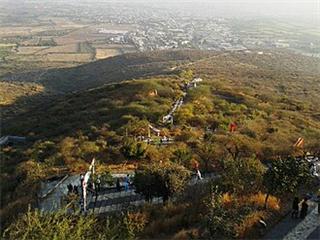
Worship differs among the traditions. Many Svetambaras and Digambaras worship in temples before images of the Tirthankaras, bathing and adorning them and offering rice, flowers and lamps; other groups, the Sthanakvasis and Terapanthis among the Svetambaras, reject image worship and focus on the teaching of their monks. Pilgrimage to sacred places such as Shatrunjaya, Mount Girnar and Sammed Shikharji, where twenty of the Tirthankaras are said to have attained liberation, is a lifelong aspiration.
Jain rulers and ministers were few after the early medieval period, but Jain merchants and scholars were often close to power, serving as advisers and financiers to Hindu and Muslim rulers; the Mughal emperor Akbar received Jain monks at his court and restricted the killing of animals during their holy days.
The ancient practice of sallekhana has become a subject of legal debate: in 2015 the High Court of Rajasthan ruled it equivalent to suicide, a judgment that the Supreme Court of India suspended soon afterwards.
Legacy
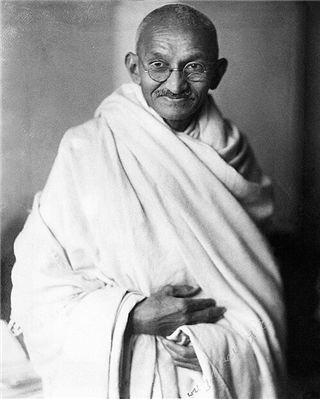
Jainism, though followed by a small community, has had an influence on Indian civilisation far beyond its numbers. Its uncompromising ethic of non-violence shaped wider Indian attitudes to vegetarianism and the treatment of animals, and through Mohandas Gandhi, who grew up in Gujarat among Jain neighbours, took his vows before leaving for London in 1888 from a Jain monk, and was guided in his youth by the Jain thinker Shrimad Rajchandra, it helped inspire the non-violent resistance that became a model for movements across the world.
Jain art and architecture include some of the masterpieces of India: the marble carving of the Dilwara and Ranakpur temples, the temple cities of Shatrunjaya and Girnar, the rock-cut shrines of Ellora and the colossal Bahubali at Shravanabelagola. Jain manuscript painting in western India is an important tradition of Indian miniature art.
Jain scholars made notable contributions to Indian logic, with the doctrine of many-sidedness; to grammar and literature in Prakrit, Sanskrit, Tamil, Kannada and Gujarati; and to mathematics, where their works treated large numbers, permutations and early ideas of infinity. Jain libraries preserved texts of every Indian tradition.
Jain principles of non-possession, restraint and respect for all forms of life have also found new audiences in modern debates about ecology and consumption, and the Jain community has been active in founding hospitals, schools and charities across India.
Jainism, taught by Mahavira in north-east India in the 6th or 5th century BCE, holds that every living being has a soul and that liberation comes through non-violence, truth and renunciation. Divided into Digambaras and Svetambaras, it has remained a small but influential Indian community of monks, nuns and merchants, whose ethics, temples and scholarship left a deep mark on India and on the modern ideal of non-violence.
References
- Babb, L.A. (1996) Absent Lord: Ascetics and Kings in a Jain Ritual Culture. Berkeley: University of California Press.
- Cort, J.E. (2001) Jains in the World: Religious Values and Ideology in India. New York: Oxford University Press.
- Dundas, P. (2002) The Jains. 2nd edn. London: Routledge.
- Jaini, P.S. (1979) The Jaina Path of Purification. Berkeley: University of California Press.
- Long, J.D. (2009) Jainism: An Introduction. London: I.B. Tauris.
- Wiley, K.L. (2004) Historical Dictionary of Jainism. Lanham: Scarecrow Press.