Inventions & Discoveries · Science and discovery
Water clock
A water clock, or clepsydra, measures time by the regulated flow of water into or out of a vessel. Its oldest documentation is the tomb inscription of the 16th-century BCE Egyptian court official Amenemhet, which names him as its inventor, and the oldest surviving one, from the reign of Amenhotep III (c. 1417–1379 BCE), was used at Karnak. Babylonian tablets record water clocks used for the night and day watches, and the oldest written reference in China dates to the 6th century BCE. Ctesibius and other Hellenistic engineers added feedback control, gearing and dials, and water clocks stayed in use until mechanical clocks replaced them in Europe around 1300.
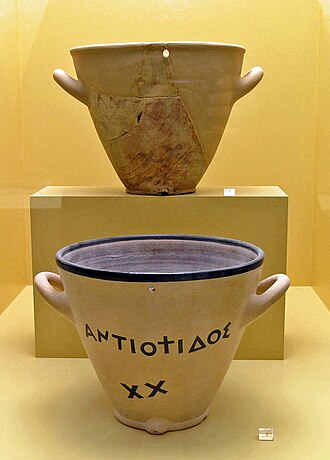
On the inventions tree
- First known
- 16th century BCE
- Where
- Egypt
- Credited to
- Amenemhet · Egyptian Empire New Kingdom
Also arose independentlyBabylon (16th century BCE); Greater Iran (500 BCE); China (6th century BCE)
NoteThe use of water clocks in Babylonian astronomy is traced back to the Old Babylonian Empire (c. 2000–1600 BCE), and N. Narahari Achar and Subhash Kak suggest their use in India as early as the 2nd millennium BCE from the Atharvaveda.
Mentioned in 1 profile
Mentioned in 1 state history
See also






Cite this entry
- APA
- The Epoch Institute. (2026). Water clock. In The Epoch Institute Encyclopedia. https://the-epoch-institute.org/encyclopedia/water-clock
- MLA
- “Water clock.” The Epoch Institute Encyclopedia, The Epoch Institute, 2026, https://the-epoch-institute.org/encyclopedia/water-clock. Accessed .
- Chicago
- The Epoch Institute. “Water clock.” The Epoch Institute Encyclopedia. 2026. https://the-epoch-institute.org/encyclopedia/water-clock.
- Harvard
- The Epoch Institute (2026) ‘Water clock’, The Epoch Institute Encyclopedia. Available at: https://the-epoch-institute.org/encyclopedia/water-clock (Accessed: ).
Last reviewed October 2026Random entry ↻