Central & East Asia
Joseon
At a glance
- Korea's longest-ruling dynasty, founded by Yi Seong-gye in 1392 and ruled from Hanseong, today's Seoul.
- A model Neo-Confucian state run by examination-trained yangban officials; King Sejong created the Korean alphabet in 1443.
- It survived Japanese and Manchu invasions but was forced open by Japan in 1876 and became the Korean Empire in 1897.
Rise & Fall
- 1392Yi Seong-gye deposes the last Goryeo king and founds Joseon
- 1394The capital moves to Hanyang (Seoul)
- 1443King Sejong creates the Korean alphabet
- 1485The Gyeongguk daejeon law code is promulgated
- 1592Hideyoshi invades; Yi Sun-sin wins at Hansan Island
- 1637Injo surrenders to the Qing after the siege of Namhansanseong
- 1876The Treaty of Ganghwa opens Korea to Japan
- 1897Gojong proclaims the Korean Empire
Foundation

Joseon was founded by Yi Seong-gye, a general from the northeastern frontier who had won fame fighting Red Turban rebels and Japanese pirates in the last decades of Goryeo. In 1388, ordered to attack the Ming in Liaodong, he turned his army back at Wihwa Island and seized control of the government. Allied with reform-minded Neo-Confucian officials led by Jeong Do-jeon, he carried out a land reform in 1391, the Rank Land Law (gwajeon), which broke the estates of the old aristocracy and endowed his supporters. In 1392 he deposed the last Goryeo king, Gongyang, and took the throne; he is known as Taejo (r. 1392–1398). In 1393 the Ming emperor Hongwu approved the name Joseon, recalling the ancient kingdom of Gojoseon, and the dynasty accepted a tributary relationship with the Ming. In 1394 the capital moved from Kaegyong to Hanyang, renamed Hanseong and today Seoul, where Gyeongbokgung palace and city walls were built. The early dynasty was violent: in 1398 Taejo's fifth son, Yi Bang-won, killed Jeong Do-jeon and two half-brothers in the first 'Strife of Princes', and in 1400 he became king as Taejong (r. 1400–1418). Taejong abolished private armies, introduced identity tags (hopae) for adult men and organised the country into eight provinces, consolidating royal power.
Socioeconomy
Joseon society was strictly hierarchical. At the top stood the yangban, the families of civil and military officials, who dominated the examinations and office and held much of the land. Below them were the jungin, hereditary specialists such as interpreters, physicians and clerks; the commoners (sangmin), mostly farmers who bore taxes, labour and military service; and the lowborn (cheonmin), above all slaves (nobi), who in the early centuries may have made up a third or more of the population. Agriculture, especially rice, was the basis of the economy. The state promoted farming manuals such as the Nongsa jikseol of 1429, and rice transplanting spread widely in the seventeenth and eighteenth centuries. The Uniform Land Tax Law (daedongbeop), introduced in stages from 1608 and extended across the country by 1708, replaced tribute in local goods with a tax in rice, which stimulated markets and licensed merchants, and copper coins, the Sangpyeong tongbo, circulated from 1678. Foreign trade was tightly limited to tribute missions to Beijing and the Japanese trading post at Busan, run by the Sō clan of Tsushima. Neo-Confucianism reshaped family life: from the seventeenth century inheritance increasingly favoured the eldest son, daughters lost their share of property, and ancestral rites centred on the male line. Buddhism lost state support, and its monks were long barred from the capital.
Military

Early Joseon fought mainly on its frontiers. In 1419, early in Sejong's reign, the retired king Taejong sent an expedition against Tsushima to suppress Japanese pirates, and campaigns against the Jurchen in the 1430s and 1440s established the four commanderies and six garrisons that fixed the northern border on the Yalu and Tumen rivers, where it still lies. A long peace followed, and by the 1590s the army was neglected. In 1592 Toyotomi Hideyoshi invaded with some 150,000 men; Busan fell at once, Seoul within three weeks, and King Seonjo fled to Uiju on the Yalu. The tide turned at sea, where Admiral Yi Sun-sin, using armoured turtle ships (geobukseon) and panokseon warships, won victories such as the Battle of Hansan Island in 1592 that cut Japanese supply lines, while 'righteous armies' (uibyeong) of volunteers harassed the invaders and Ming armies retook Pyongyang in 1593. A second invasion in 1597 was contained; Yi won at Myeongnyang with thirteen ships and was killed at the final Battle of Noryang in 1598. Reforms after the war created the Military Training Agency and the Five Army Camps, but they could not stop the Manchus, who invaded in 1627 and again in 1636–1637, forcing King Injo to surrender after a siege at Namhansanseong. In the nineteenth century Joseon forces fought off French and American expeditions in 1866 and 1871.
Governance & Law

Joseon was one of the most thoroughly Confucian states in history. The king ruled with the State Council (Uijeongbu) and six ministries, but his power was checked by the censorate, whose offices criticised royal conduct and official abuses, by the royal lectures at which kings studied the classics with scholars, and by court historians whose records became the Annals of the Joseon Dynasty. Officials were recruited through civil and military examinations held throughout the dynasty, and the country was divided into eight provinces under governors, with county magistrates rotated so that they never served in their home districts. The legal basis was the Gyeongguk daejeon (National Code), begun under Sejo and promulgated in 1485 under Seongjong. Sejong the Great (r. 1418–1450) gathered scholars in the Hall of Worthies (Jiphyeonjeon) and sponsored works on agriculture, medicine, astronomy and history. Royal authority was often contested: Sejo usurped the throne from his nephew Danjong in 1455, and the literati purges of 1498, 1504, 1519 and 1545 set kings and established officials against Neo-Confucian scholars. From the 1570s factional rivalry divided the bureaucracy. Yeongjo (r. 1724–1776) and Jeongjo (r. 1776–1800) tried to balance the factions through a 'policy of impartiality' (tangpyeong), but in the nineteenth century royal in-law families, above all the Andong Kim, dominated government.
Global & Regional Impact
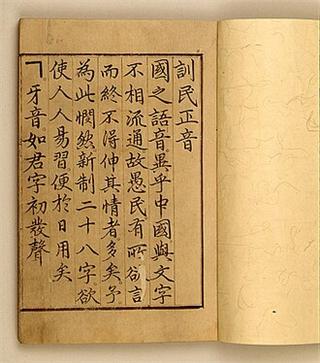
Joseon's most celebrated achievement is the Korean alphabet. In 1443 King Sejong created a script of 28 letters, promulgated in 1446 as the Hunminjeongeum ('Correct Sounds for the Instruction of the People'), so that ordinary people could learn to write their own language. Long disdained by the literati, who wrote in classical Chinese, it became the national script of modern Korea as Hangul. Sejong's reign also produced the rain gauge of 1441, water clocks and astronomical instruments developed with the engineer Jang Yeong-sil, and books printed with improved metal type. The Annals of the Joseon Dynasty and the Diaries of the Royal Secretariat are among the most detailed state records of any premodern country and are inscribed on UNESCO's Memory of the World register. Neo-Confucian philosophy reached a high level in the debates of Yi Hwang (Toegye) and Yi I (Yulgok), whose ideas also influenced Japan, and later scholars of Practical Learning (silhak) such as Jeong Yak-yong turned to the reform of land, administration and technology. Joseon's art, from white porcelain and buncheong ware to the genre paintings of Kim Hong-do, defines much of what is seen today as traditional Korean culture, and Neo-Confucian family values shaped Korean society long after the dynasty ended.
Decline & Fall
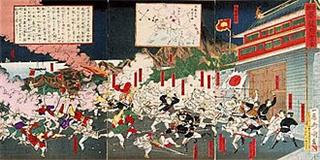
The wars of the 1590s and 1630s devastated Joseon, and the submission to the Qing in 1637 left lasting resentment, though Joseon remained a dutiful Qing tributary. The eighteenth-century revival under Yeongjo and Jeongjo, which included the building of Hwaseong Fortress at Suwon, was followed by the rule of in-law clans, corrupt taxation and recurring famines and epidemics, which provoked the Hong Gyeong-nae rebellion of 1811–1812 and widespread peasant risings in 1862. Catholicism, spreading from the late eighteenth century, was harshly persecuted, and in 1860 Choe Je-u founded the Donghak ('Eastern Learning') religion. The regent Heungseon Daewongun, father of King Gojong, strengthened the throne from 1864 and repelled French and American expeditions, but Japan forced the country open with the Treaty of Ganghwa in 1876. Joseon became a battleground for Chinese, Japanese and Russian influence: the Imo Incident of 1882 and the Gapsin Coup of 1884 brought Chinese and Japanese troops into Seoul. In 1894 the Donghak Peasant Revolution prompted both powers to intervene, leading to the First Sino-Japanese War. Japan's victory ended Chinese suzerainty in the Treaty of Shimonoseki of 1895; Japanese agents murdered Queen Min that year, and Gojong took refuge in the Russian legation in 1896. In October 1897 Gojong proclaimed the Korean Empire, ending the kingdom of Joseon; Japan annexed Korea in 1910.
Joseon, Korea's longest-ruling dynasty, governed the peninsula for five centuries as a model Neo-Confucian state, created the Hangul alphabet and an unrivalled record of government, survived Japanese and Manchu invasions, and shaped the family values, culture and identity of modern Korea before falling under Japanese pressure.
References
- Deuchler, M. (1992) The Confucian Transformation of Korea: A Study of Society and Ideology. Cambridge, MA: Council on East Asian Studies, Harvard University.
- Hawley, S. (2005) The Imjin War: Japan's Sixteenth-Century Invasion of Korea and Attempt to Conquer China. Seoul: Royal Asiatic Society, Korea Branch.
- Lee, K.-b. (1984) A New History of Korea. Trans. E.W. Wagner with E.J. Shultz. Cambridge, MA: Harvard University Press.
- Palais, J.B. (1996) Confucian Statecraft and Korean Institutions: Yu Hyŏngwŏn and the Late Chosŏn Dynasty. Seattle: University of Washington Press.
- Seth, M.J. (2010) A History of Korea: From Antiquity to the Present. Lanham, MD: Rowman & Littlefield.
Connections
Open the full connections map →