Central & East Asia
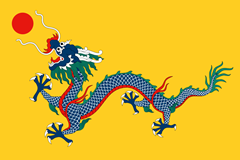
Qing Empire
At a glance
- The Qing was a Manchu dynasty that conquered Ming China in 1644 and ruled the world's most populous empire.
- It reached its greatest extent in the 18th century, setting the territorial framework of modern China.
- Rebellion, defeat in the Opium Wars and by Japan, and failed reform led to revolution and Puyi's abdication in 1912.
Rise & Fall
- 1616Nurhaci proclaims the Later Jin dynasty
- 1636Hong Taiji proclaims the Qing dynasty
- 1644Wu Sangui opens the Shanhai Pass and Qing forces capture Beijing
- 1683The Qing conquer Taiwan from the Zheng regime, completing consolidation
- 1839–1842Britain defeats the Qing in the First Opium War, forcing the Treaty of Nanjing
- 1850–1864The Taiping Rebellion kills an estimated twenty to thirty million people
- 1894–1895Japan defeats the Qing in the First Sino-Japanese War
- 1912The six-year-old Puyi abdicates, ending imperial rule in China
Foundation

The Qing Empire originated among the Jurchen people of Manchuria, a confederation of clans inhabiting the forested river valleys north-east of the Great Wall, whose unification under the chieftain Nurhaci between 1583 and 1616 transformed a fragmented tribal society into a cohesive military-political entity capable of challenging the faltering Ming dynasty, which had governed China for nearly three centuries. Nurhaci’s organisational achievement was the Banner system, begun with four banners in 1601 and expanded to eight by 1615, a military-administrative framework that divided the Jurchen population into colour-coded units functioning simultaneously as fighting formations, census registers and social structures, providing the institutional skeleton of the Qing state. In 1616 he proclaimed the Later Jin dynasty, and in 1618 he declared war on the Ming. His son Hong Taiji renamed the people “Manchu” in 1635, distancing them from the Jurchen Jin dynasty that had once ruled northern China, and proclaimed the Qing dynasty in 1636, presenting it as a legitimate successor within the Chinese imperial tradition. The decisive breakthrough came in 1644 when the Ming general Wu Sangui, facing the rebel army of Li Zicheng, which had just seized Beijing, allowed Manchu forces through the Shanhai Pass. Under the regent Dorgon, the Qing exploited this opening with great speed, capturing Beijing, enthroning the young Shunzhi Emperor as ruler of China and launching decades of campaigns against Ming loyalist resistance in the south. The Kangxi Emperor’s suppression of the Revolt of the Three Feudatories (1673–1681), led by powerful Chinese generals who had been granted semi-autonomous southern domains for supporting the conquest, and the Qing conquest of Taiwan from the Ming loyalist regime of the Zheng family in 1683 completed the consolidation, establishing the Qing as the unchallenged rulers of the most populous empire on earth.
Socioeconomy

The Qing Empire governed the most populous and one of the most productive agrarian economies in the world, its fiscal foundations resting on the taxation of agriculture that fed a population growing from perhaps 150 million around 1700 to over 400 million by the mid-nineteenth century. This demographic expansion was aided by long internal peace and by New World crops, particularly maize, sweet potatoes and peanuts, which extended cultivation into previously marginal hill and upland territories. The Kangxi Emperor’s freezing of the poll-tax quota in 1712 and the Yongzheng Emperor’s reforms of the 1720s, which merged the poll tax into the land tax and regularised the surcharges that had funded local government, simplified fiscal administration and curbed corruption while generating stable revenues that later funded the Qianlong Emperor’s military campaigns. Commercial networks linking China’s regional economies were extensive and sophisticated, with the Yangtze River system and the Grand Canal serving as principal arteries, moving grain, silk, cotton, porcelain and tea between producing regions and consuming centres. The Canton System, formalised in 1757, restricted Western maritime trade to the single port of Guangzhou, managed through licensed Chinese merchant houses, the Cohong, a policy of commercial containment that generated substantial customs revenue while keeping the terms of foreign trade under Qing control. The empire’s silver-based monetary economy depended on silver imports, largely from the Americas, and the reversal of this flow in the early nineteenth century, as rising opium imports drained silver abroad, produced deflationary pressures that compounded the fiscal strains of military expenditure and disaster relief, weakening provincial administration just as foreign pressure intensified.
Military
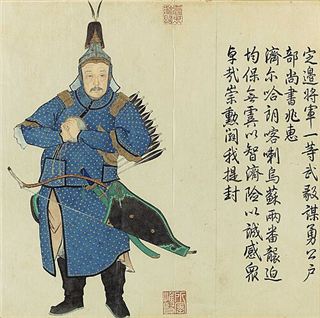
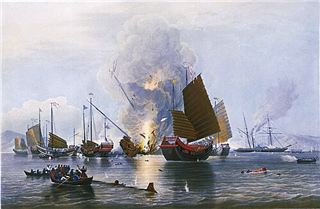
The Qing military rested on the Eight Banners of Manchu, Mongol and Han bannermen that had conquered China, supplemented by the Green Standard Army, a much larger force of Han Chinese soldiers dispersed in smaller garrisons across the provinces. The Banner forces, maintained as a hereditary military caste supported by state stipends, performed effectively during the expansionary phase but progressively declined as hereditary entitlement replaced selection by merit and stipend costs absorbed growing revenues without producing corresponding military capacity. The Qianlong Emperor’s Ten Great Campaigns between the 1750s and 1792, encompassing the conquest of Dzungaria, the subjugation of the oasis cities of the Tarim Basin in Eastern Turkestan, campaigns in Burma, Vietnam and Nepal, the suppression of rebellion on Taiwan and the two Jinchuan wars in Sichuan, represented the height of Qing military power and extended the empire to its greatest extent of some 13 to 14.7 million square kilometres by various estimates. The Dzungar campaigns of 1755–1758 brought the near-complete destruction of the Dzungar Mongols through military violence, deliberate massacre and smallpox, an episode that many historians characterise as the Dzungar genocide, in which perhaps several hundred thousand people perished. The inadequacy of Qing forces against industrialised European militaries was exposed during the First Opium War of 1839–1842, when a British fleet including steam-powered warships such as the iron steamer Nemesis, and modern artillery overcame Qing coastal and Yangtze defences, forcing the Treaty of Nanjing.
Governance & Law

The Qing administrative system adapted Ming bureaucratic institutions to the political requirements of Manchu minority rule over an overwhelmingly Han Chinese population. The dynasty retained the civil service examinations, in which candidates were tested on the Confucian classics, with the highest jinshi degree qualifying holders for senior office, as the principal means of elite recruitment, both preserving Chinese cultural tradition and co-opting the Confucian scholar-gentry whose support was indispensable to stable government. A system of ethnic dyarchy placed Manchu and Han officials in paired senior posts in the central ministries, ensuring Manchu oversight while drawing on Han administrative expertise. The Grand Council, established by the Yongzheng Emperor around 1729 as a small inner body for urgent military and political matters, concentrated decision-making close to the emperor and bypassed the more cumbersome Grand Secretariat, making government more responsive during the dynasty’s vigorous middle period. Inner Asian territories such as Mongolia, Tibet and Xinjiang were managed separately through the Lifan Yuan, the Court of Colonial Affairs, under arrangements that preserved local rulers and religious hierarchies. The Literary Inquisition, which reached its height under the Qianlong Emperor in connection with the great Siku Quanshu compilation, condemned thousands of works as seditious and punished their authors or owners, revealing the anxiety that underlay the dynasty’s confident exterior about the long-term security of Manchu rule over a vastly more numerous subject population.
Global & Regional Impact
The Qing Empire’s most enduring geopolitical legacy was the shaping of China’s modern territorial extent: the incorporation of Xinjiang, Tibet, Mongolia, Taiwan and Manchuria into the Qing realm created the territorial framework on which the modern Chinese state, today the People's Republic of China, was largely built, although Outer Mongolia broke away after 1911. The empire’s economic significance was extraordinary: at its eighteenth-century peak, China is estimated to have produced around a third of the world’s manufactured goods, and European demand for Chinese silk, porcelain and tea drew silver from the Americas through Europe and the Pacific to China on a scale that shaped global monetary flows. The forced opening of Chinese markets through the Opium Wars and the unequal treaty system, which granted foreign powers extraterritorial jurisdiction and treaty ports, fixed low import tariffs and ceded Hong Kong Island to Britain in 1842, established a pattern of semi-colonial commercial penetration that profoundly shaped Chinese political consciousness and fuelled the nationalism that drove Chinese politics in the twentieth century. The Taiping Rebellion of 1850–1864, among the most destructive civil wars in human history with an estimated twenty to thirty million deaths, and the subsequent Muslim revolts in the north-west, demonstrated how the Qing’s fiscal and military weakness created conditions for catastrophic internal violence that reshaped the human geography of entire provinces.
Decline & Fall
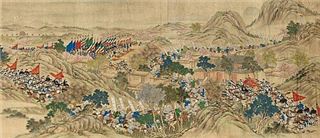
The Qing Empire’s collapse resulted from the combined effects of fiscal weakness, military obsolescence, ecological and demographic stress, internal rebellion and sustained foreign imperial pressure from the mid-nineteenth century onwards. The White Lotus Rebellion of 1796–1804 and the later Taiping, Nian and Dungan rebellions between 1850 and 1877 consumed imperial revenues, destroyed agricultural infrastructure and exposed the inability of the Banner and Green Standard armies to suppress large-scale insurgency without the Han Chinese regional armies, the Xiang Army of Zeng Guofan and the Huai Army of Li Hongzhang, whose success shifted real military power from the Manchu court to Han regional commanders. The Self-Strengthening Movement of the 1860s to 1890s attempted selective military and industrial modernisation, establishing arsenals, shipyards and schools, but its conservative framework left the political and educational system largely untouched. Defeat by Japan in the First Sino-Japanese War of 1894–1895, which forced the cession of Taiwan and the recognition of Korean independence, demonstrated that a modernising Asian neighbour could overwhelm Qing forces and destroyed much of the dynasty’s remaining prestige among the educated elite. The Empress Dowager Cixi’s suppression of the Hundred Days’ Reform in 1898, placing the reformist Guangxu Emperor under house arrest and executing six of his reformist allies, ended the most ambitious internal attempt at systemic renewal, and the disastrous Boxer Uprising of 1900 brought foreign occupation of Beijing and a crushing indemnity. The Xinhai Revolution of 1911, triggered by a military uprising at Wuchang that spread rapidly as provinces declared independence, led to the abdication of the six-year-old Puyi on 12 February 1912, ending more than two thousand years of imperial rule in China.
The Qing Empire’s historical significance lies in a profound paradox: a dynasty that achieved the greatest territorial extent and one of the largest economies in Chinese history, yet failed to develop the political institutions needed to navigate the challenges of the modern world, bequeathing to its successors both the boundaries of a vast nation and the unresolved tensions of a century of foreign encroachment that shaped China’s subsequent history.
References
- Crossley, P.K. (1999) A Translucent Mirror: History and Identity in Qing Imperial Ideology. Berkeley: University of California Press.
- Elliott, M.C. (2001) The Manchu Way: The Eight Banners and Ethnic Identity in Late Imperial China. Stanford: Stanford University Press.
- Fairbank, J.K. (ed.) (1978) The Cambridge History of China. Vol. 10: Late Ch'ing, 1800–1911. Cambridge: Cambridge University Press.
- Mote, F.W. (1999) Imperial China, 900–1800. Cambridge, MA: Harvard University Press.
- Rawski, E.S. (1998) The Last Emperors: A Social History of Qing Imperial Institutions. Berkeley: University of California Press.
- Rowe, W.T. (2009) China's Last Empire: The Great Qing. Cambridge, MA: Harvard University Press.
- Spence, J.D. (1990) The Search for Modern China. New York: W.W. Norton.
Connections
Open the full connections map →