
Central & East Asia
Ming Empire
At a glance
- The Ming dynasty restored Han Chinese rule in 1368 after driving the Mongol Yuan court back to the steppe.
- Its examination-based bureaucracy, Zheng He's voyages and global silver trade made it a centre of the early modern world.
- Fiscal crisis, famine and rebellion let Li Zicheng take Beijing in 1644, opening the way for the Manchu Qing.
Rise & Fall
- 1363Zhu Yuanzhang defeats Chen Youliang at the naval battle of Lake Poyang
- 1368Zhu Yuanzhang proclaims the Ming dynasty and his armies take the Yuan capital, Dadu
- 1405Zheng He's first expedition sets out on voyages that reach East Africa by 1433
- 1420The Forbidden City is completed in the Yongle Emperor's new capital, Beijing
- 1449The Oirat Mongols capture the Zhengtong Emperor at Tumu
- 1592–1598The Ming intervene in Korea against the Japanese invasions
- 1644Li Zicheng takes Beijing; the Chongzhen Emperor takes his own life and the Qing occupy the city
- 1662The last Southern Ming loyalist regime comes to an end
Foundation
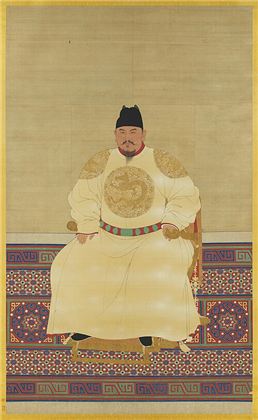
The Ming Empire was founded in 1368 by Zhu Yuanzhang, a former peasant and Buddhist novice who rose to prominence during the collapse of the Yuan dynasty. The Mongol-led Yuan had suffered internal strife, fiscal mismanagement, devastating Yellow River floods and widespread uprisings, allowing regional warlords and rebel leaders to seize power. Emerging from the Red Turban Rebellion (c. 1351–1368), Zhu took Nanjing in 1356 and unified southern China by defeating his rivals, above all Chen Youliang at the great naval battle of Lake Poyang in 1363 and Zhang Shicheng in 1367. In January 1368 he proclaimed the Ming dynasty at Nanjing, reigning as the Hongwu Emperor, and later that year his armies captured the Yuan capital, Dadu (Khanbaliq, modern Beijing), driving the Mongol court back to the steppe. He launched a programme of centralisation, Confucian ideological renewal and territorial consolidation. The dynasty's early foundations rested on disciplined military organisation, administrative restructuring and the reassertion of Han Chinese traditions as a source of legitimacy. Control of the Yangtze and Yellow River basins, combined with the support of key regional elites, enabled the Ming to stabilise China and begin a period of growth.
Socioeconomy

The Ming social and economic order combined continuity with earlier dynasties and innovations in administration. Society was organised hierarchically, with the emperor at the apex, followed by scholar-officials recruited through the civil service examinations, the local gentry, peasants and artisans, while merchants held an ambiguous status despite their wealth. Agriculture formed the backbone of the economy, with rice, wheat and millet supplemented by cotton, sericulture and, from the late 16th century, New World crops such as maize and sweet potatoes. The state compiled land surveys (the fish-scale registers) and population registers (the yellow registers) and organised households under the lijia system to assess taxes and labour service. Domestic markets thrived, and in the early 15th century the Yongle Emperor sponsored Zheng He's voyages to Southeast Asia, India and East Africa. Revenue came from taxes in kind and later in silver, consolidated in the Single Whip reforms of the 16th century, and from the salt monopoly. Silver imported from Japan and, via Manila, from Spanish America monetised the economy, fuelling population growth, urbanisation and commercial expansion, especially in the Yangtze delta.
Military

The Ming military evolved into a large and highly organised system combining infantry, artillery and cavalry. The early Ming adopted some Mongol practices but organised its forces into hereditary military households under the Weisuo system of garrisons, which was meant to make soldier-farmers self-supporting. Garrison towns along the northern frontier, and the long brick-faced walls built mainly in the 16th century and now known as the Great Wall, reflected a growing emphasis on defence, especially after the Zhengtong Emperor was captured by the Oirat Mongols at Tumu in 1449. Infantry used crossbows, pikes and gunpowder weapons including cannon and firearms such as hand cannons, while cavalry provided mobility and rapid response. Notable campaigns included the Yongle Emperor's five expeditions into Mongolia, the occupation of Vietnam (1407–1427), the suppression of coastal pirates (wokou) by commanders such as Qi Jiguang, and the intervention in Korea against the Japanese invasions of 1592–1598. Zheng He's fleets also projected Ming naval power across the Indian Ocean. Military strength underpinned internal stability and foreign influence, allowing the Ming to govern a vast and diverse empire.
Governance & Law
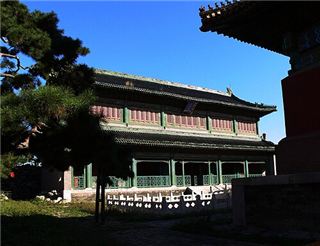
Government in the Ming Empire was highly centralised under the emperor, supported by an extensive bureaucracy shaped by Confucian principles. After abolishing the office of chancellor in 1380, the Hongwu Emperor ruled directly through the Six Ministries, and under his successors a Grand Secretariat developed to assist the throne, while palace eunuchs gained increasing influence. Officials selected through the civil service examinations administered provinces, prefectures and counties, giving government a meritocratic character. The state maintained detailed population and tax registers, and the law was codified in the Great Ming Code (Da Ming Lü). Central ministries coordinated military, fiscal and ritual affairs, while a Censorate monitored the conduct of officials. The emperor retained supreme authority and could override bureaucratic decisions, yet the administrative structure secured relative uniformity in law and resource allocation. Justice combined statutory law with Confucian norms. This balance of central authority and bureaucratic professionalism enabled the Ming state to mobilise resources efficiently for defence and infrastructure across a territory of some 6 million square kilometres at its height.
Global & Regional Impact
The Ming Empire exerted profound influence within East Asia and beyond during the early modern period. Domestically, the restoration of Han Chinese rule reinforced Confucian social order and cultural continuity. Economically, the circulation of silver, silk and porcelain integrated China with East Asian, Indian Ocean and, from the 16th century, global trade networks, with Ming blue-and-white porcelain prized from Persia to Europe. Zheng He's expeditions (1405–1433) extended China's diplomatic and commercial reach to Southeast Asia, South Asia, Arabia and East Africa, establishing tributary relations and projecting imperial prestige. Ming relations with Korea, Vietnam, Japan and Central Asian states shaped regional alliances, trade and cultural exchange. The Yongle Emperor moved the capital to Beijing, where the Forbidden City was completed in 1420, restored the Grand Canal to supply it, and sponsored the vast Yongle Encyclopedia. The Ming legacy persisted in Chinese government, in Neo-Confucian thought such as that of Wang Yangming, in vernacular novels and the arts, and in the institutions of successor dynasties and neighbouring states.
Decline & Fall

The decline of the Ming Empire was driven by internal mismanagement, fiscal strain and external pressure. By the late 16th century, the long withdrawal of the Wanli Emperor from government, eunuch influence and factional struggles such as those between the Donglin faction and its opponents undermined the bureaucracy, while the costs of border defence and of the Korean war strained state finances. Cold weather associated with the Little Ice Age brought repeated droughts, floods and famines, and a fall in silver imports in the 1630s deepened the crisis, fuelling peasant uprisings such as the Li Zicheng rebellion and that of Zhang Xianzhong. Meanwhile the Manchus, united under Nurhaci and Hong Taiji, pressed on the north-east frontier. In April 1644 Li Zicheng's rebels captured Beijing and the Chongzhen Emperor took his own life; the Ming general Wu Sangui then allied with the Manchus, who defeated Li at Shanhai Pass and occupied Beijing, establishing the Qing dynasty there. Ming loyalists in the south formed the Southern Ming regimes, which survived in fragmented form until 1662. Ming administrative, cultural and technological achievements nevertheless continued to shape China and East Asia long after the dynasty's fall.
The Ming Empire stands as the restoration of Han Chinese rule after the Mongol Yuan, whose Confucian bureaucracy, northern defences, and the voyages of Zheng He shaped East Asia long after the dynasty fell to rebellion and the Manchu capture of Beijing in 1644.
References
- Brook, T. (1998) The Confusions of Pleasure: Commerce and Culture in Ming China. Berkeley: University of California Press.
- Dreyer, E.L. (1982) Early Ming China: A Political History, 1355–1435. Stanford: Stanford University Press.
- Dreyer, E.L. (2007) Zheng He: China and the Oceans in the Early Ming Dynasty, 1405–1433. New York: Pearson Longman.
- Geiss, J. (1988) 'The Chia-ching Reign, 1522–1566', in D. Twitchett and F.W. Mote (eds.) The Cambridge History of China. Vol. 7. Cambridge: Cambridge University Press, pp. 440–510.
- Huang, R. (1981) 1587: A Year of No Significance: The Ming Dynasty in Decline. New Haven: Yale University Press.
- Mote, F.W. (1999) Imperial China, 900–1800. Cambridge, MA: Harvard University Press.
- Tsai, S.H. (1996) The Eunuchs in the Ming Dynasty. Albany: State University of New York Press.
Connections
Open the full connections map →