Central & East Asia
Timurid Empire
At a glance
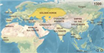
- Timur, a Barlas noble from Transoxiana, carved out an empire from Anatolia to the borders of China by conquest and calculated terror.
- His heirs turned Samarkand and Herat into brilliant centres of painting, poetry and astronomy that shaped Safavid and Mughal culture.
- Built on one man's authority, it split among feuding princes after 1405 and fell to the Uzbeks, but Babur carried its legacy to Mughal India.
Rise & Fall
- 1387Timur's army raises towers of skulls from the population of Isfahan
- 1395Timur defeats Tokhtamysh of the Golden Horde on the Terek
- 1398Timur sacks Delhi, leaving the city devastated for decades
- 1402Timur defeats and captures the Ottoman Sultan Bayezid I at Ankara
- 1405Timur dies at Otrar while marching to invade Ming China
- 1449Ulugh Beg is put to death at the instigation of his own son
- 1469Abu Sa'id, last Timurid to reunite much of the realm, is killed fighting the Aq Qoyunlu
- 1507Muhammad Shaybani Khan takes Herat, ending Timurid rule
Foundation

The Timurid Empire was founded by Timur (Tamerlane), one of history's most destructive conquerors, who rose from the minor nobility of the Barlas tribe in Transoxiana (modern Uzbekistan), within the Chagatai Khanate, through extraordinary military talent, political ruthlessness and skilful use of the Mongol framework of legitimacy. Not being of Chinggisid descent, he could not claim the title of khan; instead he ruled through Chinggisid puppet khans, styled himself by the title 'Amir' (commander) and, after marrying a Chinggisid princess, Güregen, 'royal son-in-law'. His conquests began in the 1360s and continued for four decades, sweeping across Persia, Iraq, Syria, Anatolia, the steppe of the Golden Horde and northern India in an arc of devastation unmatched in the late medieval world. His sack of Delhi in 1398, before which some 100,000 captives were reportedly massacred, left the city so thoroughly plundered that it took decades to recover and remains among the best-documented atrocities of the period. His defeat of the Ottoman Sultan Bayezid I at the Battle of Ankara in 1402, in which Bayezid was captured and died in captivity the following year, shattered Ottoman power and plunged the dynasty into a decade-long civil war, the Ottoman Interregnum, which is often said to have postponed the fall of Constantinople by half a century. The empire Timur assembled stretched from Anatolia to the borders of China, but its administrative infrastructure was thin: he governed chiefly through terror, the speed of his armies and the appointment of sons and grandsons to regional commands, an arrangement that bred the succession struggles which began tearing the empire apart after his death at Otrar in February 1405, as he marched to invade Ming China.
Socioeconomy
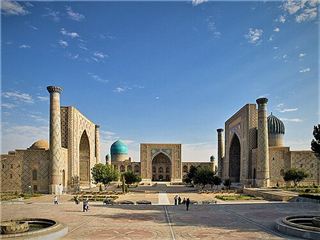
The Timurid economy presents a stark paradox: an empire whose founder destroyed more productive capacity than almost any conqueror in history became, under his successors, one of the most culturally and commercially sophisticated societies of the fifteenth century. Timur's campaigns killed vast numbers of artisans, scholars, merchants and farmers and depopulated agricultural regions of Persia, Mesopotamia and northern India, while his forced transfer of skilled craftsmen from conquered cities to Samarkand drained talent from the periphery to enrich the centre. Yet his successors, above all Shah Rukh (r. 1405–1447, sole ruler from 1409) and his son Ulugh Beg (governor of Samarkand from 1409 and briefly ruler, 1447–1449), invested heavily in rebuilding agriculture, irrigation, urban infrastructure and commerce in the Transoxianan and Khorasanian heartlands. Under Timur, Samarkand became one of the most lavishly built cities in the Islamic world, its monuments such as the Bibi Khanym Mosque funded by the plunder of conquered lands; under Shah Rukh and Ulugh Beg, it became a genuine centre of intellectual and commercial life. The caravan trade between China, India and the Mediterranean, which crossed Timurid territory, generated significant revenues, and the silk and textile industries of Samarkand, Bukhara and Herat were among the most accomplished of their time. Herat under Husayn Bayqara (r. 1469–1506) was arguably the most brilliant literary and artistic court of the fifteenth-century Islamic world, bringing Persian miniature painting and poetry to a refinement that influenced Safavid and Mughal culture for centuries.
Military
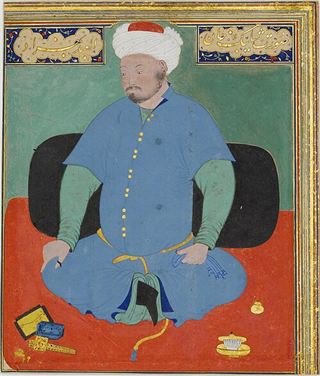
Timur's army was the most formidable of the late fourteenth century, built on Chagatai Mongol cavalry traditions combined with the tactical flexibility and logistical skill that generations of steppe warfare had produced. It incorporated contingents from many conquered peoples, organised on the decimal system inherited from the Mongols, and Timur's personal strategic and tactical genius compensated for whatever such a heterogeneous force lacked in cohesion. His campaigns demonstrated mastery of every mode of warfare: open-field cavalry battle, as against Tokhtamysh of the Golden Horde on the Terek in 1395; siege operations, in which he employed every contemporary siege technique; winter campaigning in extreme conditions; and the movement of armies across vast distances through meticulous logistical preparation. Deliberate and widely publicised atrocity, above all the towers of skulls raised from the populations of cities such as Isfahan in 1387 and Baghdad in 1401, served as a calculated deterrent that persuaded many other cities to surrender without resistance. After Timur's death the empire's military capacity declined rapidly as it fragmented: no successor inherited his genius, and the Timurid princes who divided his realm spent much of their strength fighting one another. The Uzbek Shaybanids eventually destroyed Timurid rule in Central Asia. Muhammad Shaybani Khan's campaigns of 1500–1507 drove the Timurid prince Babur from Samarkand and Transoxiana and extinguished the Herat branch, pushing Babur south to Kabul and ultimately to found the Mughal Empire in India, the final and most enduring expression of the Timurid military tradition.
Governance & Law

Timurid government was defined by the tension between Timur's personal authority and the system's inability to survive his death without institutional continuity. Timur ruled through a combination of Mongol traditions (the yasa and the decimal military organisation), Islamic institutions (sharia courts and religious scholars who lent him legitimacy) and the Persian bureaucratic tradition of the settled lands. Court historians such as Sharaf al-Din Ali Yazdi, author of the Zafarnama, portray him as closely involved in building works, irrigation and commerce in Samarkand, but this engagement rested on his personal authority rather than on institutional design, and could not be transferred. Under Shah Rukh the empire was governed with greater regularity: Herat became the political and cultural capital, Persian administrative practice was employed more systematically, and a functioning tax system provided more stable revenues. Timurid patronage of Persian literature, miniature painting and Islamic architecture was not merely aesthetic but political, a deliberate construction of cultural legitimacy that compensated for the dynasty's lack of Chinggisid descent and for the founder's reputation as the destroyer of many of the cities his heirs now governed. Ulugh Beg's Samarkand Observatory, built in the 1420s, and his patronage of mathematical astronomy represent the most scientifically significant achievement of the Timurid court; its astronomical tables, the Zij-i Sultani, contained one of the most accurate pre-telescopic star catalogues, listing more than a thousand stars, later studied in Europe, where it was published at Oxford in 1665.
Global & Regional Impact
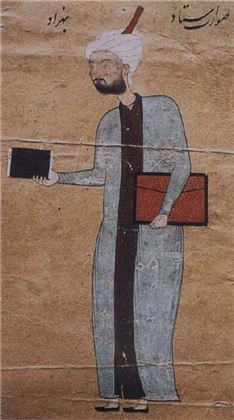
The Timurid Empire's historical impact flowed through two contradictory channels: the destruction wrought by Timur's campaigns, and the cultural flowering that Timurid patronage produced in the fifteenth century. The destructive impact was immediate. The sack of Delhi left the Delhi Sultanate permanently weakened, a diminished state later ruled by the Sayyid and Lodi dynasties until the Mughal conquest; the campaigns in Persia and Iraq depopulated agricultural regions that had supported dense populations for millennia; and the victory at Ankara temporarily relieved Byzantium, Serbia and the Anatolian beyliks of Ottoman pressure. The breathing space Ankara gave the Byzantine Empire and the Balkan Christian states was welcomed by contemporary European observers as a providential deliverance, and European rulers exchanged embassies with Timur, among them the Castilian mission of Ruy González de Clavijo, who left a celebrated account of Samarkand. The cultural legacy was equally substantial but deliberately created: Timurid painting, above all the Herat school associated with Kamal al-Din Bihzad, established the aesthetic tradition that the Safavid and Mughal courts developed into one of the most refined artistic traditions in Islamic history. Timurid patronage also fostered the Persian poetry of Jami and the works of Ali-Shir Nava'i, the greatest poet of Chaghatai Turkic. Babur, a Timurid prince expelled from Central Asia by the Uzbeks, carried this cultural tradition to India, where the Mughal dynasty he founded, which always regarded itself as Timurid, built upon it the culture of the great Mughal court, making the Timurid influence on Indian civilisation among the most enduring in Asian history.
Decline & Fall
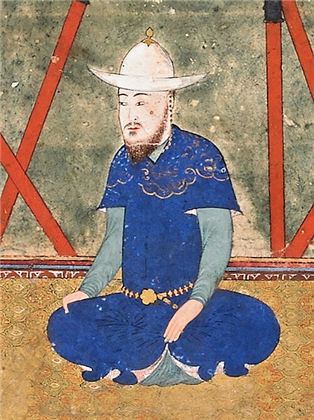
The Timurid Empire began to fragment immediately upon Timur's death in February 1405, a process so rapid that it showed how thoroughly the empire had been a personal rather than an institutional creation. The succession struggle among Timur's sons and grandsons consumed the following years, reducing the empire from its maximum extent, from Anatolia to the edge of China, to a cluster of regional principalities centred on Transoxiana, Khorasan and Persia. Shah Rukh's long reign stabilised the Khorasan and Transoxiana heartland and created the conditions for the cultural flowering of Herat, but his authority over the western Timurid territories was always contested and often nominal. After his death in 1447 fragmentation accelerated: Ulugh Beg, despite his intellectual brilliance, could not hold power against rival princes and military commanders, and in 1449 was defeated and put to death at the instigation of his own son, Abd al-Latif. Over the following decades the Turkmen confederations of the Kara Koyunlu and then the Aq Qoyunlu absorbed the western Persian territories, and Abu Sa'id (r. 1451–1469), the last Timurid to reunite much of the realm, was defeated and killed in 1469 while campaigning against the Aq Qoyunlu leader Uzun Hasan. The fatal blow came from the Uzbek Shaybanids: Muhammad Shaybani Khan took Bukhara and Samarkand in 1500–1501 and Herat in 1507, driving Babur south to Kabul and ultimately into northern India. The Timurid Empire as a political entity effectively ended with the fall of Herat in 1507, though the dynasty's cultural legacy survived and flourished in India through the Mughal Empire that Babur founded after his victory at Panipat in 1526.
The Timurid Empire's paradoxical legacy, a dynasty whose founder was one of history's greatest destroyers and whose successors created one of its most brilliant courts, shows how thoroughly the character of imperial achievement can change within a few generations of a single dynasty.
References
- Clavijo, R.G. de (1928) Embassy to Tamerlane, 1403–1406. Translated by G. le Strange. London: Routledge.
- Grousset, R. (1970) The Empire of the Steppes: A History of Central Asia. Translated by N. Walford. New Brunswick: Rutgers University Press.
- Lentz, T.W. and Lowry, G.D. (1989) Timur and the Princely Vision: Persian Art and Culture in the Fifteenth Century. Los Angeles: Los Angeles County Museum of Art.
- Manz, B.F. (1989) The Rise and Rule of Tamerlane. Cambridge: Cambridge University Press.
- Manz, B.F. (1999) 'Tamerlane's Career and Its Uses', Journal of World History, 10(1), pp. 1–25.
- Subtelny, M.E. (2007) Timurids in Transition: Turko-Persian Politics and Acculturation in Medieval Iran. Leiden: Brill.
Connections
Open the full connections map →