Egypt & North Africa
Egyptian Empire New Kingdom
At a glance
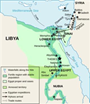
- Egypt's imperial age, founded when Ahmose I expelled the Hyksos c. 1550 BCE, stretched from Nubia to the Euphrates.
- Nubian gold, Levantine tribute and the Amarna letters' great-power diplomacy made Egypt the hub of the Late Bronze Age world.
- It ended not by conquest but by dissolution, as the Bronze Age Collapse and the rising Amun priesthood hollowed out royal power.
Rise & Fall
- c. 1550 BCEAhmose I completes the expulsion of the Hyksos and reunites Egypt
- 1457 BCEThutmose III defeats a Canaanite coalition at Megiddo after a daring march through the Aruna pass
- c. 1353 BCEAkhenaten begins his reign, elevating the Aten and moving the capital to Akhetaten
- 1274 BCERamesses II fights the Hittite king Muwatalli II to a draw at the Battle of Kadesh
- 1258 BCEEgypt and the Hittites conclude a peace treaty acknowledging strategic stalemate
- c. 1177 BCERamesses III repels land and sea invasions by the Sea Peoples
- c. 1153 BCERamesses III is assassinated by harem conspirators
- c. 1070 BCEDeath of Ramesses XI ends the New Kingdom amid administrative dissolution
Foundation
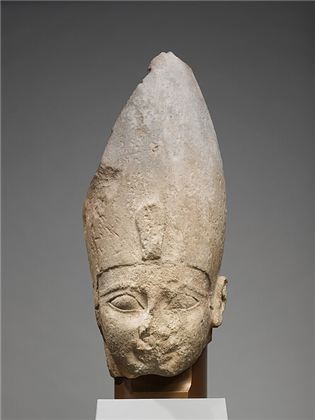
The New Kingdom emerged from the expulsion of the Hyksos, an Asiatic dynasty that had controlled Lower Egypt for over a century during the Second Intermediate Period. Ahmose I, founding pharaoh of the Eighteenth Dynasty, completed this expulsion around 1550 BCE, reunited the country, reconquered Nubian territories lost during the preceding fragmentation, and began rebuilding the administrative and military institutions that would sustain the empire for nearly five centuries. His successors pressed aggressively outward: Thutmose I crossed the Euphrates, the first pharaoh to do so, and carried Egyptian arms beyond the fourth Nile cataract in Nubia. Hatshepsut, who ruled as pharaoh alongside the young Thutmose III from approximately 1479 to 1458 BCE, consolidated this inheritance through trade rather than war, dispatching the celebrated expedition to Punt and sponsoring an extraordinary building programme at Karnak and Deir el-Bahari. Her death in 1458 BCE was followed by a rebellion of Canaanite and Syrian rulers led by the king of Kadesh, who evidently doubted the resolve of her successor. Thutmose III would prove the most consequential military pharaoh in Egyptian history, and the empire he built provided the territorial foundation upon which Amenhotep III's golden age rested.
Socioeconomy
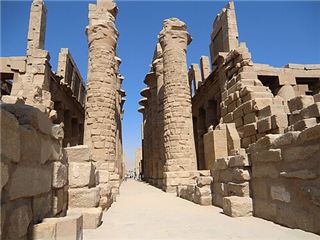
The New Kingdom economy rested on three interlocking foundations: Nubian gold, Levantine tribute, and agricultural surplus from the Nile floodplain. Nubian gold in particular underwrote the entire imperial superstructure, funding monumental construction, sustaining diplomatic gift exchanges with Near Eastern powers, and maintaining the army. The temple complexes, most prominently Karnak and Luxor, functioned simultaneously as religious centres, economic institutions, and state treasuries, accumulating land, livestock, and labour obligations on a scale that eventually made the Amun priesthood a rival power to the crown. By the reign of Ramesses III, according to the Great Harris Papyrus, the temples of Amun held roughly two-thirds of all temple lands in Egypt and some ninety percent of temple-owned ships. Hatshepsut's Punt expedition exemplified the state's direct involvement in long-distance trade, bringing back myrrh trees, ebony, ivory, and exotic animals. The policy begun under Thutmose III of raising the sons of conquered rulers as Egyptians at the pharaonic court served both diplomatic and economic ends, producing a class of Egyptianised client princes who governed peripheral territories at minimal cost to the crown.
Military
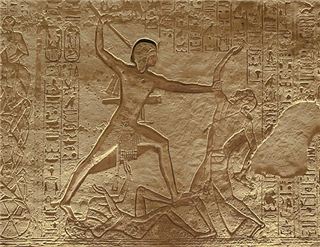
Thutmose III remains the defining military figure of the New Kingdom, conducting some seventeen campaigns over twenty years, beginning with his decisive victory at the Battle of Megiddo in 1457 BCE. His march through the narrow Aruna pass to surprise a coalition of Canaanite rulers led by the king of Kadesh demonstrated a willingness to accept high operational risk for decisive strategic effect. The chariot, introduced into Egyptian warfare during the Hyksos period and subsequently developed into a sophisticated combined-arms instrument, formed the operational backbone of New Kingdom expansion. The largest single engagement of the era was the Battle of Kadesh in 1274 BCE, where Ramesses II led an estimated 20,000 soldiers against the Hittite king Muwatalli II and his thousands of chariots. The battle was tactically indecisive, and the peace treaty of 1258 BCE, concluded with Muwatalli's successor Hattusili III and the earliest such treaty to survive in both parties' versions, effectively acknowledged strategic stalemate. The empire's final military test came under Ramesses III, who repelled land and sea invasions by the Sea Peoples around 1177 BCE, preserving Egypt while almost every other Bronze Age power collapsed or contracted.
Governance & Law

The New Kingdom was administered through a centralised pharaonic system in which the king functioned simultaneously as divine ruler, supreme judge, and commander-in-chief. Two viziers, one for Upper and one for Lower Egypt, managed day-to-day administration, overseeing taxation, judicial proceedings, and the distribution of state resources. Provincial governors administered the nomes, while the Viceroy of Kush, the King's Son of Kush, exercised authority over Nubia as a semi-autonomous imperial sub-administration. The Amarna Letters, the diplomatic archive recovered from Akhenaten's capital, reveal a sophisticated system of international correspondence conducted in Akkadian cuneiform, through which Egypt managed its relationships with Babylon, Mitanni, Assyria, the Hittites, and Alashiya (Cyprus). Akhenaten's reign, from approximately 1353 to 1336 BCE, represented the most disruptive governance crisis in the empire's history: his elevation of the Aten above all other gods, suppression of the Amun cult, and relocation of the capital to Akhetaten produced religious upheaval at home and diplomatic drift abroad, with Levantine vassals repeatedly requesting Egyptian military assistance against Hittite-backed rivals and receiving little response.
Global & Regional Impact

The New Kingdom defined the cultural, diplomatic, and commercial architecture of the Late Bronze Age Near East. The Amarna diplomatic system, in which great powers exchanged elaborate gifts and correspondence to maintain equilibrium, represented the most sophisticated framework for inter-state relations the ancient world had yet produced. Egyptian artistic styles, religious concepts, and architectural forms radiated outward across Canaan, Nubia, and the Levant through conquest, trade, and the deliberate Egyptianisation of foreign elites. Nubia under New Kingdom administration was transformed so thoroughly that the later Kushite kingdom centred on Napata adopted Egyptian gods, titles, and monumental forms, and would eventually conquer Egypt itself as the Twenty-Fifth Dynasty. The disintegration of the Bronze Age trading network amid the upheavals of around 1200 BCE permanently undermined the New Kingdom's economic foundations, demonstrating how dependent the empire's prosperity was on the wider Mediterranean commercial system.
Decline & Fall
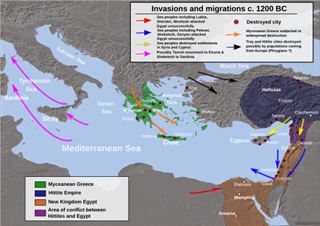
The New Kingdom's decline was structural rather than sudden, driven by the convergence of three processes. The Bronze Age Collapse from approximately 1200 BCE severed the trade networks that sustained imperial revenues and eliminated the Hittite rival whose existence had given Egyptian foreign policy its organising logic. Simultaneously, the progressive accumulation of land and institutional power by the Amun priesthood at Thebes created a theocratic counter-authority that the weakened Twentieth Dynasty pharaohs could not suppress. The assassination of Ramesses III by harem conspirators around 1153 BCE, documented in the Judicial Papyrus of Turin and supported by forensic examination of his mummy, inaugurated a succession of short-lived rulers bearing his name but little of his ability. By approximately 1080 BCE, the High Priest of Amun Herihor governed Upper Egypt as a de facto independent ruler, while Smendes controlled Lower Egypt from Tanis. The death of Ramesses XI around 1070 BCE ended the New Kingdom not through conquest but through administrative dissolution.
The Egyptian New Kingdom endures as one of history's most compelling demonstrations that imperial greatness rests as much on diplomacy and cultural magnificence as on military conquest.
References
- Grimal, N. (1992) A History of Ancient Egypt. Translated by I. Shaw. Oxford: Blackwell.
- James, T.G.H. (1992) Howard Carter: The Path to Tutankhamun. London: Kegan Paul International.
- Kemp, B.J. (2006) Ancient Egypt: Anatomy of a Civilisation. 2nd edn. London: Routledge.
- Kitchen, K.A. (1982) Pharaoh Triumphant: The Life and Times of Ramesses II. Warminster: Aris and Phillips.
- Redford, D.B. (ed.) (2001) The Oxford Encyclopedia of Ancient Egypt. 3 vols. Oxford: Oxford University Press.
- Shaw, I. (ed.) (2000) The Oxford History of Ancient Egypt. Oxford: Oxford University Press.
- Tyldesley, J. (2000) Ramesses: Egypt's Greatest Pharaoh. London: Viking.
Connections
Open the full connections map →