At a glance
- A Saharan kingdom in Libya's Fezzan, sustained by underground foggara channels tapping fossil water beneath the desert.
- It controlled trans-Saharan routes, sending ivory, enslaved people and wild animals to Carthaginian and Roman markets.
- As the water table sank below the channels and trade faltered, it faded into scattered oases before the Arab conquest.
Rise & Fall
- 20-19 BCELucius Cornelius Balbus captures Garama, earning Rome's last triumph for a non-imperial general
- 69The Garamantes join Oea against Leptis Magna and are driven back by Valerius Festus
- c. 202Septimius Severus campaigns against the Garamantes and sets outposts at Ghadames and Bu Njem
- 429The Vandal conquest of North Africa begins, disrupting Mediterranean trade demand
- c. 500Garama is greatly reduced as falling groundwater starves the foggara system
- 640sArab expeditions into the Fezzan begin, meeting little significant resistance
Foundation
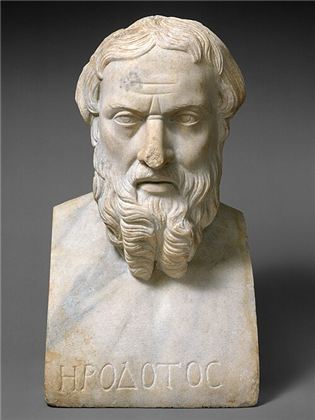
The Garamantes did not conquer their empire. They engineered it. Settled in the habitable depressions of the Fezzan region of modern Libya, above all the Wadi al-Ajal and the Wadi ash-Shati, the Berber-speaking pastoralists who became the Garamantes faced a fundamental constraint: the Sahara's surface water had largely vanished with the end of the Green Sahara period. Their response was one of antiquity's most remarkable feats of hydraulic engineering. From the later first millennium BCE, they developed the foggara, gently inclined underground channels tapping the fossil water stored in the sandstone aquifers beneath the Fezzan. Herodotus, writing in the fifth century BCE, described them as a very great nation who used four-horse chariots to hunt the cave-dwelling peoples of the desert. The hilltop settlement at Zinkekra served as an early centre during this formative phase. No river, no coastline, and no reliable rain sustained them. The Garamantian state existed because its engineers found a way to mine water from stone, and every institution that followed rested on that foundation.
Socioeconomy

The Garamantian economy operated on two interdependent pillars: irrigated agriculture and control of trans-Saharan trade. The foggara network, which in the Wadi al-Ajal alone eventually comprised an estimated 550 or more channels with over 100,000 vertical shafts, delivered water by gravity to fields producing wheat, barley, and dates in quantities the Sahara could not otherwise support. This agricultural surplus sustained a population estimated at around 10,000 in and around the capital Garama at its peak, an exceptional concentration for the central Sahara. Trade was equally vital. The Garamantes controlled key desert routes between sub-Saharan Africa and the North African coast, channelling ivory, enslaved people, precious stones known to the Romans as carbuncles, and wild animals northward to Carthaginian, Greek, and Roman markets. The Zliten Mosaic near Leptis Magna, which appears to show captives, possibly Garamantes, thrown to wild beasts in the arena, reflects how closely Roman Tripolitania watched this frontier. Enslaved labour, likely obtained through raids on neighbouring peoples, almost certainly provided much of the workforce that dug and maintained the foggara tunnels, meaning the empire's water infrastructure and its slave trade were structurally connected.
Military
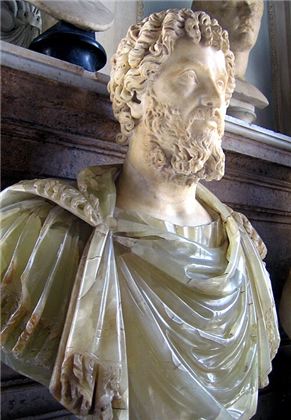
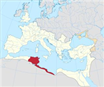
Garamantian military power was real but geographically bounded. The Garamantes raided the North African coastal settlements and subjugated Saharan neighbours with chariots and horsemen, a mode of warfare Herodotus noted. Their territorial reach at its maximum covered, by some estimates, around 180,000 square kilometres of the central Sahara. Against Rome, however, the limits were clear. Lucius Cornelius Balbus led a punitive expedition in 20 to 19 BCE, captured a series of Garamantian settlements including Garama itself, and earned the last triumph ever awarded to a general outside the imperial family. The Garamantes recovered quickly, demonstrating that the desert itself was their greatest defensive asset: no Roman force could sustain a permanent occupation across hundreds of kilometres of waterless terrain. In 69 CE they joined Oea in a war against Leptis Magna and were driven back by the legate Valerius Festus. The emperor Septimius Severus, born in Leptis Magna, campaigned against them around 202 CE and established forward outposts such as Ghadames and Bu Njem far south of the earlier frontier. Each time, the Romans stopped short of occupation. The Limes Tripolitanus, a system of forts and barriers developed in stages and above all under the Severans, ultimately proved more effective than any punitive expedition, controlling Garamantian movement towards the coastal cities without requiring permanent desert occupation.
Governance & Law

The Garamantian state was a monarchy with a royal centre at Garama, supported by a tributary structure through which subordinate settlements delivered agricultural surplus and trade revenues upward. No written legal code survives, and governance is reconstructed almost entirely from archaeology and external accounts. The construction of the foggara network required centralised labour mobilisation on a scale that presupposes hierarchical political organisation: coordinating the digging of hundreds of kilometres of underground channels across a desert basin demanded planning, resource allocation, and enforcement capacity that a simple chiefdom could not easily have provided. Roman sources treated the Garamantian king as a recognised sovereign. Ptolemy's Geographia, drawing on Marinus of Tyre, records that a Roman named Julius Maternus accompanied the Garamantian king on an expedition south to the land of Agisymba in the late first century CE, suggesting a diplomatic relationship capable of producing formal military cooperation. After the Roman period, the state fragmented into disconnected oasis communities as the water supply declined, indicating that centralised authority had depended on the infrastructure that sustained it.
Global & Regional Impact

The Garamantes were the essential intermediary of the ancient trans-Saharan world. Without their oases and water infrastructure, sustained caravan commerce between sub-Saharan Africa and the Mediterranean was scarcely possible, meaning that the Roman appetite for African luxury goods, enslaved people, and arena animals depended structurally on Garamantian engineering. Their trade network brought sub-Saharan African goods to Mediterranean markets centuries before Arab and Berber traders reorganised those routes in the Islamic period. Archaeologically, Garamantian sites have yielded Roman glass, Mediterranean amphorae, and beads from distant sources side by side, making the Fezzan one of the best-documented points of ancient intercontinental exchange. Libya's Great Man-Made River Project, begun in the 1980s and pumping from the same deep aquifers the Garamantes exploited, is a modern echo of the resource dependence that shaped the civilisation's rise and fall.
Decline & Fall
Recent hydrological research has clarified the mechanism: the foggara channels functioned only while the groundwater table remained above their intake level. That condition appears to have held around the turn of the era, from approximately 100 BCE to 100 CE. Thereafter the water table fell progressively below the intakes, delivering less water with each generation and requiring ever-deeper excavation as a palliative that could not reverse the underlying depletion. The Vandal conquest of North Africa between 429 and 439 CE disrupted Mediterranean trade demand at the same time, eroding both economic pillars at once. By around 500 CE, Garama was greatly reduced. The Arab conquest of the Fezzan, through expeditions between the 640s and 660s CE, encountered small fortified settlements offering little significant resistance. The foggara network was abandoned, the tunnels silted and collapsed, and the civilisation that had sustained itself in the world's largest hot desert for close to a millennium through engineering alone was extinguished.
The Garamantian Empire endures as antiquity's most honest rise-and-fall story: a civilisation that engineered its own existence from fossil water, peaked precisely when that engineering reached full capacity, and faded irreversibly when the geological capital it had spent centuries consuming finally ran out.
References
- Daniels, C. (1970) The Garamantes of Southern Libya. Stoughton: Oleander Press.
- Law, R.C.C. (1967) 'The Garamantes and Trans-Saharan Enterprise in Classical Times', Journal of African History, 8(2), pp. 181–200.
- Liverani, M. (2000) 'The Garamantes: A Fresh Approach', Libyan Studies, 31, pp. 17–28.
- Mattingly, D.J. (2010) Imperialism, Power, and Identity: Experiencing the Roman Empire. Princeton: Princeton University Press.
- Mattingly, D.J. (ed.) (2003) The Archaeology of Fazzān. Vol. 1. London: Society for Libyan Studies.
- Wilson, A.I. (2012) 'Saharan Trade in the Roman Period: Short-, Medium- and Long-Distance Trade Networks', Azania, 47(4), pp. 409–449.
Connections
Open the full connections map →