Europe
Ephesus
At a glance
- An Ionian Greek port near the mouth of the Cayster, founded by tradition c. 1000 BCE and famed for its sanctuary of Artemis.
- The Artemision acted as bank, refuge and pilgrimage centre; its rebuilt temple was one of the Seven Wonders of the Ancient World.
- Ephesus passed from Lydian, Persian, Athenian and Hellenistic overlords to Rome in 133 BCE and became the chief city of Roman Asia.
Rise & Fall
- c. 1000 BCEIonian settlers, by tradition led by Androclus, found Greek Ephesus
- c. 560 BCECroesus of Lydia takes the city and pays for columns of the marble Artemision
- 546 BCEEphesus passes under the Achaemenid Empire after the fall of Lydia
- 406 BCELysander defeats the Athenian fleet at Notium, near Ephesus
- 356 BCEHerostratus burns the Temple of Artemis
- 334 BCEAlexander the Great restores democracy and gives the Persian tribute to Artemis
- c. 290 BCELysimachus moves the city to a new site and renames it Arsinoeia
- 133 BCEAttalus III bequeaths Pergamon, including Ephesus, to Rome
Foundation
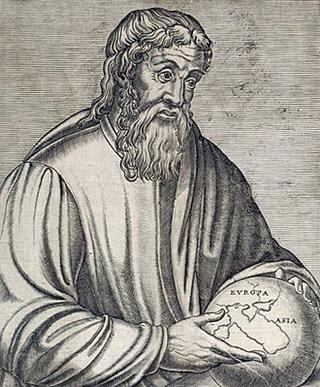
Ephesus lay on the west coast of Asia Minor near the mouth of the Cayster River, on a bay that has since silted up and left its ruins several kilometres inland. The site was settled long before the Greeks arrived: many scholars identify it with Apasa, the capital of the Late Bronze Age kingdom of Arzawa named in Hittite texts, and Greek writers said that Carians and Leleges lived there first. According to the tradition recorded by Strabo and Pausanias, Ionian settlers led by Androclus, son of King Codrus of Athens, founded the Greek city around 1000 BCE, after an oracle told them to settle where a fish and a wild boar would show them the place. The newcomers found a native cult of a mother goddess, whom they identified with Artemis. Her sanctuary in the marshy plain, the Artemision, received its first temple buildings in the eighth century BCE and became the centre of the city's identity. Early Ephesus was ruled by kings said to descend from Androclus, and the family kept the title of king and certain priestly honours long after monarchy ended. Ephesus was one of the twelve cities of the Ionian League, which met at the Panionion on Mount Mycale, and by the seventh century BCE it was a substantial trading town.
Socioeconomy
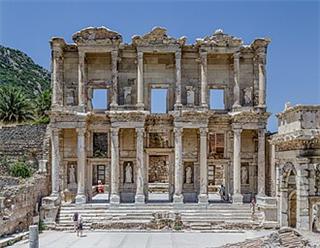
Ephesus lived from its position at the western end of routes into the Anatolian interior, above all the road to Sardis, capital of the Kingdom of Lydia. Grain, wine, timber, textiles and luxury goods passed through its harbour, and close ties with Lydia brought Lydian wealth and customs into the city. The Artemision dominated economic life. The goddess owned estates and fisheries, received dedications from kings and private donors, lent money and held deposits, so that the temple served as one of the great banks of the Greek world, while its right of asylum offered refuge to debtors and fugitives. A deposit beneath the temple contained some of the earliest known coins, small lumps of electrum from around 600 BCE, and the city's own coinage carried the bee, the emblem of the goddess. The cult was served by a eunuch high priest with the Persian title of Megabyzos and by colleges of priestesses and temple officials. Ephesus was also a home of Greek poetry and thought: the iambic poet Hipponax worked there in the sixth century BCE, the philosopher Heraclitus wrote his book of sayings around 500 BCE and reportedly deposited it in the temple, and the painter Parrhasius was born in the city.
Military

Ephesus was never a major military power, and its history is largely one of accommodation with stronger neighbours. In the seventh century BCE the Cimmerians raided western Asia Minor, and later tradition said they threatened the Artemision. Around 560 BCE Croesus of Lydia besieged the city; according to Herodotus, the Ephesians placed their town under the protection of Artemis by stretching a rope from the walls to the temple, some seven stades away, and then came to terms with him. After Cyrus the Great defeated Croesus in 546 BCE, Persian generals reduced the Ionian cities one by one. During the Ionian Revolt the rebels assembled at Ephesus in 498 BCE before marching inland to burn Sardis, but they were defeated near Ephesus on their return, and the city took little further part in the war. As a member of the Delian League, Ephesus paid tribute to Athens rather than supplying warships. It went over to the Spartan side during the Ionian War (412–404 BCE), and Lysander made it his naval base, defeating the Athenian fleet at the Battle of Notium nearby in 406 BCE. Agesilaus II of Sparta gathered his army there for his campaigns of 396–394 BCE. In the Hellenistic wars its harbour and new walls made Ephesus a prize that repeatedly changed hands among the successors of Alexander.
Governance & Law
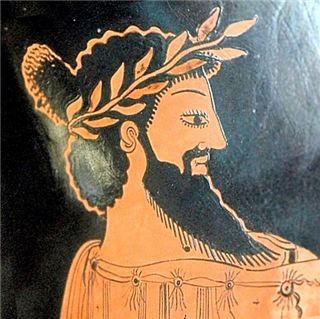
Monarchy gave way early to rule by aristocratic clans, and in the sixth century BCE Ephesus passed through a series of tyrannies. The best known tyrant, Pindarus, was related to the Lydian royal house; when Croesus took the city around 560 BCE he allowed Pindarus to withdraw and left Ephesus a tributary of Lydia with its institutions intact. Under the Achaemenid Empire the city paid tribute through the satrap at Sardis and was governed by local leaders acceptable to Persia. Within the Delian League it seems to have had a more popular constitution, and its later political life swung between democratic and oligarchic factions backed by Athens, Sparta or Persia. When Alexander the Great arrived in 334 BCE he restored the democracy, recalled exiles and ordered that the tribute formerly paid to Persia go to Artemis instead. Hellenistic Ephesus was governed by a council (boule) and assembly (demos) that passed decrees, granted citizenship and honoured benefactors, while Lysimachus created a council of elders, the gerousia. The Artemision was run by its own boards, such as the temple wardens (neopoioi), and its wealth, asylum and festivals gave it a political weight that every ruler of the city, Lydian, Persian, Macedonian or Roman, had to respect.
Global & Regional Impact
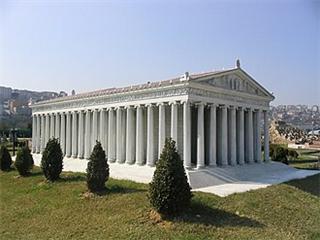
The Temple of Artemis at Ephesus was the city's greatest contribution to the ancient world. The archaic temple, begun in the mid-sixth century BCE by the architects Chersiphron and Metagenes with columns paid for by Croesus, was among the first great marble temples of the Ionic order, and its fourth-century successor was counted among the Seven Wonders of the Ancient World. The cult of Ephesian Artemis, with its distinctive cult statue hung with rounded ornaments, spread across the Mediterranean; Strabo records that Phocaean colonists took it to Massalia and its daughter cities. Heraclitus, with his teaching on the unity of opposites, constant change and the logos, became one of the most influential of the early Greek philosophers, read by Plato, the Stoics and modern thinkers. Ephesus' role as a meeting point of Greek, Lydian and Persian worlds made it a channel for ideas, art and goods between the Aegean and Anatolia. Its later greatness as the leading city of Roman Asia, a centre of early Christianity linked with the apostle Paul and the Gospel of John, and a council city of the church in 431 CE, rested on the foundations laid in these centuries. The ruins are now a UNESCO World Heritage Site.
Decline & Fall

The independent life of Ephesus ended gradually, through a combination of natural change and great-power politics. In 356 BCE a man named Herostratus burned the Artemision, traditionally on the night Alexander the Great was born; according to Strabo the Ephesians declined Alexander's later offer to pay for the rebuilding and raised a still grander temple themselves. The silt carried by the Cayster steadily filled the harbour and pushed the coast westwards. Around 290 BCE Lysimachus moved the city to a new site between two hills closer to the sea, enclosed it with long walls and renamed it Arsinoeia after his wife, reportedly forcing reluctant citizens to move by blocking the drains of the old town. After his death at the Battle of Corupedium in 281 BCE the old name returned, and Ephesus passed between the Seleucid Empire and the Ptolemaic Empire until Antiochus III took it in 197–196 BCE. The Treaty of Apamea in 188 BCE gave it to the Kingdom of Pergamon. When Attalus III died in 133 BCE and left his kingdom to Rome, Ephesus sided with Rome against the pretender Aristonicus and became part of the province of Asia, organised by 129 BCE, where it grew into the region's chief city.
Ephesus matters as the home of the Temple of Artemis, one of the Seven Wonders, and of the philosopher Heraclitus, and as a port where Greek, Lydian and Persian worlds met; it survived successive overlords to become the leading city of Roman Asia.
References
- Rogers, G.M. (1991) The Sacred Identity of Ephesos: Foundation Myths of a Roman City. London: Routledge.
- Koester, H. (ed.) (1995) Ephesos, Metropolis of Asia: An Interdisciplinary Approach to Its Archaeology, Religion, and Culture. Valley Forge, PA: Trinity Press International.
- Greaves, A.M. (2010) The Land of Ionia: Society and Economy in the Archaic Period. Chichester: Wiley-Blackwell.
- Hansen, M.H. and Nielsen, T.H. (eds) (2004) An Inventory of Archaic and Classical Poleis. Oxford: Oxford University Press.
- Herodotus, The Histories, trans. A. de Sélincourt, rev. J. Marincola (2003). London: Penguin.
Connections
Open the full connections map →