Europe
Samos
At a glance
- An Ionian island state off Mount Mycale, home of the great sanctuary of Hera and an early Greek naval power.
- Under the tyrant Polycrates around 530 BCE it dominated the Aegean and built the harbour mole, the Heraion and the Tunnel of Eupalinos.
- Samos was the birthplace of Pythagoras, Epicurus and Aristarchus, who argued that the earth moves around the sun.
Rise & Fall
- c. 638 BCEThe Samian merchant Colaeus reaches Tartessos in Spain
- c. 538 BCEPolycrates seizes power and builds a fleet of a hundred ships
- c. 525 BCEA Spartan and Corinthian siege of Samos fails after forty days
- c. 522 BCEPolycrates is killed by the Persian satrap Oroetes
- 494 BCEMost Samian ships desert at the Battle of Lade
- 440–439 BCEAthens under Pericles crushes the Samian revolt
- 365 BCEAthens takes Samos and settles it with Athenian cleruchs
- 129 BCESamos becomes part of the Roman province of Asia
Foundation
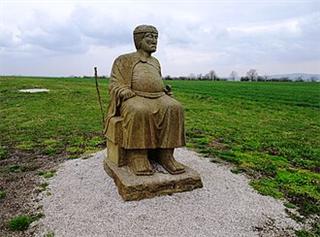
Samos is a fertile, mountainous island in the eastern Aegean, separated from Mount Mycale on the coast of Asia Minor by a strait little more than a kilometre and a half wide. It was inhabited in the Neolithic and Bronze Age, and a cult of the goddess Hera at a marshy site near the mouth of the Imbrasos river, later the great sanctuary of the Heraion, reaches back at least to the end of the Bronze Age. Greek tradition held that the island had earlier been settled by Carians and Leleges and that Ionian colonists arrived under a leader named Procles from Epidaurus; whatever the details, Ionian Greeks were established on Samos by about 1000 BCE. Their chief town grew up on the south-east coast, on the site of modern Pythagoreio, with a natural harbour facing Asia, and Samos became one of the twelve members of the Ionian League, which met at the Panionion on Mount Mycale opposite. It also held territory on the mainland, which brought it into repeated conflict with its neighbours Priene and Miletus. In the eighth century BCE the Samians built one of the earliest monumental temples in the Greek world at the Heraion, which became a rich sanctuary receiving dedications from Egypt, Cyprus and the Near East and a symbol of the island's identity for the rest of its history.
Socioeconomy
Samos combined good farmland with an outstanding position on the sea routes between the Aegean, Asia Minor and Egypt. Its people grew olives and vines, and Samian oil and wine were exported in their own types of amphora. The island was also a major centre of craft: Samian workshops were famous for bronze-working, and tradition credited the architects Rhoecus and Theodorus with pioneering the casting of bronze statues. Samians traded and settled widely. Herodotus tells how a merchant named Colaeus, driven off course on the way to Egypt, reached Tartessos in southern Spain around 638 BCE and returned with a fortune in silver, part of which he dedicated at the Heraion as a great bronze bowl. Samos had its own sanctuary of Hera at Naucratis in Egypt, and it founded colonies such as Perinthus on the Propontis, Nagidus and Celenderis in Cilicia and Minoa on Amorgos, while exiles from the island settled Dicaearchia, the later Puteoli, in Italy. Land on the island was long held by an aristocracy of landowners, the geomoroi. The Heraion stood at the centre of religious life, and Samian poets, craftsmen and thinkers made the island one of the cultural centres of archaic Greece. Herodotus also records that the fable-teller Aesop was the slave of a Samian named Iadmon.
Military
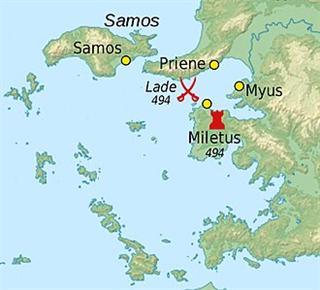
Samos was one of the earliest Greek naval powers. Thucydides records that the Corinthian shipwright Ameinocles built four ships for the Samians around 700 BCE, and in the Lelantine War the island is said to have sided with Chalcis while its rival Miletus supported Eretria. Its naval power peaked under the tyrant Polycrates, who seized power around 538 BCE and built a fleet of a hundred penteconters, backed by a thousand archers. Herodotus calls him the first Greek after the legendary Minos to aim at mastery of the sea; he raided islands and mainland towns, captured Rhenaea and dedicated it to Apollo of Delos, and defeated a Lesbian fleet sent to help Miletus. Around 525 BCE Samian exiles brought a Spartan and Corinthian army to the island, but it failed to take the city after a siege of forty days. Polycrates built a harbour mole and strong walls to protect his base. In the Ionian Revolt Samos sent sixty ships to the Battle of Lade in 494 BCE, but forty-nine of them deserted before the fighting, contributing to the Ionian defeat. Later, as a ship-providing member of the Delian League, Samos fought Athens itself in 440–439 BCE, when its fleet under the philosopher Melissus won a victory before Pericles forced the city to surrender after a siege of nine months.
Governance & Law
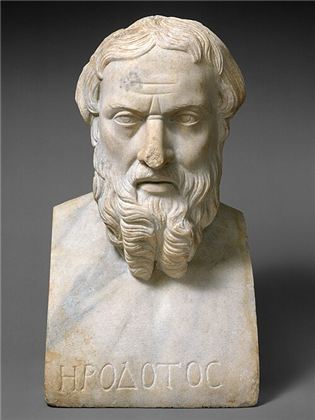
Early Samos was ruled by kings, one of whom, Amphicrates, Herodotus mentions in connection with a war against Aegina. Power later rested with the geomoroi, a landowning aristocracy that was probably overthrown in the early sixth century BCE. Polycrates, son of Aeaces, seized power around 538 BCE together with his brothers Pantagnotus and Syloson, then killed the first and banished the second to rule alone. His court attracted the poets Anacreon and Ibycus and the physician Democedes of Croton, and he made alliances first with Amasis of Egypt and later with Cambyses II of Persia. Around 522 BCE the Persian satrap Oroetes lured him to the mainland and had him killed. His secretary Maeandrius briefly took over until the Persians installed Syloson as a client tyrant, and Persian-backed tyrants, including Syloson's son Aeaces, ruled Samos until 479 BCE. In the Delian League the island was governed by an oligarchy until Athens imposed a democracy in 440 BCE. A democratic revolution in 412 BCE made Samos Athens' most loyal ally, and in 405 BCE Athens granted the Samians citizenship. Lysander restored the oligarchs in 404 BCE, and from 365 to 322 BCE the island was held by Athenian settlers, cleruchs, while the Samians themselves lived in exile.
Global & Regional Impact
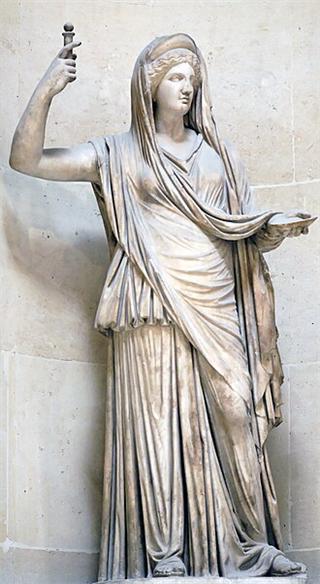
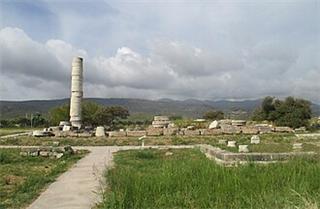
Samos left a lasting mark through its engineering, its sanctuary and the people it produced. Herodotus singled out three Samian works as the greatest in the Greek world: the harbour mole, the temple of Hera, which he considered the largest temple he knew, and the tunnel built by the engineer Eupalinos of Megara to bring water to the city. The tunnel, 1,036 metres long, was dug through a mountain from both ends at once, and the two teams met with only a small error, a remarkable feat of surveying that can still be walked through today. The town of Pythagoreio and the Heraion are now together a UNESCO World Heritage Site. Samos was the birthplace of Pythagoras, who left for Croton in southern Italy, by tradition to escape the rule of Polycrates, and whose followers shaped Greek mathematics and philosophy. The Eleatic philosopher Melissus was a Samian statesman, the historian Duris came from the island, and Epicurus was born there to an Athenian settler family in 341 BCE. Aristarchus of Samos, working in the third century BCE, proposed that the earth moves around the sun, an idea that anticipated Copernicus by some eighteen centuries. The Samian expedition of Colaeus to Tartessos also became one of the best-known stories of early Greek long-distance trade.
Decline & Fall

The independence of Samos was worn away by more powerful neighbours. After the death of Polycrates the Persian general Otanes conquered the island for Syloson around 517 BCE and, according to Herodotus, killed so many inhabitants that it had to be repopulated. After the Battle of Mycale in 479 BCE Samos regained its freedom, but the crushing defeat by Athens in 439 BCE cost it its walls, its fleet and a heavy indemnity. When Lysander took the island in 404 BCE and restored the oligarchs, the Samians honoured him as a god, the first Greek so treated in his lifetime. In 365 BCE the Athenian general Timotheus expelled a Persian garrison after a siege of ten months, and Athens settled the island with its own citizens. The Samians recovered their home only in 322 BCE, when Perdiccas returned them in line with Alexander the Great's decree on exiles. In the Hellenistic period Samos had its own institutions but was usually subordinate to a larger power: it served as a major Ptolemaic naval base in the third century BCE and later came within the orbit of Pergamon and Rome. After Attalus III bequeathed his kingdom to Rome, Samos became part of the province of Asia, organised in 129 BCE. It remained a prosperous island under Roman rule, and its sanctuary of Hera continued to attract visitors and dedications.
Samos was one of the great island states of archaic Greece: under Polycrates the strongest naval power in the Aegean, it produced landmark engineering such as the Tunnel of Eupalinos and the Heraion, and was home to Pythagoras, Epicurus and Aristarchus before Athens, Persia and the Hellenistic kings absorbed it.
Test yourself
4 questions on this page, from its key events and facts.
The questions open here once the page has loaded.
References
- Shipley, G. (1987) A History of Samos 800–188 BC. Oxford: Clarendon Press.
- Hansen, M.H. and Nielsen, T.H. (eds) (2004) An Inventory of Archaic and Classical Poleis. Oxford: Oxford University Press.
- Greaves, A.M. (2010) The Land of Ionia: Society and Economy in the Archaic Period. Chichester: Wiley-Blackwell.
- Herodotus, The Histories, trans. A. de Sélincourt, rev. J. Marincola (2003). London: Penguin.
- Thucydides, History of the Peloponnesian War, trans. R. Warner (1954). Harmondsworth: Penguin.
Connections
Open the full connections map →